The Opel Vectra C, particularly the facelifted model introduced in 2005, represents a significant iteration of Opel’s mid-size family car, primarily marketed across Europe and various international markets. As a prominent player in the highly competitive D-segment, the Vectra C aimed to offer a blend of comfort, practicality, and efficient performance, catering to both private buyers seeking a reliable family sedan and fleet operators valuing economical running costs. This specific variant, the Opel Vectra C (facelift 2005) 1.9 CDTI (150 Hp) Automatic, stood out for its robust diesel powertrain paired with an automatic transmission, a combination highly sought after in its primary European market for its balance of torque, fuel economy, and driving convenience. Produced from 2005 until June 2008, this generation of the Vectra C cemented Opel’s reputation for engineering practical and well-rounded vehicles, even if it was not officially sold in the United States, where its platform-mate, the Saturn Aura, offered a different market proposition.
Engineering and Performance of the Opel Vectra C (facelift 2005)
At the heart of the Opel Vectra C (facelift 2005) 1.9 CDTI (150 Hp) Automatic lies a meticulously engineered 1.9-liter (1910 cm3 or 116.56 cu. in.) inline-four diesel engine, designated by the code Z19DTH. This powerplant was a testament to the growing sophistication of diesel technology in the mid-2000s, featuring a Double Overhead Camshaft (DOHC) valvetrain with four valves per cylinder, ensuring optimal airflow and combustion efficiency. The engine’s performance is significantly bolstered by a turbocharger and an intercooler, which together force more air into the cylinders, resulting in a substantial increase in power and torque. Fuel delivery is handled by a common rail diesel injection system, a key technology for achieving precise fuel atomization and cleaner, more efficient combustion.
The 1.9 CDTI engine produces a healthy 150 horsepower at 4000 rpm, translating to a power output of 78.5 HP per liter, a commendable figure for a diesel engine of its era. More importantly for real-world driving, it generates an impressive 236.02 lb.-ft. of torque at a low 2000 rpm. This abundant torque, available early in the rev range, provides the Vectra C with strong acceleration and effortless cruising, particularly beneficial for highway driving and overtaking maneuvers. The power is efficiently managed by a 6-speed automatic transmission, which smoothly transfers drive to the front wheels. This automatic gearbox was a popular choice for drivers seeking a relaxed driving experience without sacrificing efficiency.
In terms of outright performance, the Vectra C 1.9 CDTI (150 Hp) Automatic is capable of accelerating from 0 to 60 mph in a respectable 9.5 seconds, while its top speed reaches 130.49 mph (210 km/h). These figures position it as a competent performer within its class, offering more than adequate power for daily driving and longer journeys. The vehicle’s weight-to-power ratio stands at 10.2 kg/Hp (approximately 22.49 lbs/Hp), indicating a solid balance between its curb weight of 3357.64 lbs. (1523 kg) and its engine output. The weight-to-torque ratio further highlights the engine’s strong pulling power, registering at 4.8 kg/Nm.
One of the most compelling aspects of this diesel variant is its fuel economy. The Vectra C 1.9 CDTI boasts an impressive combined fuel consumption of 40.6 US mpg (5.8 l/100 km). Urban driving yields 24.8 US mpg (9.5 l/100 km), while extra-urban cruising can achieve an excellent 43.6 US mpg (5.4 l/100 km). These figures underscore the inherent efficiency of modern diesel engines, making it an economically attractive option for high-mileage drivers in markets where diesel fuel is prevalent. The 16.11 US gallon (61 liter) fuel tank provides a considerable driving range between fill-ups, further enhancing its suitability for long-distance travel.
Design and Features of the Opel Vectra C
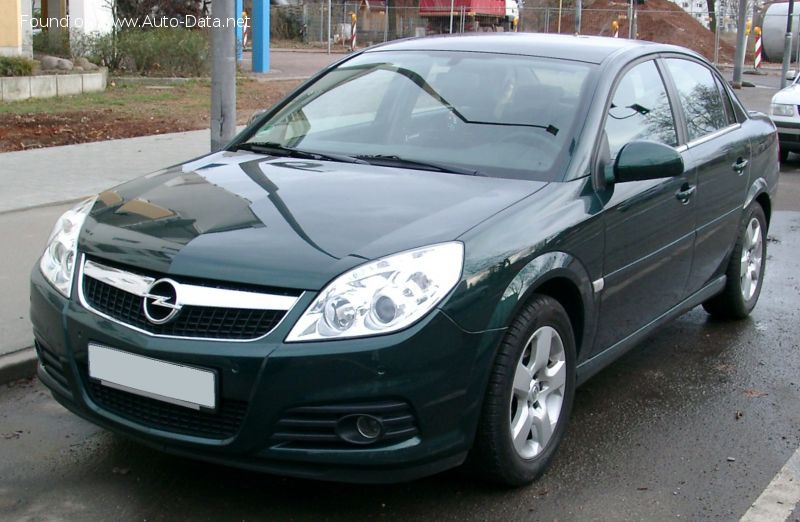
The Opel Vectra C (facelift 2005) presents itself as a classic four-door sedan, a body type that dominated the mid-size segment in Europe for decades. Measuring 177.6 inches (4511 mm) in length, 70.79 inches (1798 mm) in width, and 57.48 inches (1460 mm) in height, the Vectra C projects a substantial and assertive stance on the road. The 2005 facelift brought a refreshed aesthetic, characterized by a more refined front fascia, updated headlamps, and a revised grille, giving the vehicle a more contemporary and sophisticated appearance than its pre-facelift predecessor. These subtle but impactful changes ensured the Vectra remained competitive against rivals.
Inside, the Vectra C is designed to accommodate five occupants comfortably, with a focus on ergonomics and practicality. The wheelbase of 106.3 inches (2700 mm) contributes to a spacious cabin, offering ample legroom for both front and rear passengers. The trunk space is particularly generous, ranging from 17.66 cu. ft. (500 liters) with all seats in place, expanding to a cavernous 37.08 cu. ft. (1050 liters) when the rear seats are folded down. This flexibility makes the Vectra C highly practical for families and those needing to transport larger items, reinforcing its appeal as a versatile daily driver.
The vehicle’s chassis and suspension systems are engineered to provide a balanced ride, combining comfort with confident handling. The front suspension employs a robust spring strut design, while the rear features a multi-link setup (described as “several levers and rods”), which is more sophisticated than simpler torsion beam designs and contributes to improved ride quality and stability. Braking performance is assured by ventilated discs at the front and solid discs at the rear, complemented by an Anti-lock Braking System (ABS) as a standard assisting system. The steering system utilizes a rack and pinion setup, offering precise control and feedback to the driver. Standard tire size for this model is 195/65 R15, mounted on 6.5J x 15-inch wheel rims, providing a good balance between ride comfort and road holding. Overall, the Opel Vectra C (facelift 2005) 1.9 CDTI (150 Hp) Automatic was a well-rounded package, offering a compelling blend of design, practicality, and efficient performance for its target market.
Technical Specifications: Opel Vectra C (facelift 2005) 1.9 CDTI (150 Hp) Automatic
| Brand | Opel |
| Model | Vectra |
| Generation | Vectra C (facelift 2005) |
| Type (Engine) | 1.9 CDTI (150 Hp) Automatic |
| Start of production | 2005 year |
| End of production | June, 2008 year |
| Powertrain Architecture | Internal Combustion engine |
| Body type | Sedan |
| Seats | 5 |
| Doors | 4 |
| Fuel consumption (economy) – urban | 9.5 l/100 km (24.8 US mpg) |
| Fuel consumption (economy) – extra urban | 5.4 l/100 km (43.6 US mpg) |
| Fuel consumption (economy) – combined | 5.8 l/100 km (40.6 US mpg) |
| Fuel Type | Diesel |
| Acceleration 0 – 60 mph | 9.5 sec |
| Maximum speed | 210 km/h (130.49 mph) |
| Weight-to-power ratio | 10.2 kg/Hp (22.49 lbs/Hp) |
| Weight-to-torque ratio | 4.8 kg/Nm |
| Power | 150 Hp @ 4000 rpm. |
| Power per liter | 78.5 Hp/l |
| Torque | 320 Nm @ 2000 rpm (236.02 lb.-ft. @ 2000 rpm) |
| Engine layout | Front, Transverse |
| Engine Model/Code | Z19DTH |
| Engine displacement | 1910 cm3 (116.56 cu. in.) |
| Number of cylinders | 4 |
| Engine configuration | Inline |
| Cylinder Bore | 82 mm (3.23 in.) |
| Piston Stroke | 90.4 mm (3.56 in.) |
| Compression ratio | 17.5:1 |
| Number of valves per cylinder | 4 |
| Fuel injection system | Diesel Commonrail |
| Engine aspiration | Turbocharger, Intercooler |
| Valvetrain | DOHC |
| Engine oil capacity | 4.3 l (4.54 US qt) |
| Coolant capacity | 7 l (7.4 US qt) |
| Kerb Weight | 1523 kg (3357.64 lbs.) |
| Max. weight | 2010 kg (4431.29 lbs.) |
| Max load | 487 kg (1073.65 lbs.) |
| Trunk (boot) space – minimum | 500 l (17.66 cu. ft.) |
| Trunk (boot) space – maximum | 1050 l (37.08 cu. ft.) |
| Fuel tank capacity | 61 l (16.11 US gal) |
| Length | 4511 mm (177.6 in.) |
| Width | 1798 mm (70.79 in.) |
| Height | 1460 mm (57.48 in.) |
| Wheelbase | 2700 mm (106.3 in.) |
| Front track | 1535 mm (60.43 in.) |
| Rear (Back) track | 1525 mm (60.04 in.) |
| Drivetrain Architecture | Front wheel drive (Internal Combustion engine drives front wheels) |
| Drive wheel | Front wheel drive |
| Number of gears and type of gearbox | 6 gears, automatic transmission |
| Front suspension | Spring Strut |
| Rear suspension | Several levers and rods |
| Front brakes | Ventilated discs |
| Rear brakes | Disc |
| Assisting systems | ABS (Anti-lock braking system) |
| Steering type | Steering rack and pinion |
| Tires size | 195/65 R15 |
| Wheel rims size | 6.5J x 15 |