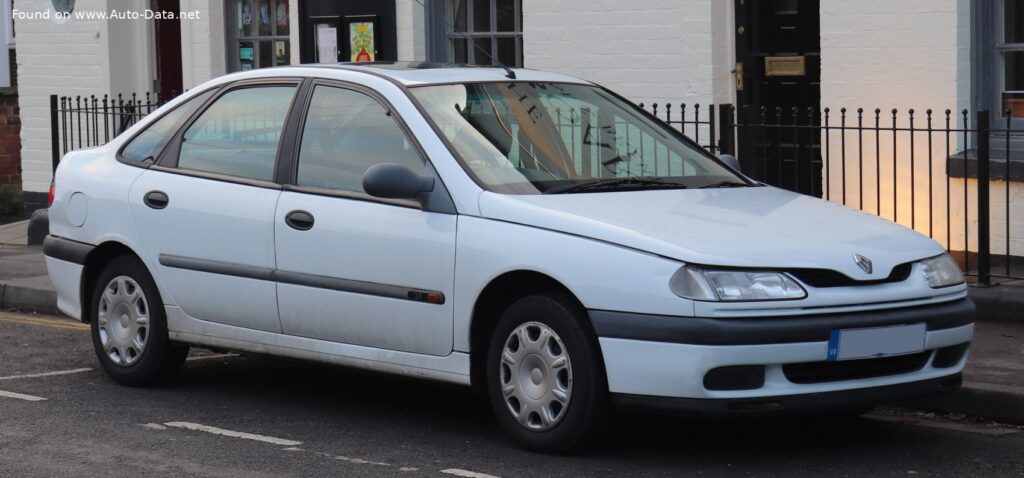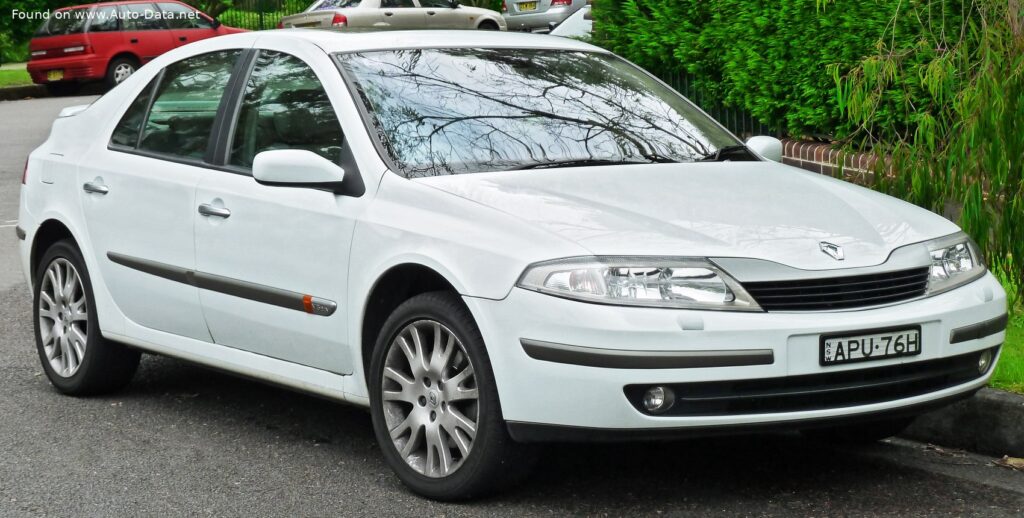
The Renault Laguna II 2.0 i T 16V (165 Hp) represented a significant offering in the European D-segment, or mid-size car category, during its production run from 2002 to 2007. This particular variant, a part of the second generation of the Laguna series, was engineered to blend sophisticated design with a compelling driving experience, setting it apart in a highly competitive market dominated by German and other French marques. While never officially sold in the United States, the Laguna II was a critical model for Renault in its primary European and select Asian markets, embodying the brand’s commitment to innovation, safety, and comfort. It aimed to deliver a premium feel without the premium price tag, appealing to families and business users seeking a practical yet engaging vehicle. The hatchback body style, a common choice in Europe for its versatility, provided a flexible interior space, while the turbocharged gasoline engine promised robust performance and reasonable efficiency for its era. The Laguna II was also notable for its advanced safety features, often leading its class in crash test ratings, a testament to Renault’s proactive approach to occupant protection. Its role was to elevate Renault’s image in the executive segment, offering a distinct alternative to more conservative rivals.
Engine and Performance of the Renault Laguna II
At the heart of the Renault Laguna II 2.0 i T 16V (165 Hp) lies a meticulously engineered 2.0-liter, 16-valve, turbocharged inline-four engine, designated by the internal code F4R. This powertrain was a cornerstone of the Laguna II’s appeal, providing a compelling blend of power and responsiveness. With a displacement of 1998 cubic centimeters (121.93 cu. in.), this engine generated a robust 165 horsepower at 5000 revolutions per minute, delivering an impressive power-per-liter ratio of 82.6 Hp/l. More critically for everyday driving, the engine produced a substantial 199.14 pound-feet of torque at a relatively low 3250 rpm. This broad torque band, characteristic of turbocharged engines, ensured strong acceleration and flexible in-gear performance, making the Laguna II feel effortlessly capable on both urban streets and open highways.
The inclusion of a turbocharger and intercooler was instrumental in achieving these performance figures, allowing the compact 2.0-liter unit to rival larger, naturally aspirated engines while potentially offering better fuel economy. The engine utilized a multi-port manifold injection system and a DOHC (Double Overhead Camshaft) valvetrain, both advanced features for its time, contributing to efficient combustion and optimal valve timing. Power was channeled to the front wheels through a precise 6-speed manual transmission, offering drivers an engaging and direct connection to the vehicle’s capabilities. This drivetrain architecture, combined with a kerb weight of 2987.26 pounds, resulted in a commendable weight-to-power ratio of 8.2 kg/Hp. Performance metrics were competitive for the segment, with the Laguna II 2.0 i T 16V capable of accelerating from 0 to 60 mph in a brisk 8.1 seconds, and achieving a top speed of 135.46 mph. These figures underscored the car’s dynamic character, appealing to those who sought a spirited driving experience in a practical family car.
Despite its performance orientation, Renault also paid attention to fuel efficiency. The official combined fuel consumption figure stood at 28.7 US mpg (8.2 l/100 km), which was respectable for a turbocharged gasoline engine in the early 2000s, especially considering its power output. Urban driving would see consumption around 20.6 US mpg, while extra-urban cruising improved significantly to 36.8 US mpg. The engine’s compression ratio of 10:1 further optimized efficiency and power delivery. With an engine oil capacity of 5.71 US quarts and a coolant capacity of 6.87 US quarts, the F4R engine was designed for durability and ease of maintenance, reflecting Renault’s commitment to reliability for its European customer base.
Design and Features of the Renault Laguna II
The Renault Laguna II, particularly in its 2.0 i T 16V (165 Hp) hatchback configuration, presented a distinctive and modern aesthetic that helped it stand out in the European mid-size segment. Measuring 180.16 inches in length, 69.76 inches in width, and 56.26 inches in height, with a generous wheelbase of 107.87 inches, the Laguna II offered a substantial road presence. Its proportions were designed to maximize interior space and comfort for its five occupants, a key consideration for its target market. The five-door hatchback body type was a practical choice, providing excellent versatility and ease of access for both passengers and cargo.
One of the Laguna II’s most significant advantages was its highly adaptable cargo area. With the rear seats in place, the trunk offered a respectable 15.19 cubic feet (430 liters) of space. When the rear seats were folded down, this capacity expanded dramatically to 46.97 cubic feet (1330 liters), transforming the car into a highly capable load-hauler for families or individuals with active lifestyles. This flexibility underscored the car’s utility, making it a popular choice for those needing a blend of passenger comfort and cargo capacity. A substantial fuel tank capacity of 18.49 US gallons (70 liters) further enhanced its long-distance touring capabilities, reducing the frequency of fuel stops.
Beyond its dimensions and practicality, the Laguna II incorporated a range of features aimed at enhancing safety, comfort, and driving dynamics. The suspension system comprised a Spring Strut setup at the front and a Coil spring arrangement at the rear, designed to strike a balance between ride comfort and handling precision. Braking performance was ensured by ventilated discs at the front and disc brakes at the rear, complemented by an Anti-lock Braking System (ABS) as standard, a crucial safety feature for preventing wheel lock-up during emergency braking. Steering was handled by a rack and pinion system with hydraulic power steering, providing tactile feedback and effortless maneuverability, particularly in urban environments.
The car rode on 205/55 R16 tires mounted on 16-inch wheel rims, a specification chosen to provide a good balance of grip, comfort, and resistance to hydroplaning. While specific interior amenities are not detailed in the raw data, for its segment and era, the Laguna II would have typically offered features such as automatic climate control, a comprehensive audio system, power windows and mirrors, and a suite of airbags, consistent with Renault’s reputation for well-equipped and safety-conscious vehicles. Indeed, the Laguna II was a pioneer in Euro NCAP crash testing, being one of the first vehicles to achieve a full five-star rating, highlighting Renault’s unwavering commitment to occupant protection and structural integrity.
Technical Specifications: Renault Laguna II 2.0 i T 16V (165 Hp)
| Brand | Renault |
| Model | Laguna |
| Generation | Laguna II |
| Type (Engine) | 2.0 i T 16V (165 Hp) |
| Start of production | 2002 year |
| End of production | 2007 year |
| Powertrain Architecture | Internal Combustion engine |
| Body type | Hatchback |
| Seats | 5 |
| Doors | 5 |
| Fuel consumption (economy) – urban | 11.4 l/100 km (20.6 US mpg) |
| Fuel consumption (economy) – extra urban | 6.4 l/100 km (36.8 US mpg) |
| Fuel consumption (economy) – combined | 8.2 l/100 km (28.7 US mpg) |
| Fuel Type | Petrol (Gasoline) |
| Acceleration 0 – 60 mph | 8.1 sec |
| Acceleration 0 – 100 km/h | 8.5 sec |
| Maximum speed | 218 km/h (135.46 mph) |
| Weight-to-power ratio | 8.2 kg/Hp (121.8 Hp/tonne) |
| Weight-to-torque ratio | 5 kg/Nm (199.3 Nm/tonne) |
| Power | 165 Hp @ 5000 rpm |
| Power per liter | 82.6 Hp/l |
| Torque | 270 Nm @ 3250 rpm (199.14 lb.-ft. @ 3250 rpm) |
| Engine layout | Front, Transverse |
| Engine Model/Code | F4R |
| Engine displacement | 1998 cm3 (121.93 cu. in.) |
| Number of cylinders | 4 |
| Engine configuration | Inline |
| Cylinder Bore | 82.7 mm (3.26 in.) |
| Piston Stroke | 93 mm (3.66 in.) |
| Compression ratio | 10:1 |
| Number of valves per cylinder | 4 |
| Fuel injection system | Multi-port manifold injection |
| Engine aspiration | Turbocharger, Intercooler |
| Valvetrain | DOHC |
| Engine oil capacity | 5.4 l (5.71 US qt) |
| Coolant | 6.5 l (6.87 US qt) |
| Kerb Weight | 1355 kg (2987.26 lbs.) |
| Max. weight | 1905 kg (4199.81 lbs.) |
| Max load | 550 kg (1212.54 lbs.) |
| Trunk (boot) space – minimum | 430 l (15.19 cu. ft.) |
| Trunk (boot) space – maximum | 1330 l (46.97 cu. ft.) |
| Fuel tank capacity | 70 l (18.49 US gal) |
| Length | 4576 mm (180.16 in.) |
| Width | 1772 mm (69.76 in.) |
| Height | 1429 mm (56.26 in.) |
| Wheelbase | 2740 mm (107.87 in.) |
| Front track | 1525 mm (60.04 in.) |
| Rear (Back) track | 1480 mm (58.27 in.) |
| Drivetrain Architecture | The Internal combustion engine (ICE) drives the front wheels of the vehicle. |
| Drive wheel | Front wheel drive |
| Number of gears and type of gearbox | 6 gears, manual transmission |
| Front suspension | Spring Strut |
| Rear suspension | Coil spring |
| Front brakes | Ventilated discs |
| Rear brakes | Disc |
| Assisting systems | ABS (Anti-lock braking system) |
| Steering type | Steering rack and pinion |
| Power steering | Hydraulic Steering |
| Tires size | 205/55 R16 |
| Wheel rims size | 16 |