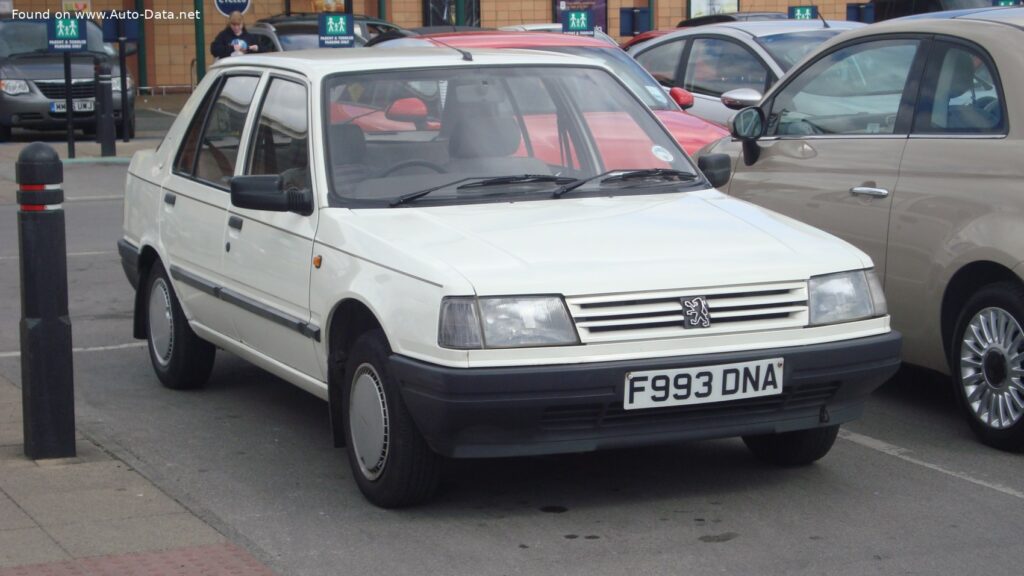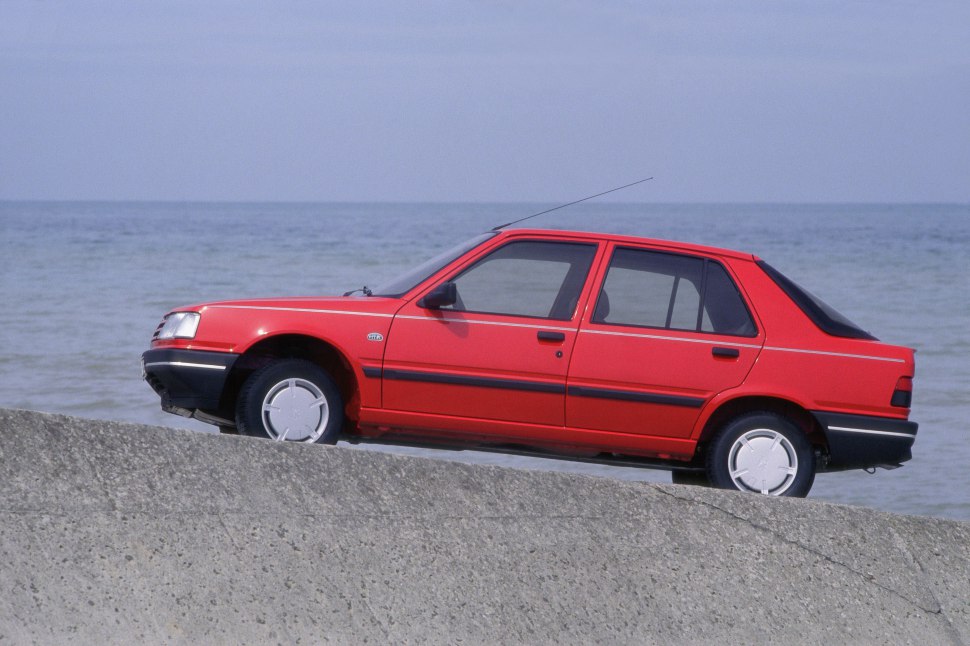
The Peugeot 309, particularly its formidable 1.9 GTI 16V (158 Hp) variant from the 1989 facelift generation, represents a significant chapter in the history of European hot hatchbacks. Launched in 1989 and produced through 1990, this iteration of the 309 solidified Peugeot’s reputation for producing agile, driver-focused performance vehicles. While never officially imported to the United States, the 309 carved out a distinct niche in its primary European market, serving as a larger, more practical, yet equally engaging alternative to the legendary 205 GTI. It bridged the gap between compact agility and family-car practicality, offering a compelling blend of everyday usability and exhilarating performance that defined the late 1980s automotive landscape.
Engine and Performance: The Heart of the Peugeot 309 (3C,3A facelift 1989) 1.9 GTI 16V (158 Hp)
At the core of the Peugeot 309 (3C,3A facelift 1989) 1.9 GTI 16V (158 Hp) lies a highly acclaimed powertrain: the D6C XU9J4 engine. This naturally aspirated, 1.9-liter (1905 cm³ or 116.25 cu. in.) inline four-cylinder engine was a masterpiece of engineering for its time, featuring a 16-valve cylinder head that allowed for superior breathing and power delivery at higher RPMs. It generated a robust 158 horsepower at a spirited 6500 rpm, demonstrating a power-per-liter output of 82.9 HP/l, which was highly competitive for a non-turbocharged engine of that era. Torque figures were equally impressive, peaking at 130.55 lb.-ft. (177 Nm) at 5000 rpm, providing a strong mid-range pull essential for dynamic driving.
Power was efficiently channeled to the front wheels via a precise 5-speed manual transmission, a setup that underscored the car’s driver-centric philosophy. This combination enabled the 309 GTI 16V to achieve remarkable acceleration for its class, sprinting from 0 to 60 mph in a mere 7.4 seconds. Its top speed was an impressive 136.7 mph (220 km/h), allowing it to comfortably hold its own on the autobahns and open roads of Europe. The engine utilized a multi-port manifold injection system, ensuring optimal fuel delivery and combustion, contributing to both performance and a respectable fuel economy for a performance vehicle. On the combined cycle, it achieved approximately 29.4 US mpg (8.0 l/100 km), with extra-urban figures reaching 36.2 US mpg (6.5 l/100 km), highlighting a surprising degree of efficiency when cruising.
The performance was further enhanced by a favorable weight-to-power ratio of 6.2 kg/HP (162.1 HP/tonne). With a curb weight of just 2149.51 lbs (975 kg), the 309 GTI 16V was exceptionally light, contributing significantly to its agile handling and responsive acceleration. This low mass, combined with the potent 16-valve engine, solidified its position as a true “hot hatch,” delivering an engaging and visceral driving experience that remained a hallmark of Peugeot’s performance models.
Design, Features, and Driving Dynamics
The Peugeot 309 (3C,3A facelift 1989) adopted a distinctive hatchback body type, featuring three doors and seating for five occupants. Its design language was a blend of Peugeot’s contemporary aesthetic, drawing cues from both the smaller 205 and the larger 405. The facelift introduced subtle enhancements, refining its already purposeful stance. Measuring 159.45 inches in length, 64.17 inches in width, and 54.33 inches in height, with a wheelbase of 97.24 inches, the 309 offered a more spacious interior than its 205 sibling, making it a more versatile option for small families or those needing extra cargo capacity. The trunk space ranged from a practical 10.42 cu. ft. (295 liters) with all seats in place, expanding to a generous 21.72 cu. ft. (615 liters) when the rear seats were folded, underscoring its dual nature as both a performance car and a capable daily driver.
Peugeot’s engineering prowess was particularly evident in the 309 GTI 16V’s chassis and suspension setup, which contributed significantly to its renowned handling. The front suspension utilized coil springs, while the rear featured a torsion beam system, a configuration that provided excellent road holding and a compliant ride without sacrificing responsiveness. This setup, combined with a hydraulic rack and pinion steering system, offered precise and communicative feedback to the driver, making the car a joy to pilot through winding roads. Braking performance was equally robust, with ventilated discs at the front and solid discs at the rear, complemented by an Anti-lock Braking System (ABS) as an assisting feature – a significant safety enhancement for a car of its era. The vehicle rode on 195/55 VR15 tires, providing ample grip and further enhancing its dynamic capabilities.
Despite its performance focus, the 309 GTI 16V did not entirely forego practicality. Its 14.53 US gallon (55-liter) fuel tank provided a decent cruising range, and its maximum load capacity of 936.96 lbs (425 kg) meant it could handle a reasonable amount of cargo or passengers. The interior, while typical of late 1980s European design, was ergonomically laid out, with controls easily accessible to the driver. The 309 GTI 16V represented a sweet spot in Peugeot’s lineup, offering a mature yet thrilling driving experience that cemented its status as a desirable classic hot hatch among enthusiasts worldwide, even those in markets where it was never officially sold.
Technical Specifications
| Brand | Peugeot |
| Model | 309 |
| Generation | 309 (3C,3A facelift 1989) |
| Type (Engine) | 1.9 GTI 16V (158 Hp) |
| Start of production | 1989 year |
| End of production | 1990 year |
| Powertrain Architecture | Internal Combustion engine |
| Body type | Hatchback |
| Seats | 5 |
| Doors | 3 |
| Fuel consumption (economy) – urban | 11.8 l/100 km (19.9 US mpg, 23.9 UK mpg, 8.5 km/l) |
| Fuel consumption (economy) – extra urban | 6.5 l/100 km (36.2 US mpg, 43.5 UK mpg, 15.4 km/l) |
| Fuel consumption (economy) – combined | 8 l/100 km (29.4 US mpg, 35.3 UK mpg, 12.5 km/l) |
| Fuel Type | Petrol (Gasoline) |
| Acceleration 0 – 100 km/h | 7.8 sec |
| Acceleration 0 – 62 mph | 7.8 sec |
| Acceleration 0 – 60 mph (Calculated by Auto-Data.net) | 7.4 sec |
| Maximum speed | 220 km/h (136.7 mph) |
| Weight-to-power ratio | 6.2 kg/Hp, 162.1 Hp/tonne |
| Weight-to-torque ratio | 5.5 kg/Nm, 181.5 Nm/tonne |
| Power | 158 Hp @ 6500 rpm. |
| Power per litre | 82.9 Hp/l |
| Torque | 177 Nm @ 5000 rpm. (130.55 lb.-ft. @ 5000 rpm.) |
| Engine layout | Front, Transverse |
| Engine Model/Code | D6C XU9J4 |
| Engine displacement | 1905 cm³ (116.25 cu. in.) |
| Number of cylinders | 4 |
| Engine configuration | Inline |
| Cylinder Bore | 83 mm (3.27 in.) |
| Piston Stroke | 88 mm (3.46 in.) |
| Compression ratio | 10.4:1 |
| Number of valves per cylinder | 4 |
| Fuel injection system | Multi-port manifold injection |
| Engine aspiration | Naturally aspirated engine |
| Engine oil capacity | 4.6 l (4.86 US qt | 4.05 UK qt) |
| Coolant | 7.5 l (7.93 US qt | 6.6 UK qt) |
| Kerb Weight | 975 kg (2149.51 lbs.) |
| Max. weight | 1400 kg (3086.47 lbs.) |
| Max load | 425 kg (936.96 lbs.) |
| Trunk (boot) space – minimum | 295 l (10.42 cu. ft.) |
| Trunk (boot) space – maximum | 615 l (21.72 cu. ft.) |
| Fuel tank capacity | 55 l (14.53 US gal | 12.1 UK gal) |
| Length | 4050 mm (159.45 in.) |
| Width | 1630 mm (64.17 in.) |
| Height | 1380 mm (54.33 in.) |
| Wheelbase | 2470 mm (97.24 in.) |
| Front track | 1405 mm (55.31 in.) |
| Rear (Back) track | 1380 mm (54.33 in.) |
| Drivetrain Architecture | The Internal combustion engine (ICE) drives the front wheels of the vehicle. |
| Drive wheel | Front wheel drive |
| Number of gears and type of gearbox | 5 gears, manual transmission |
| Front suspension | Coil spring |
| Rear suspension | Torsion |
| Front brakes | Ventilated discs |
| Rear brakes | Disc |
| Assisting systems | ABS (Anti-lock braking system) |
| Steering type | Steering rack and pinion |
| Power steering | Hydraulic Steering |
| Tires size | 195/55 VR15 |