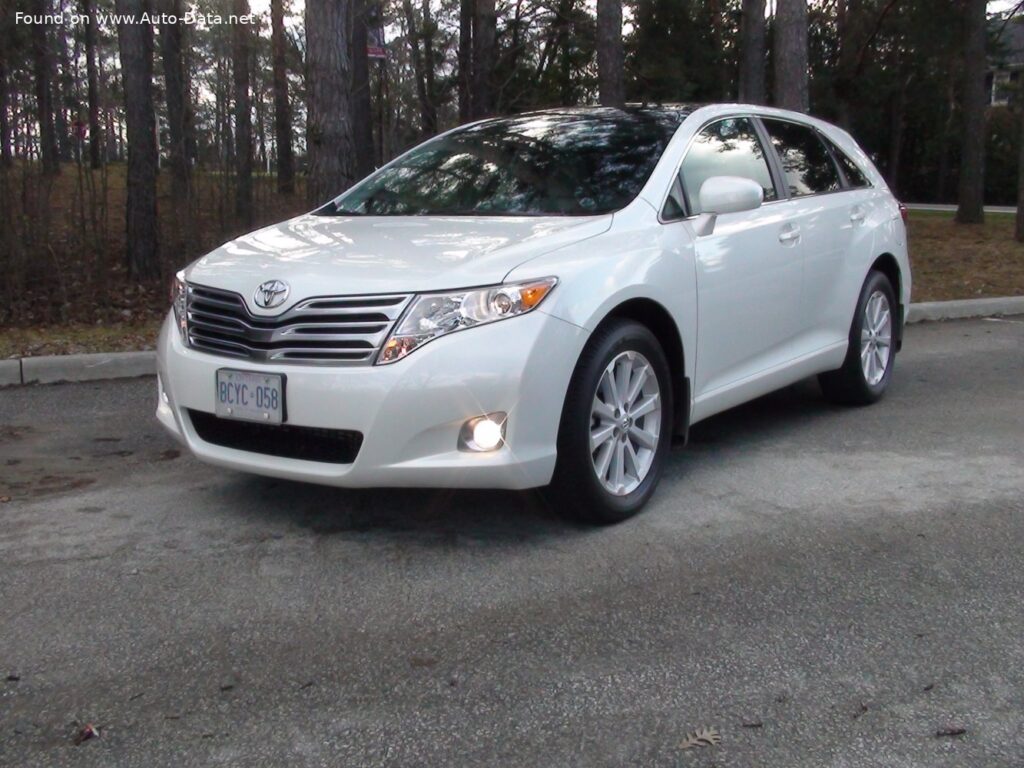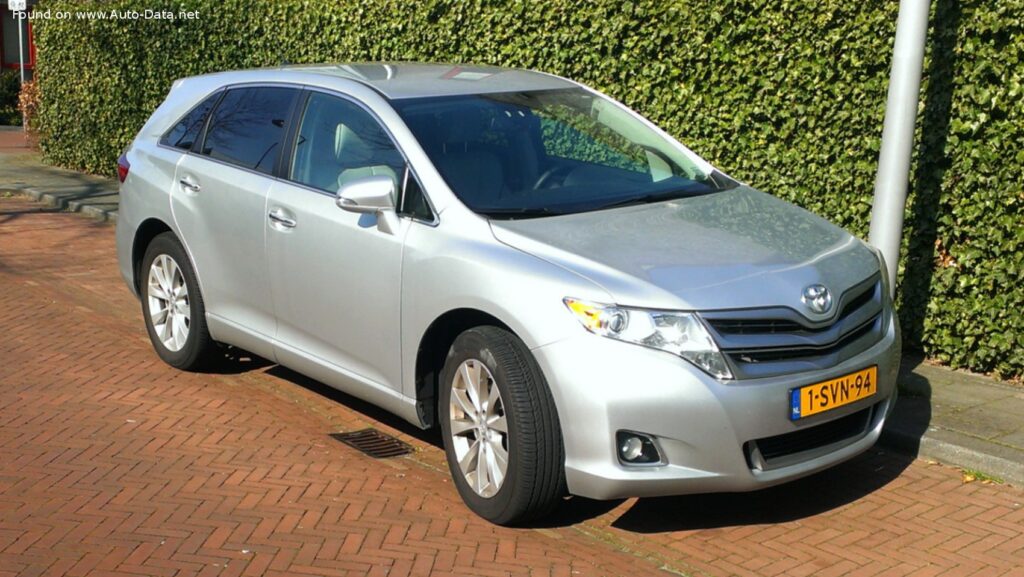
The Toyota Venza, particularly the first generation (AV10) with its 2012 facelift, represented a unique proposition in the North American automotive landscape. Positioned as a versatile crossover that blended the practicality of a station wagon with the elevated stance and utility of an SUV, the Toyota Venza I (AV10, facelift 2012) aimed to carve out a niche between traditional sedans and larger sport utility vehicles. This particular iteration, produced from May 2012 until its discontinuation in 2017, featured a robust 3.5-liter V6 engine, offering a compelling balance of power, refinement, and everyday usability. Its design and engineering were specifically tailored to appeal to families and individuals seeking comfort, ample cargo space, and a confident driving experience, without the bulk or fuel economy penalties often associated with full-size SUVs. The Venza’s market role was to provide a more car-like driving experience than a traditional SUV, yet offer more interior volume and ground clearance than a conventional sedan or wagon, establishing it as a highly adaptable vehicle for diverse American lifestyles.
Engine and Performance of the Toyota Venza I (AV10, facelift 2012)
At the heart of the 2012 facelifted Toyota Venza I (AV10) lies the formidable 3.5-liter V6 engine, designated with the model code 2GR-FE. This naturally aspirated powerhouse delivers a strong 268 horsepower at 6200 rpm, providing ample acceleration and confident passing power for highway driving. Complementing this output is a robust 246.35 lb.-ft. of torque, peaking at a relatively accessible 4700 rpm, which ensures responsive performance in various driving conditions, from city commutes to traversing challenging terrains. The engine’s V6 configuration, with six cylinders and four valves per cylinder, contributes to its smooth operation and refined power delivery, a hallmark of Toyota’s engineering philosophy.
The 2GR-FE engine benefits from advanced valvetrain technology, specifically Dual Variable Valve Timing with intelligence (D-VVT-i). This system continuously optimizes valve timing on both the intake and exhaust camshafts, enhancing engine efficiency across the entire RPM range. The result is improved low-end torque for better launch feel, stronger mid-range power for effortless cruising, and enhanced fuel economy. With a power per liter rating of 77.5 Hp/l and an engine displacement of 3456 cm3 (210.9 cu. in.), the Venza’s V6 demonstrates efficient power generation for its size.
Power is managed by a sophisticated 6-speed automatic transmission with Electronic Controlled Transmission intelligence (ECT-i). This advanced gearbox provides seamless and responsive shifts, optimizing power delivery and contributing to the vehicle’s overall refinement. The ECT-i system adapts to driving conditions and driver input, ensuring smooth acceleration and efficient cruising. The drivetrain architecture for this specific Venza variant is front-wheel drive, where the internal combustion engine drives the front wheels, prioritizing efficiency and predictable handling. This configuration, combined with the V6 engine, offers a weight-to-power ratio of 6.5 kg/Hp (152.7 Hp/tonne) and a weight-to-torque ratio of 5.3 kg/Nm (190.3 Nm/tonne), indicating a well-balanced power-to-weight relationship for a vehicle of its class.
Despite its powerful V6 engine, the Venza strives for commendable fuel efficiency for its segment. It achieves an urban fuel economy of 19 US mpg (12.4 l/100 km) and an extra-urban (highway) economy of 26.1 US mpg (9 l/100 km). These figures, combined with a 17.7 US gallon fuel tank capacity, provide a substantial driving range between fill-ups, making the Venza suitable for long road trips. Furthermore, the vehicle adheres to the ULEV-II (Ultra-Low Emission Vehicle) standard, underscoring Toyota’s commitment to environmental responsibility. The combination of a potent V6, an intelligent automatic transmission, and thoughtful engineering ensured that the Toyota Venza delivered a performance package that was both exhilarating and practical for its target audience.
Design and Features
The Toyota Venza I (AV10, facelift 2012) embraced a distinctive body type that Toyota officially categorized as a “station wagon (estate),” though it was widely perceived in North America as a mid-size crossover. Its design philosophy aimed to blend the sleek aesthetics of a sedan with the enhanced utility and commanding presence of an SUV. The 2012 facelift introduced subtle yet effective styling revisions, including a refreshed front grille, updated fog lamp bezels, and new exterior color options, giving it a more contemporary and refined appearance that resonated with its target demographic.
Measuring 189.02 inches in length, 75 inches in width, and 63.39 inches in height, with a substantial 109.29-inch wheelbase, the Venza struck an imposing yet elegant stance. The generous dimensions translated directly into a spacious and comfortable cabin, designed to accommodate five occupants across two rows of seating with ease. The five-door configuration provided excellent accessibility for both passengers and cargo. A notable feature for its class was the ample ground clearance of 8.11 inches, which not only contributed to a confident driving position but also offered practical benefits for navigating uneven terrain, snowy roads, or simply clearing curbs with ease.
Interior design focused on comfort, practicality, and user-friendly ergonomics. The cabin was characterized by quality materials and thoughtful storage solutions. One of the Venza’s strongest selling points was its exceptional cargo capacity. With the rear seats in place, it offered a substantial 30.09 cu. ft. (852 liters) of trunk space. Folding down the rear seats expanded this volume dramatically to an impressive 70.21 cu. ft. (1988 liters), making it highly adaptable for carrying luggage, sports equipment, or large household items. This flexibility underscored its station wagon roots and crossover utility.
For its era, the Venza came equipped with a range of features aimed at enhancing convenience and safety. The electric power steering system provided light and precise control, making maneuvering in tight spaces effortless, complemented by a minimum turning circle of 40.68 feet. Standard safety features included an Anti-lock Braking System (ABS), which worked in conjunction with the robust braking system comprising 325 mm ventilated discs at the front and 297 mm discs at the rear, ensuring strong and reliable stopping power. The suspension system, featuring independent McPherson struts with coil springs and an anti-roll bar at the front, and McPherson struts at the rear, delivered a comfortable and composed ride, absorbing road imperfections effectively. Large 20-inch wheels, fitted with 245/50 R20 102H tires, not only contributed to the Venza’s assertive road presence but also provided excellent grip and stability. The Venza’s ability to tow up to 3500.94 lbs (1588 kg) with brakes further enhanced its utility, catering to those with recreational needs or light hauling requirements. Overall, the 2012 Toyota Venza was a well-rounded package, offering a compelling blend of style, space, comfort, and performance for the discerning American consumer.
Technical Specifications
| Brand | Toyota |
| Model | Venza |
| Generation | Venza I (AV10, facelift 2012) |
| Type (Engine) | 3.5i V6 (268 Hp) ECT-i |
| Start of production | May, 2012 year |
| End of production | 2017 year |
| Powertrain Architecture | Internal Combustion engine |
| Body type | Station wagon (estate) |
| Seats | 5 |
| Doors | 5 |
| Fuel consumption (economy) – urban | 12.4 l/100 km (19 US mpg) |
| Fuel consumption (economy) – extra urban | 9 l/100 km (26.1 US mpg) |
| Fuel Type | Petrol (Gasoline) |
| Emission standard | ULEV-II |
| Weight-to-power ratio | 6.5 kg/Hp (152.7 Hp/tonne) |
| Weight-to-torque ratio | 5.3 kg/Nm (190.3 Nm/tonne) |
| Power | 268 Hp @ 6200 rpm |
| Power per litre | 77.5 Hp/l |
| Torque | 334 Nm @ 4700 rpm (246.35 lb.-ft. @ 4700 rpm) |
| Engine layout | Front, Transverse |
| Engine Model/Code | 2GR-FE |
| Engine displacement | 3456 cm3 (210.9 cu. in.) |
| Number of cylinders | 6 |
| Engine configuration | V-engine |
| Number of valves per cylinder | 4 |
| Fuel injection system | Multi-port manifold injection |
| Engine aspiration | Naturally aspirated engine |
| Valvetrain | DOHC, D-VVT-i |
| Engine oil capacity | 6.1 l (6.45 US qt) |
| Coolant | 10.3 l (10.88 US qt) |
| Kerb Weight | 1755 kg (3869.11 lbs.) |
| Max. weight | 2311 kg (5094.88 lbs.) |
| Max load | 556 kg (1225.77 lbs.) |
| Trunk (boot) space – minimum | 852 l (30.09 cu. ft.) |
| Trunk (boot) space – maximum | 1988 l (70.21 cu. ft.) |
| Fuel tank capacity | 67 l (17.7 US gal) |
| Permitted trailer load with brakes (12%) | 1588 kg (3500.94 lbs.) |
| Length | 4801 mm (189.02 in.) |
| Width | 1905 mm (75 in.) |
| Height | 1610 mm (63.39 in.) |
| Wheelbase | 2776 mm (109.29 in.) |
| Front track | 1631 mm (64.21 in.) |
| Rear (Back) track | 1641 mm (64.61 in.) |
| Ride height (ground clearance) | 206 mm (8.11 in.) |
| Minimum turning circle (turning diameter) | 12.4 m (40.68 ft.) |
| Drivetrain Architecture | The Internal combustion engine (ICE) drives the front wheels of the vehicle. |
| Drive wheel | Front wheel drive |
| Number of gears and type of gearbox | 6 gears, automatic transmission ECT-i |
| Front suspension | Independent, type McPherson with coil spring and anti-roll bar |
| Rear suspension | McPherson |
| Front brakes | Ventilated discs, 325 mm |
| Rear brakes | Disc, 297 mm |
| Assisting systems | ABS (Anti-lock braking system) |
| Steering type | Steering rack and pinion |
| Power steering | Electric Steering |
| Tires size | 245/50 R20 102H |
| Wheel rims size | 20 |