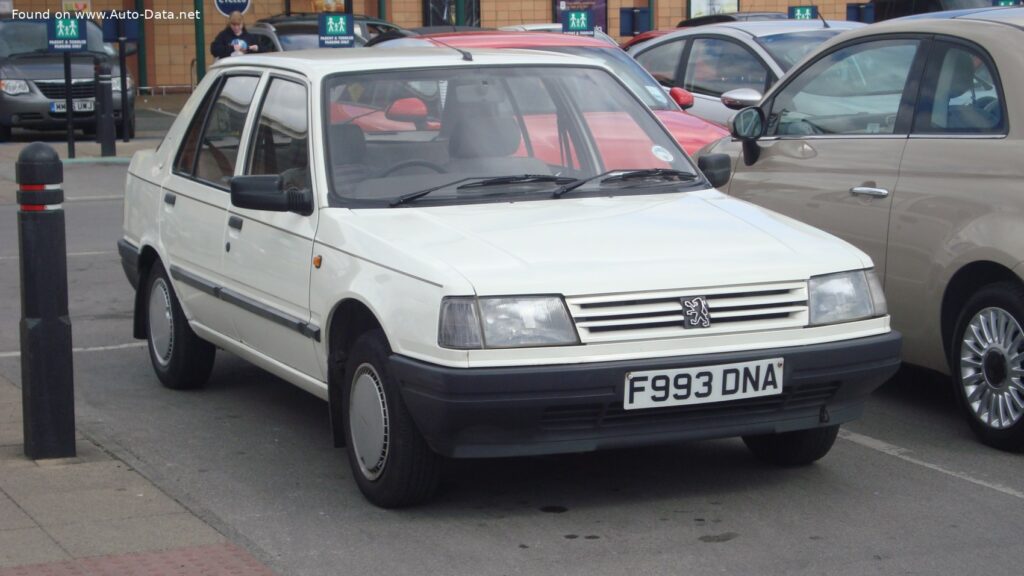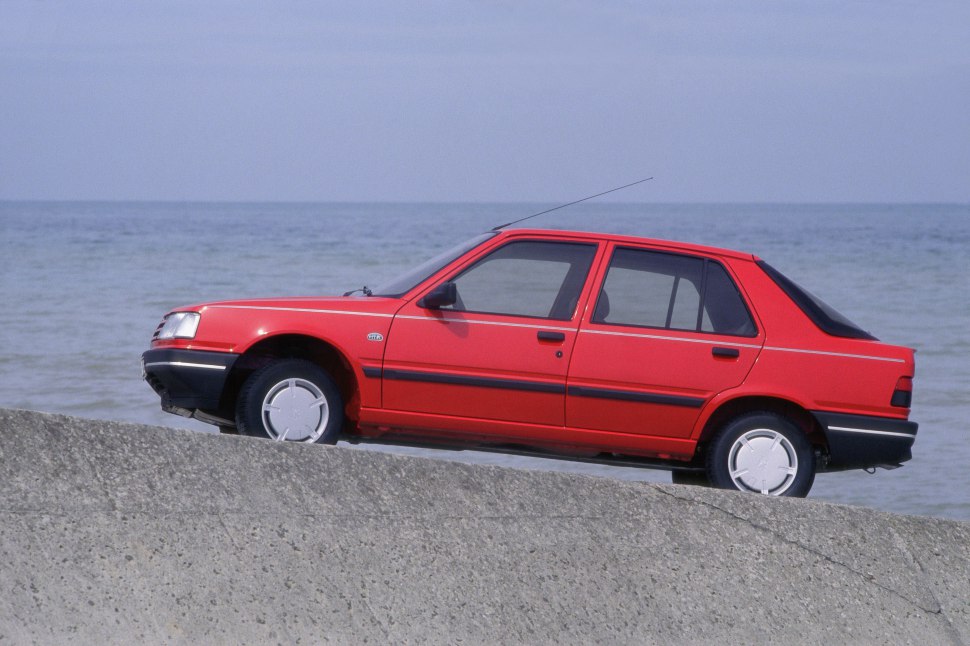
The Peugeot 309, particularly the facelifted 1989-1993 generation, represents a significant chapter in the history of the French automaker’s compact car offerings. While never officially imported to the United States, the Peugeot 309 (3C,3A facelift 1989) 1.9i (98 Hp) carved out a niche for itself in European markets as a practical, robust, and often understated family hatchback. Positioned to bridge the gap between the smaller 205 and the larger 405, the 309 was initially conceived as a Talbot model but was rebranded as a Peugeot following the acquisition of Chrysler Europe (which included the Talbot brand) by PSA Group. This particular variant, produced from 1989 to 1993, featured a notable refresh that refined its aesthetics and mechanical package, solidifying its reputation for reliable performance and economy within its class. As a classic from the late 1980s and early 1990s, it offers a glimpse into the design philosophies and engineering priorities of European manufacturers during that transitional era, emphasizing utility, efficiency, and a spirited driving experience for the everyday motorist.
Engine and Performance of the Peugeot 309 (3C,3A facelift 1989) 1.9i (98 Hp)
At the heart of the Peugeot 309 (3C,3A facelift 1989) 1.9i (98 Hp) lies a naturally aspirated 1.9-liter (1905 cm3, or 116.25 cu. in.) inline-four engine, designated by the code DFZ XU9J1. This robust powertrain delivered a respectable 98 horsepower at 6000 revolutions per minute, a significant output for a compact car of its vintage. The engine’s architecture, featuring a front, transverse layout and an inline configuration with two valves per cylinder, was a common and proven design for the period, prioritizing reliability and ease of maintenance. With a bore of 83 mm (3.27 in.) and a piston stroke of 88 mm (3.46 in.), it exhibited an oversquare design, contributing to its ability to rev freely. Fuel delivery was handled by a single-point injection system, a step up from carburetors, offering improved fuel atomization and efficiency, though not as precise as the multi-point systems that would become standard in later years.
Performance figures for the 1.9i (98 Hp) variant were quite commendable for its segment. It could accelerate from 0 to 62 mph (0-100 km/h) in a brisk 9.9 seconds, with a calculated 0-60 mph time of 9.4 seconds. The vehicle’s top speed reached 119.3 mph (192 km/h), making it a capable performer on European highways. These figures were greatly aided by the car’s remarkably light curb weight of just 2006.21 lbs (910 kg), resulting in an impressive weight-to-power ratio of 9.3 kg/Hp (107.7 Hp/tonne). This combination of a relatively powerful engine and low mass contributed to a lively and engaging driving experience, a hallmark of many Peugeot models of the era.
Fuel economy, a critical consideration for European buyers, was also a strong suit for the 309 1.9i. The combined cycle consumption was rated at 7 liters per 100 km, which translates to an appealing 33.6 US mpg. In urban driving, it achieved 9.3 l/100 km (25.3 US mpg), while on the open road (extra-urban), it managed an impressive 5.5 l/100 km (42.8 US mpg). These figures underscore the efficiency gains provided by the single-point injection system and the careful calibration of the engine. Power was transferred to the front wheels via a smooth-shifting 5-speed manual transmission, a standard and reliable setup that offered drivers direct control over the engine’s output. The engine oil capacity stood at 4.6 liters (4.86 US qt), with a coolant capacity of 7.5 liters (7.93 US qt), indicating standard maintenance requirements for the period.
Design and Features
The Peugeot 309’s design, especially after its 1989 facelift, embodied the functional and practical aesthetic prevalent in European compact hatchbacks of the late 1980s and early 1990s. Available with either three or five doors, the hatchback body style offered versatility and ease of access, catering to a wide range of buyers from young families to single commuters. The car comfortably accommodated five occupants, making it a viable family vehicle despite its compact exterior dimensions. With a length of 159.45 inches (4050 mm), a width of 64.17 inches (1630 mm), and a height of 54.33 inches (1380 mm), the 309 was agile and easy to maneuver in congested city environments, yet offered sufficient interior space for its class. The wheelbase of 97.24 inches (2470 mm) contributed to a stable ride quality for a car of its size.
Inside, the 309 prioritized ergonomics and straightforward functionality. While not laden with luxury features, the cabin was designed for durability and ease of use, reflecting its positioning as an affordable and practical daily driver. Storage capacity was a key advantage, with a minimum trunk space of 10.42 cu. ft. (295 liters) that could expand significantly to 21.72 cu. ft. (615 liters) with the rear seats folded, offering ample room for groceries, luggage, or other cargo. The fuel tank capacity of 14.53 US gallons (55 liters) provided a decent cruising range, especially considering its economical fuel consumption.
Underneath its practical exterior, the 309 featured a well-engineered chassis. The drivetrain architecture was front-wheel drive, with the internal combustion engine driving the front wheels, a layout favored for its packaging efficiency, traction, and cost-effectiveness. The suspension system comprised coil springs at the front, offering a comfortable and controlled ride, complemented by a torsion beam setup at the rear, which was compact and allowed for more cargo space. Braking performance was handled by disc brakes at the front and drum brakes at the rear, a common and effective combination for a vehicle of this weight and performance level. For enhanced safety, the 309 was equipped with an Anti-lock Braking System (ABS), a significant feature for its time, providing improved control during emergency stops. Steering was managed by a rack and pinion system, assisted by hydraulic power steering, ensuring light and responsive handling. The car rode on 165/70 TR13 tires, providing a good balance of grip and ride comfort for its intended use.
Technical Specifications
| Brand | Peugeot |
| Model | 309 |
| Generation | 309 (3C,3A facelift 1989) |
| Type (Engine) | 1.9i (98 Hp) |
| Start of production | 1989 year |
| End of production | 1993 year |
| Powertrain Architecture | Internal Combustion engine |
| Body type | Hatchback |
| Seats | 5 |
| Doors | 3-5 |
| Fuel consumption (economy) – urban | 9.3 l/100 km (25.3 US mpg, 30.4 UK mpg) |
| Fuel consumption (economy) – extra urban | 5.5 l/100 km (42.8 US mpg, 51.4 UK mpg) |
| Fuel consumption (economy) – combined | 7 l/100 km (33.6 US mpg, 40.4 UK mpg) |
| Fuel Type | Petrol (Gasoline) |
| Acceleration 0 – 100 km/h | 9.9 sec |
| Acceleration 0 – 62 mph | 9.9 sec |
| Acceleration 0 – 60 mph (Calculated) | 9.4 sec |
| Maximum speed | 192 km/h (119.3 mph) |
| Weight-to-power ratio | 9.3 kg/Hp, 107.7 Hp/tonne |
| Power | 98 Hp @ 6000 rpm |
| Power per litre | 51.4 Hp/l |
| Engine layout | Front, Transverse |
| Engine Model/Code | DFZ XU9J1 |
| Engine displacement | 1905 cm3 (116.25 cu. in.) |
| Number of cylinders | 4 |
| Engine configuration | Inline |
| Cylinder Bore | 83 mm (3.27 in.) |
| Piston Stroke | 88 mm (3.46 in.) |
| Compression ratio | 9:1 |
| Number of valves per cylinder | 2 |
| Fuel injection system | Single-point injection |
| Engine aspiration | Naturally aspirated engine |
| Engine oil capacity | 4.6 l (4.86 US qt) |
| Coolant | 7.5 l (7.93 US qt) |
| Kerb Weight | 910 kg (2006.21 lbs) |
| Max. weight | 1350 kg (2976.24 lbs) |
| Max load | 440 kg (970.03 lbs) |
| Trunk (boot) space – minimum | 295 l (10.42 cu. ft.) |
| Trunk (boot) space – maximum | 615 l (21.72 cu. ft.) |
| Fuel tank capacity | 55 l (14.53 US gal) |
| Length | 4050 mm (159.45 in.) |
| Width | 1630 mm (64.17 in.) |
| Height | 1380 mm (54.33 in.) |
| Wheelbase | 2470 mm (97.24 in.) |
| Front track | 1405 mm (55.31 in.) |
| Rear (Back) track | 1380 mm (54.33 in.) |
| Drivetrain Architecture | The Internal combustion engine (ICE) drives the front wheels of the vehicle. |
| Drive wheel | Front wheel drive |
| Number of gears and type of gearbox | 5 gears, manual transmission |
| Front suspension | Coil spring |
| Rear suspension | Torsion |
| Front brakes | Disc |
| Rear brakes | Drum |
| Assisting systems | ABS (Anti-lock braking system) |
| Steering type | Steering rack and pinion |
| Power steering | Hydraulic Steering |
| Tires size | 165/70 TR13 |