
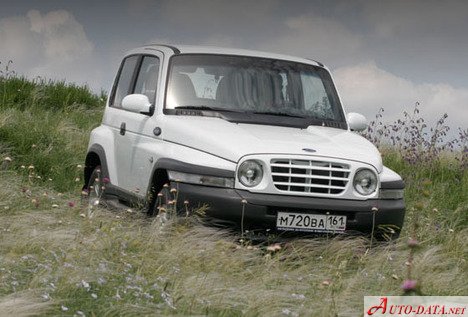
The TagAz Tager 2.9 D (120 Hp) 4×4 Automatic, produced between 2008 and 2012, represents a distinctive chapter in the history of Russian automotive manufacturing. As a rebadged version of the first-generation SsangYong Korando, this rugged off-road vehicle was assembled by the Taganrog Automobile Plant (TagAZ) in Russia. It carved out a niche in its primary markets, particularly within Russia and the Commonwealth of Independent States (CIS), as a utilitarian and robust option for consumers seeking genuine off-road capability without the premium price tag of more sophisticated foreign imports. The Tager was designed to tackle challenging terrains and harsh climates, embodying a no-nonsense approach to mobility. Its generation, a carryover from the late 20th-century SsangYong design, positioned it as a durable workhorse rather than a luxury SUV, appealing to practical buyers and those in need of a dependable vehicle for rural or demanding environments. The specific variant, the 2.9 D (120 Hp) 4×4 Automatic, offered a blend of diesel efficiency and the convenience of an automatic transmission, enhancing its appeal for both arduous tasks and daily usability.
Engine and Performance of the TagAz Tager
At the heart of the TagAz Tager 2.9 D (120 Hp) 4×4 Automatic lies a robust 2.9-liter (2874 cm3 or 175.38 cu. in.) inline five-cylinder diesel engine. This powerplant, a direct descendant of Mercedes-Benz OM602 technology licensed by SsangYong, was renowned for its durability and reliability, characteristics highly valued in the markets where the Tager operated. Generating a solid 120 horsepower at 4000 rpm and a commendable 188.82 lb.-ft. (256 Nm) of torque at a relatively low 2800 rpm, the engine was engineered for sustained performance under load, rather than outright speed. Its naturally aspirated design, combined with a Diesel Commonrail fuel injection system and a DOHC (Double Overhead Camshaft) valvetrain with four valves per cylinder, contributed to its efficiency and a healthy power-to-displacement ratio of 41.8 HP per liter, despite the absence of turbocharging common in later diesel designs.
The power delivery of the 2.9 D engine was specifically tuned for off-road prowess and towing capability, with its peak torque arriving early in the rev range. This characteristic made it well-suited for climbing steep grades, traversing uneven terrain, and hauling loads. Mated to a four-speed automatic transmission, the powertrain provided smooth and predictable shifts, a significant advantage in stop-and-go traffic or when navigating challenging off-road conditions where precise throttle control is paramount. The full-time all-wheel-drive (4×4) system ensured maximum traction and stability across varied surfaces, from muddy tracks to snowy roads, reinforcing the Tager’s identity as a serious off-roader.
While not designed for high-speed cruising, the TagAz Tager 2.9 D achieved a maximum speed of approximately 86.99 mph (140 km/h), which was adequate for its intended use and the prevailing speed limits in its primary markets. Fuel economy, a critical consideration for diesel vehicles, was respectable for an off-road vehicle of its size and era. The combined fuel consumption was rated at 22.4 US mpg (10.5 l/100 km), with urban consumption at 17 US mpg (13.8 l/100 km) and extra-urban figures reaching 26.7 US mpg (8.8 l/100 km). With a 18.49 US gallon (70 L) fuel tank, the Tager offered a decent cruising range, a practical benefit for long journeys in regions with sparse refueling infrastructure. The vehicle’s substantial kerb weight of 4078.55 lbs. (1850 kg) resulted in a weight-to-power ratio of 15.4 kg/Hp and a weight-to-torque ratio of 7.2 kg/Nm, indicating a sturdy build designed to withstand demanding operational conditions and contribute to its stable road presence, both on and off the pavement.
Design and Features of the TagAz Tager
The design of the TagAz Tager is unmistakably that of a rugged off-road vehicle, drawing heavily from its SsangYong Korando lineage. Its three-door body configuration, accommodating five occupants, emphasized its practical, adventure-ready character. With a length of 170.47 inches (4330 mm), a width of 72.48 inches (1841 mm), and a height of 72.44 inches (1840 mm), the Tager possessed a compact yet commanding presence, typical of purpose-built SUVs. The relatively short wheelbase of 97.64 inches (2480 mm) was a key factor in its off-road agility, allowing for better break-over angles and maneuverability over obstacles, making it adept at navigating tight trails and challenging terrain.
Externally, the Tager featured a functional and somewhat boxy aesthetic, prioritizing utility over aerodynamic sleekness. Large windows provided excellent visibility, a crucial aspect for off-road driving, and its robust construction was evident in its overall stance. The front and rear tracks, measuring 59.45 inches (1510 mm) and 59.84 inches (1520 mm) respectively, contributed to its stable footprint. The interior, while not opulent, was designed for durability and ease of maintenance, reflecting its role as a workhorse. The seating for five was practical, and the cargo area offered considerable versatility
