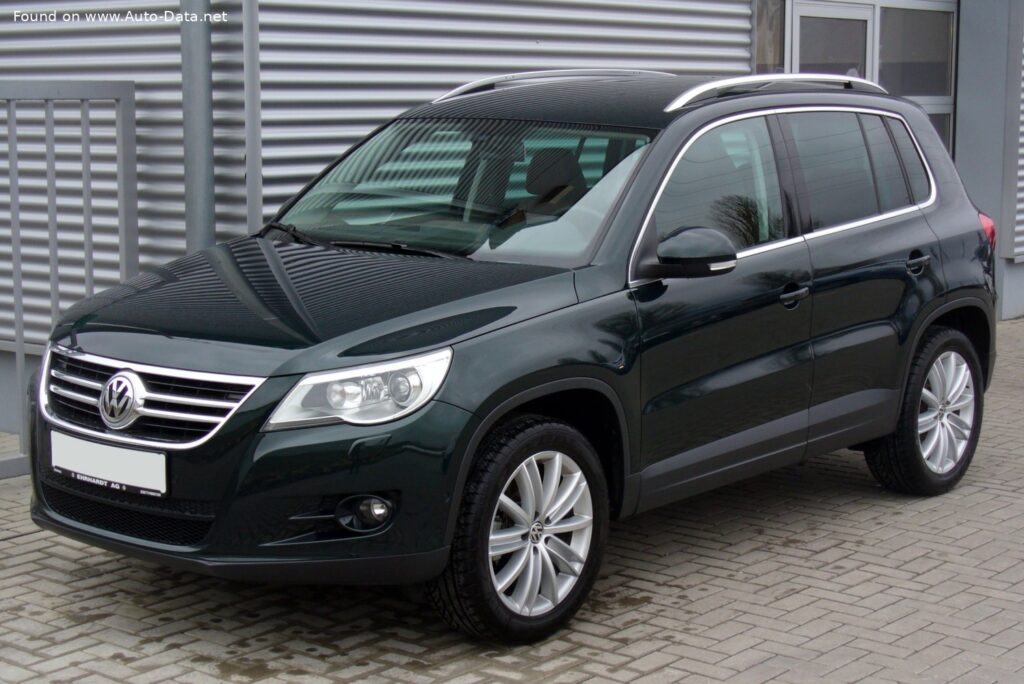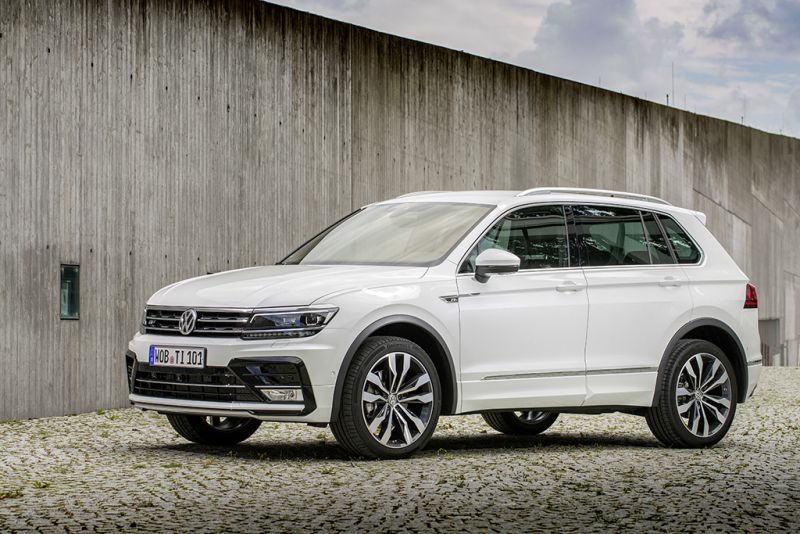
The Volkswagen Tiguan II 2.0 TDI (150 Hp) SCR represents a significant offering in the highly competitive compact SUV segment, specifically tailored for markets where diesel powertrains remain a popular and efficient choice. Introduced in 2019 as part of the second generation Tiguan, this particular variant, with its 2.0-liter turbocharged direct injection diesel engine, was produced until 2020. It carved a niche for itself by combining Volkswagen’s renowned build quality and sophisticated engineering with impressive fuel economy and robust performance, making it a compelling option for families and individuals seeking a versatile and economical daily driver, particularly across Europe and other international markets.
Powertrain and Performance of the Volkswagen Tiguan II 2.0 TDI (150 Hp) SCR
At the heart of the Volkswagen Tiguan II 2.0 TDI (150 Hp) SCR lies a finely tuned 2.0-liter (1968 cm3 or 120.09 cu. in.) inline four-cylinder diesel engine. This powerplant, identified by codes such as DBGA, DBGC, DCYA, or DFGA, is a testament to modern diesel technology, featuring a common rail fuel injection system, a turbocharger, and an intercooler to optimize combustion and efficiency. It delivers a respectable 150 horsepower at a broad range of 3500-4000 revolutions per minute, providing ample power for both urban commuting and highway cruising. More importantly for an SUV, the engine generates a substantial 340 Nm (250.77 lb.-ft.) of torque, available from a low 1750 rpm up to 3000 rpm. This wide torque band ensures strong acceleration and effortless overtaking maneuvers, contributing to a confident driving experience.
The performance figures for this Tiguan variant underscore its balanced capabilities. It can accelerate from 0 to 60 mph in a brisk 8.9 seconds, a commendable time for a compact SUV of its class and weight. The vehicle’s top speed is rated at 126.76 mph (204 km/h), demonstrating its capability to maintain comfortable speeds on freeways. Power is delivered to the front wheels via a precise 6-speed manual transmission, offering engaging control for the driver. This front-wheel-drive architecture, combined with the engine’s transverse layout, contributes to efficient packaging and optimized interior space. The weight-to-power ratio stands at 10.2 kg/Hp (or 98.4 Hp/tonne), while the weight-to-torque ratio is 4.5 kg/Nm (or 223 Nm/tonne), indicating a well-matched powertrain for its intended purpose.
Design, Dimensions, and Features
The Volkswagen Tiguan II generation adopted a sharper, more defined design language compared to its predecessor, giving it a more assertive and contemporary presence. As an SUV body type, it features 5 doors and comfortably accommodates 5 occupants, making it a practical choice for families. Its exterior dimensions are well-proportioned: a length of 176.61 inches (4486 mm), a width of 72.4 inches (1839 mm, or 82.64 inches / 2099 mm including mirrors), and a height of 65.12 inches (1654 mm). The wheelbase measures 105.39 inches (2677 mm), which is crucial for interior roominess and ride stability. The generous ground clearance of 7.52 inches (191 mm), along with respectable approach (17.4°), departure (16.4°), and ramp-over (15.5°) angles, provides a degree of off-road capability, making it suitable for light trails or challenging urban obstacles.
Inside, the Tiguan II offers a spacious and thoughtfully designed cabin. The minimum trunk (boot) space is an impressive 21.72 cu. ft. (615 liters), expanding to a cavernous 58.45 cu. ft. (1655 liters) with the rear seats folded down. This flexibility makes it highly adaptable for various cargo needs, from grocery runs to hauling luggage for longer trips. The vehicle’s kerb weight is 3362.05 lbs. (1525 kg), with a maximum permissible weight of 4872.22 lbs. (2210 kg), allowing for a maximum load of 1510.17 lbs. (685 kg). Practical considerations extend to a maximum roof load of 165.35 lbs. (75 kg) and substantial towing capacities: 4409.25 lbs. (2000 kg) with brakes and 1653.47 lbs. (750 kg) without brakes.
The chassis and suspension setup contribute significantly to the Tiguan’s balanced ride and handling. It features an independent multi-link suspension at the front and an independent coil spring suspension at the rear, providing a comfortable yet composed ride. Braking performance is handled by ventilated discs at the front and disc brakes at the rear, complemented by an Anti-lock Braking System (ABS) for enhanced safety. The electric power steering system, with a rack and pinion setup, offers precise control and a manageable minimum turning circle of 37.73 feet (11.5 meters), aiding maneuverability in tight spaces. A variety of tire and wheel sizes were available, ranging from 215/65 R17 to 255/40 R20, allowing for customization of aesthetics and driving dynamics.
Fuel Economy and Environmental Stewardship
One of the standout attributes of the Volkswagen Tiguan II 2.0 TDI (150 Hp) SCR is its exceptional fuel economy, a hallmark of modern diesel engines. The combined fuel consumption is rated at 4.5-4.6 liters per 100 kilometers, which translates to an impressive 52.3 – 51.1 US mpg. For urban driving, the figures are 5.4-5.5 l/100 km (43.6 – 42.8 US mpg), while extra-urban driving yields even more remarkable results at 4.0-4.1 l/100 km (58.8 – 57.4 US mpg). These figures highlight the efficiency advantages of diesel technology, especially for drivers who cover significant mileage.
Beyond fuel efficiency, this Tiguan variant also demonstrates Volkswagen’s commitment to environmental responsibility, particularly in meeting stringent European emission standards. The “SCR” in its name stands for Selective Catalytic Reduction, a system that uses AdBlue (a urea-based liquid) to convert harmful nitrogen oxides (NOx) in the exhaust gases into harmless nitrogen and water. With an AdBlue tank capacity of 3.17 US gallons (12 liters), the system operates effectively over long periods. The vehicle meets the Euro 6d-TEMP-EVAP-ISC emission standard, reflecting its low CO2 emissions of 119-122 g/km. Additionally, it features a Start & Stop System to reduce fuel consumption and emissions during idle periods, and a particulate filter to capture soot, further enhancing its eco-credentials. The fuel tank capacity of 15.32 US gallons (58 liters) combined with its excellent fuel economy ensures a substantial driving range between fill-ups.
The Volkswagen Tiguan II in the Global Market
The Volkswagen Tiguan II 2.0 TDI (150 Hp) SCR played a crucial role in Volkswagen’s global lineup, particularly in markets outside of North America where diesel powertrains continue to be highly valued for their efficiency and torque characteristics. Its production run from 2019 to 2020 saw it compete effectively against other compact SUVs, offering a compelling blend of practicality, refined driving dynamics, and low running costs. As a five-seater SUV with ample cargo space, a sophisticated engine, and a focus on environmental compliance through SCR technology, it exemplified the modern European utility vehicle. It appealed to a broad demographic looking for a reliable, well-engineered, and economical family vehicle capable of handling diverse driving conditions. While North American markets typically favor gasoline engines in this segment, this particular TDI variant underscored Volkswagen’s engineering prowess in diesel technology and its commitment to offering tailored solutions for different global preferences and regulatory environments.
Technical Specifications
| Brand | Volkswagen |
| Model | Tiguan |
| Generation | Tiguan II |
| Type (Engine) | 2.0 TDI (150 Hp) SCR |
| Start of production | 2019 year |
| End of production | 2020 year |
| Powertrain Architecture | Internal Combustion engine |
| Body type | SUV |
| Seats | 5 |
| Doors | 5 |
| Fuel consumption (economy) – urban | 5.4-5.5 l/100 km (43.6 – 42.8 US mpg) |
| Fuel consumption (economy) – extra urban | 4.0-4.1 l/100 km (58.8 – 57.4 US mpg) |
| Fuel consumption (economy) – combined | 4.5-4.6 l/100 km (52.3 – 51.1 US mpg) |
| CO2 emissions | 119-122 g/km |
| Fuel Type | Diesel |
| Acceleration 0 – 60 mph (Calculated) | 8.9 sec |
| Acceleration 0 – 100 km/h | 9.4 sec |
| Maximum speed | 204 km/h (126.76 mph) |
| Emission standard | Euro 6d-TEMP-EVAP-ISC |
| Weight-to-power ratio | 10.2 kg/Hp (98.4 Hp/tonne) |
| Weight-to-torque ratio | 4.5 kg/Nm (223 Nm/tonne) |
| Power | 150 Hp @ 3500-4000 rpm |
| Power per liter | 76.2 Hp/l |
| Torque | 340 Nm @ 1750-3000 rpm (250.77 lb.-ft.) |
| Engine layout | Front, Transverse |
| Engine Model/Code | DBGA, DBGC, DCYA, DFGA |
| Engine displacement | 1968 cm3 (120.09 cu. in.) |
| Number of cylinders | 4 |
| Engine configuration | Inline |
| Number of valves per cylinder | 4 |
| Fuel injection system | Diesel Commonrail |
| Engine aspiration | Turbocharger, Intercooler |
| Engine oil capacity | 4.7 l (4.97 US qt) |
| Engine systems | Start & Stop System, Particulate filter |
| Kerb Weight | 1525 kg (3362.05 lbs.) |
| Max. weight | 2210 kg (4872.22 lbs.) |
| Max load | 685 kg (1510.17 lbs.) |
| Trunk (boot) space – minimum | 615 l (21.72 cu. ft.) |
| Trunk (boot) space – maximum | 1655 l (58.45 cu. ft.) |
| Fuel tank capacity | 58 l (15.32 US gal) |
| AdBlue tank | 12 l (3.17 US gal) |
| Max. roof load | 75 kg (165.35 lbs.) |
| Permitted trailer load with brakes (12%) | 2000 kg (4409.25 lbs.) |
| Permitted trailer load without brakes | 750 kg (1653.47 lbs.) |
| Permitted towbar download | 100 kg (220.46 lbs.) |
| Length | 4486 mm (176.61 in.) |
| Width | 1839 mm (72.4 in.) |
| Width including mirrors | 2099 mm (82.64 in.) |
| Height | 1654 mm (65.12 in.) |
| Wheelbase | 2677 mm (105.39 in.) |
| Front track | 1579-1589 mm (62.17 – 62.56 in.) |
| Rear (Back) track | 1570-1580 mm (61.81 – 62.2 in.) |
| Ride height (ground clearance) | 191 mm (7.52 in.) |
| Minimum turning circle (turning diameter) | 11.5 m (37.73 ft.) |
| Approach angle | 17.4° |
| Departure angle | 16.4° |
| Ramp-over (brakeover) angle | 15.5° |
| Drivetrain Architecture | Internal combustion engine drives front wheels |
| Drive wheel | Front wheel drive |
| Number of gears and type of gearbox | 6 gears, manual transmission |
| Front suspension | Independent multi-link suspension |
| Rear suspension | Independent coil spring |
| Front brakes | Ventilated discs |
| Rear brakes | Disc |
| Assisting systems | ABS (Anti-lock braking system) |
| Steering type | Steering rack and pinion |
| Power steering | Electric Steering |
| Tires size | 215/65 R17; 235/55 R18; 235/50 R19; 255/45 R19; 235/45 R20; 255/40 R20 |
| Wheel rims size | 7J x 17; 7J x 18; 7J x 19; 8J x 20 |