
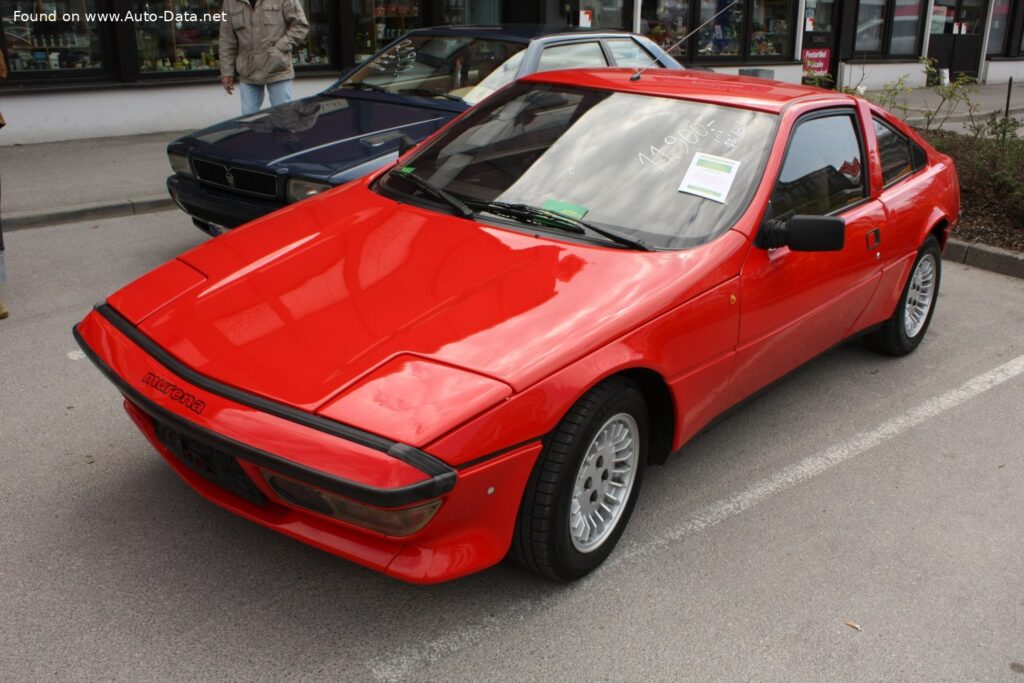
The Talbot Murena 1.6, produced between 1981 and 1985, stands as a distinctive, if often overlooked, chapter in the history of European sports coupes. Emerging from the complex lineage of the Talbot brand, which itself had been absorbed into the PSA Group (Peugeot S.A.), the Murena was a bold attempt to carve out a niche in the competitive mid-engine, two-plus-one seater market. As a direct successor to the Matra Bagheera, the Murena retained its predecessor’s unique three-abreast seating configuration, a design choice that set it apart from virtually all its rivals. While never officially imported to the United States, the Murena represented a fascinating blend of French engineering ingenuity and pragmatic design, offering a unique proposition to European enthusiasts seeking something beyond the conventional. Its primary market was undoubtedly Europe, where its innovative seating and spirited performance for its class garnered attention, particularly among those valuing individuality and agile handling over outright speed. This particular variant, the Talbot Murena 1.6 (90 Hp), served as the entry-level model, designed to offer an accessible gateway into the Murena’s distinctive driving experience.
The Genesis and Market Positioning of the Talbot Murena 1.6
The Murena’s story is deeply intertwined with Matra, a French engineering firm renowned for its aerospace and motorsports endeavors, which had a history of collaborating with automotive manufacturers. Following the demise of the Matra-Simca Bagheera, Matra approached Peugeot (which had acquired Chrysler Europe, including Simca and Talbot) to develop a successor. The result was the Murena, launched under the Talbot brand, reflecting the new corporate structure. Positioned as a compact, relatively affordable mid-engine sports coupe, the Murena aimed to combine practicality with performance. Its target audience in Europe comprised individuals looking for a sporty car that could also accommodate an occasional third passenger, thanks to its innovative interior layout. In an era dominated by front-engine, rear-wheel-drive coupes and the emerging popularity of hot hatches, the Murena offered a genuinely different proposition. Its mid-engine configuration promised superior weight distribution and handling characteristics, echoing the principles found in much more exotic and expensive sports cars. The 1.6-liter variant, with its 90 horsepower output, was conceived as the volume seller, providing an engaging driving experience without the higher running costs or insurance premiums associated with larger-engined models.
Powertrain and Performance: The Talbot Murena 1.6 (90 Hp)
At the heart of the entry-level Talbot Murena 1.6 was a naturally aspirated 1.6-liter (1592 cc) inline-four engine, a robust unit derived from the Simca/Talbot engine family. This powerplant delivered a respectable 90 horsepower, or 90 Hp, a figure that, while not earth-shattering by today’s standards, was entirely competitive for a lightweight European sports coupe in the early 1980s. The engine’s naturally aspirated nature meant a linear power delivery, encouraging drivers to explore the upper reaches of the RPM range to extract maximum performance. This characteristic contributed to an engaging driving experience, where driver involvement was paramount. The engine was transversely mounted in a mid-ship configuration, positioned just behind the passenger compartment and ahead of the rear axle. This layout was crucial to the Murena’s dynamic appeal, providing a near-ideal weight balance that greatly enhanced its handling and cornering capabilities. For a car of its class and price point, this mid-engine architecture was a significant differentiator, typically reserved for more high-performance or exotic machinery. The power was sent to the rear wheels through a five-speed manual transmission, offering precise shifts and allowing the driver to effectively manage the engine’s output. While official acceleration figures for the 1.6-liter model are not provided, contemporary road tests from its era suggested a 0-60 mph time in the low 10-second range, with a top speed approaching 110 mph – performance figures that were more than adequate for spirited driving on European roads and highways. The focus was less on raw straight-line speed and more on the car’s agility, responsiveness, and the tactile feedback it offered to the driver.
Design and Features of the Talbot Murena
The Talbot Murena’s design was a product of its time, characterized by a sharp, wedge-shaped profile that was fashionable in the early 1980s. Penned by Antoine Volanis, the Murena inherited the sleek, aerodynamic lines of its predecessor, the Bagheera, but with a more refined and modern aesthetic. Its coupe body type featured a low-slung silhouette, a steeply raked windshield, and a long, expansive rear glass hatch that provided excellent visibility and access to a surprisingly usable cargo area for a mid-engine car. The overall impression was one of dynamism and purpose, signaling its sporting intentions. One of the Murena’s most distinctive features, carried over from the Bagheera, was its unique three-abreast seating arrangement. Instead of the conventional two-seater or 2+2 layout, the Murena offered three individual seats in a single row, allowing three adults to sit comfortably side-by-side. This innovative solution provided a level of practicality unmatched by its direct competitors, offering an unusual blend of sports car dynamics with unexpected passenger capacity. This feature alone made the Murena a conversation starter and a highly practical choice for small families or groups of friends on short trips. Inside, the cabin reflected the functional design philosophy of the era. While not overtly luxurious, the materials were durable, and the ergonomics were generally well-considered. Instrumentation was clear and concise, providing the driver with all necessary information without distraction. Features for the early 1980s would have included basic heating and ventilation, manual windows, and a period-appropriate radio. Safety, for its time, would have comprised standard seatbelts and a relatively rigid passenger cell, benefiting from the inherent structural strength of a mid-engine chassis. The Murena’s design was not just about aesthetics; it was a testament to clever packaging and a willingness to challenge conventional automotive norms, creating a vehicle that was both visually striking and remarkably functional for its segment.
Technical Specifications: Talbot Murena 1.6 (90 Hp)
| Brand | Talbot |
| Model | Murena |
| Generation | Murena |
| Type (Engine) | 1.6 (90 Hp) |
| Start of production | 1981 year |
| End of production | 1985 year |
| Powertrain Architecture | Internal Combustion engine |
| Body type | Coupe |
| Fuel Type | Petrol (Gasoline) |
| Power | 90 Hp |
| Engine aspiration | Naturally aspirated engine |
