
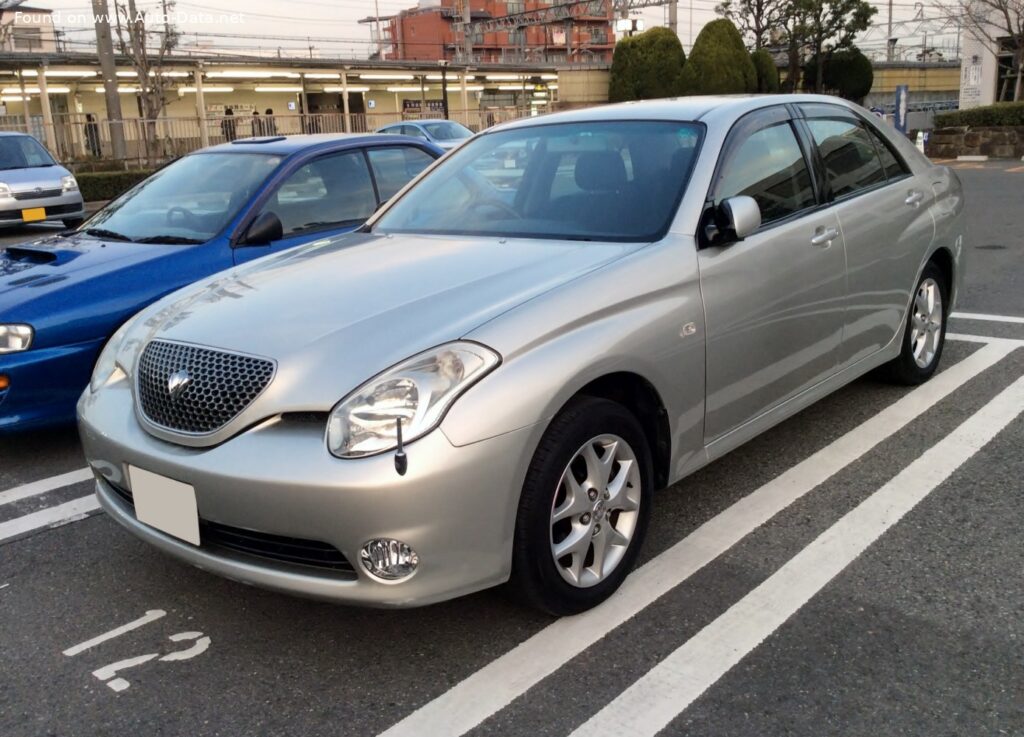
The Toyota Verossa, a distinctive and performance-oriented sedan, emerged from the Japanese Domestic Market (JDM) between 2001 and April 2004, representing a unique chapter in Toyota’s pursuit of blending luxury with sportiness. Positioned as a direct successor to the Cresta, it shared its robust JZX110 platform with the more conventional Mark II and the sportier Chaser, yet carved out its own niche with a polarizing, avant-garde design. The Verossa was conceived for a discerning Japanese clientele seeking a blend of executive comfort, advanced engineering, and exhilarating performance, particularly in its top-tier variant, the Toyota Verossa 2.5i 24V Turbo (280 Hp). This model epitomized Toyota’s engineering prowess, offering a potent turbocharged inline-six engine, a sophisticated rear-wheel-drive architecture, and a driving experience tailored for enthusiasts, all wrapped in a four-door sedan body style. While never officially exported to North America or Europe, the Verossa has garnered a cult following globally, appreciated for its robust mechanicals and unique aesthetic.
The Toyota Verossa: A Distinctive JDM Performance Sedan
The Verossa’s introduction in 2001 marked a significant design departure for Toyota within its mid-size luxury sedan lineup. Moving away from the more conservative styling of its predecessors and platform siblings, the Verossa adopted a fluid, almost organic aesthetic characterized by its distinctive front fascia, sweeping lines, and a somewhat controversial rear treatment. This design philosophy aimed to differentiate it from its stablemates, appealing to a younger, more style-conscious buyer who desired individuality without compromising on Toyota’s renowned reliability and engineering. As a four-door, five-seat sedan, it offered practical family usability alongside its performance credentials, making it a versatile choice within the Japanese market.
Built on the venerable JZX110 chassis, the Verossa benefited from a well-engineered foundation that was praised for its balance and rigidity. Its role in the market was to provide a premium, driver-focused experience, standing as a testament to Toyota’s capability in producing engaging rear-wheel-drive sedans. The production run, though relatively short from 2001 to 2004, solidified its status as a niche model, celebrated for its unique character rather than mass-market appeal. Its focus on performance and driver engagement, especially in the 2.5i 24V Turbo guise, underscored Toyota’s commitment to offering diverse options within its extensive model range, catering to specific market desires for a high-output, luxury-sport sedan.
Powertrain and Performance: The Heart of the Toyota Verossa 2.5i 24V Turbo
Engine & Performance
At the core of the Verossa’s appeal, particularly for enthusiasts, was its formidable powertrain. The Toyota Verossa 2.5i 24V Turbo variant was equipped with the legendary 1JZ-GTE engine, an inline-six masterpiece renowned for its durability, tunability, and smooth power delivery. This 2.5-liter (2492 cm3 or 152.07 cu. in.) engine featured a DOHC (Double Overhead Camshaft) valvetrain with 24 valves, ensuring optimal airflow and combustion efficiency. The heart of its performance lay in its sophisticated turbocharger system, complemented by an intercooler, which significantly boosted power output without excessive lag. Fuel delivery was managed by a precise multi-port manifold injection system, contributing to its impressive performance figures.
The 1JZ-GTE in the Verossa unleashed a potent 280 horsepower at 6200 rpm, a figure that was at the gentleman’s agreement limit for Japanese domestic market vehicles at the time. More impressively, it generated a robust 378 Nm (278.8 lb.-ft.) of torque at a remarkably low 2400 rpm. This early torque delivery provided excellent responsiveness and strong acceleration from virtually any speed, making for a highly engaging driving experience. The engine’s longitudinal, front-mounted layout and inline-six configuration contributed to the car’s balanced weight distribution and characteristic smooth operation. With a compression ratio of 9:1, the engine was optimized for forced induction, delivering consistent and reliable power.
Power was channeled to the rear wheels via a five-speed manual transmission, a choice that further emphasized the Verossa 2.5i 24V Turbo’s sporting intentions and driver focus. This rear-wheel-drive architecture is a hallmark of performance sedans, offering superior handling characteristics and a more involving driving feel. The vehicle’s kerb weight of 3373.07 lbs (1530 kg) resulted in an impressive weight-to-power ratio of 5.5 kg/Hp (183 Hp/tonne) and a weight-to-torque ratio of 4 kg/Nm (247.1 Nm/tonne), underscoring its ability to deliver brisk performance relative to its size. The engine oil capacity stood at 5.4 liters (5.71 US qt), with a coolant capacity of 7.7 liters (8.14 US qt), reflecting the robust cooling requirements of a high-performance turbocharged engine.
Design, Features, and Chassis Dynamics
Design & Features
The Toyota Verossa’s exterior design was arguably its most defining characteristic. While sharing its underlying platform with more conservatively styled siblings, the Verossa presented a bold and distinctive aesthetic. Its length of 185.24 inches (4705 mm), width of 69.29 inches (1760 mm), and height of 57.09 inches (1450 mm) gave it a substantial road presence. The generous 109.45-inch (2780 mm) wheelbase contributed to a spacious cabin for five occupants and enhanced ride stability. The design featured sleek, elongated headlights and a unique grille that flowed into the hood, creating a cohesive and somewhat futuristic look for its era. The four-door sedan body type ensured practical access and utility, balancing its performance aspirations with everyday usability.
Inside, the Verossa offered a refined and comfortable cabin, typical of Toyota’s attention to detail in its higher-end models. While specific interior features would vary by trim, the general focus was on ergonomic design, quality materials, and a driver-centric cockpit. Standard features for a vehicle of its class and time would have included automatic climate control, power windows and locks, and a premium audio system. Safety was also a consideration, with the inclusion of an Anti-lock Braking System (ABS) as a standard assisting system, providing enhanced control during emergency braking. The steering system was a responsive rack-and-pinion setup, complemented by hydraulic power steering for effortless maneuverability at low speeds and good feedback at higher velocities.
Chassis and Handling
The Verossa’s chassis dynamics were engineered to complement its powerful engine. Both the front and rear suspensions utilized a sophisticated double wishbone design. This configuration is highly regarded for its ability to maintain optimal tire contact with the road surface, providing superior handling, precise steering response, and a comfortable ride. The front track measured 58.86 inches (1495 mm) and the rear track was 5

