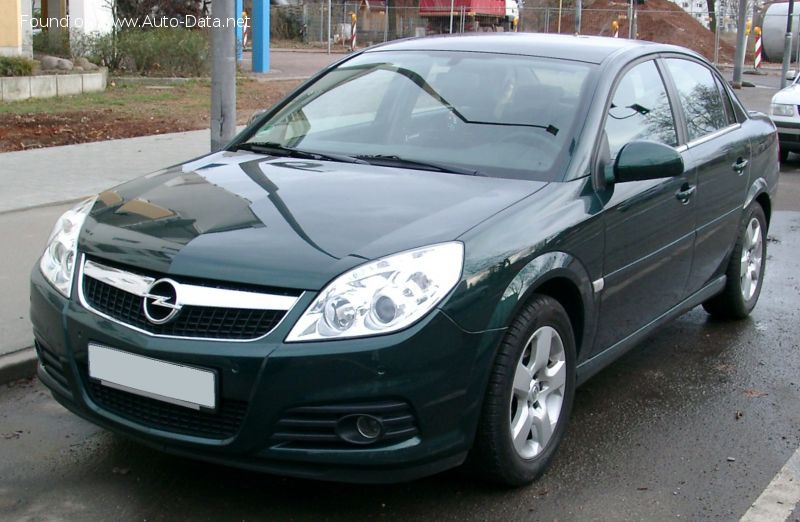
The Opel Vectra C, particularly the facelifted model introduced in July 2005, represented a significant contender in the highly competitive European D-segment, or mid-size car market. As a product of the German marque Opel, part of the General Motors family at the time, the Vectra C was designed to offer a blend of practicality, comfort, and dynamic performance to a broad European audience. The specific variant, the Opel Vectra C (facelift 2005) 2.8i V6 24V Turbo (230 Hp), stood out as a performance-oriented option within the lineup. Produced from July 2005 until October 2006, this particular iteration combined a powerful turbocharged V6 engine with a conventional four-door sedan body style, aiming to provide a spirited driving experience without sacrificing the utility expected from a family-oriented vehicle. While never officially sold in the United States, its engineering and market position offer insights into the European automotive landscape of the mid-2000s, showcasing General Motors’ global platform strategies.
Engine and Performance: The Opel Vectra C (facelift 2005) 2.8i V6 24V Turbo (230 Hp)
At the heart of this performance-focused Vectra C was a potent 2.8-liter (2792 cm3 or 170.38 cu. in.) V6 engine, designated with the model code Z28NEL. This robust powerplant was configured in a front, transverse layout, driving the front wheels through a sophisticated 6-speed manual transmission. What truly distinguished this engine was its advanced aspiration system, featuring a turbocharger complemented by an intercooler. This forced induction setup was instrumental in boosting the engine’s output to an impressive 230 horsepower at 5500 rpm, translating to a specific output of 82.4 HP per liter. Torque delivery was equally compelling, peaking at 330 Nm (243.4 lb.-ft.), providing a strong surge of acceleration across the rev range. The multi-port manifold injection system ensured precise fuel delivery, contributing to both performance and efficiency.
The performance figures for the Opel Vectra C (facelift 2005) 2.8i V6 24V Turbo (230 Hp) underscored its sporting intentions. It could accelerate from 0 to 60 mph in a swift 6.9 seconds, with a 0-100 km/h sprint completed in 7.3 seconds. The top speed was electronically limited to 250 km/h (155.34 mph), a common practice for high-performance German vehicles. Despite its power, Opel aimed for a reasonable balance with fuel economy, achieving a combined cycle consumption of 10.9 l/100 km, which translates to approximately 21.6 US mpg. Urban driving saw consumption at 15.4 l/100 km (15.3 US mpg), while extra-urban figures were more economical at 7.3 l/100 km (32.2 US mpg). These numbers, while not groundbreaking by modern standards, were competitive for a turbocharged V6 sedan of its era, especially considering its weight-to-power ratio of 6.5 kg/Hp (153.8 Hp/tonne) and a weight-to-torque ratio of 4.5 kg/Nm (220.7 Nm/tonne).
The engine’s internal architecture featured a compression ratio of 9.5:1, with six cylinders arranged in a V-configuration. Each cylinder was equipped with four valves, totaling 24 valves for optimal airflow and combustion efficiency. The cylinder bore measured 89 mm (3.5 in.) and the piston stroke was 74.8 mm (2.94 in.), indicating an oversquare design that generally favors higher engine speeds and power output. The engine oil capacity was 6 liters (6.34 US quarts), and the cooling system held 7.5 liters (7.93 US quarts) of coolant, ensuring proper thermal management for sustained performance.
Design and Features of the Opel Vectra C (facelift 2005)
The Opel Vectra C, in its facelifted 2005 iteration, presented a refined and contemporary aesthetic for the mid-2000s. As a four-door sedan accommodating five occupants, it maintained a conventional yet elegant profile. The facelift typically brought subtle but impactful changes to the exterior, including revised front fascia elements such as a redesigned grille, updated headlights, and restyled bumpers, lending the car a more assertive and modern appearance. Similar refinements were often applied to the rear lighting clusters and bumper design. These updates were crucial in keeping the Vectra competitive against rivals in a segment where visual appeal played a significant role in consumer choice.
Dimensionally, the Vectra C facelift measured 4611 mm (181.54 in.) in length, 1798 mm (70.79 in.) in width, and 1460 mm (57.48 in.) in height. Its wheelbase of 2700 mm (106.3 in.) contributed to a stable ride and a spacious interior, crucial for its role as a family or executive sedan. The front track was 1536 mm (60.47 in.) and the rear track was 1525 mm (60.04 in.), providing a confident stance on the road. The vehicle’s kerb weight stood at 1495 kg (3295.91 lbs.), with a maximum permissible weight of 2040 kg (4497.43 lbs.), allowing for a substantial maximum load of 545 kg (1201.52 lbs.).
Inside, the Vectra C was designed with practicality and comfort in mind. The sedan offered a generous trunk space of 500 liters (17.66 cu. ft.), making it highly suitable for luggage and cargo needs. The fuel tank capacity was 61 liters (16.11 US gallons), providing a decent cruising range. For ride and handling, the Vectra C utilized an independent coil spring suspension system for both the front and rear axles, a common and effective setup for balancing comfort and dynamic stability in this segment. Braking performance was handled by ventilated discs at both the front and rear, ensuring effective stopping power, further augmented by an Anti-lock Braking System (ABS) for enhanced safety during emergency maneuvers. The car rode on 215/55 R16 tires mounted on 16-inch wheel rims, a specification that offered a good compromise between ride comfort and road grip for everyday driving and spirited performance.
Technical Specifications
| Brand | Opel |
| Model | Vectra |
| Generation | Vectra C (facelift 2005) |
| Type (Engine) | 2.8i V6 24V Turbo (230 Hp) |
| Start of production | July, 2005 year |
| End of production | October, 2006 year |
| Powertrain Architecture | Internal Combustion engine |
| Body type | Sedan |
| Seats | 5 |
| Doors | 4 |
| Fuel consumption (economy) – urban | 15.4 l/100 km (15.3 US mpg) |
| Fuel consumption (economy) – extra urban | 7.3 l/100 km (32.2 US mpg) |
| Fuel consumption (economy) – combined | 10.9 l/100 km (21.6 US mpg) |
| Fuel Type | Petrol (Gasoline) |
| Acceleration 0 – 60 mph | 6.9 sec |
| Acceleration 0 – 100 km/h | 7.3 sec |
| Maximum speed | 250 km/h (155.34 mph) |
| Weight-to-power ratio | 6.5 kg/Hp (153.8 Hp/tonne) |
| Weight-to-torque ratio | 4.5 kg/Nm (220.7 Nm/tonne) |
| Power | 230 Hp @ 5500 rpm |
| Power per litre | 82.4 Hp/l |
| Torque | 330 Nm (243.4 lb.-ft.) |
| Engine layout | Front, Transverse |
| Engine Model/Code | Z28NEL |
| Engine displacement | 2792 cm3 (170.38 cu. in.) |
| Number of cylinders | 6 |
| Engine configuration | V-engine |
| Cylinder Bore | 89 mm (3.5 in.) |
| Piston Stroke | 74.8 mm (2.94 in.) |
| Compression ratio | 9.5:1 |
| Number of valves per cylinder | 4 |
| Fuel injection system | Multi-port manifold injection |
| Engine aspiration | Turbocharger, Intercooler |
| Engine oil capacity | 6 l (6.34 US qt) |
| Engine oil specification | Not specified |
| Coolant | 7.5 l (7.93 US qt) |
| Kerb Weight | 1495 kg (3295.91 lbs.) |
| Max. weight | 2040 kg (4497.43 lbs.) |
| Max load | 545 kg (1201.52 lbs.) |
| Trunk (boot) space – maximum | 500 l (17.66 cu. ft.) |
| Fuel tank capacity | 61 l (16.11 US gal) |
| Length | 4611 mm (181.54 in.) |
| Width | 1798 mm (70.79 in.) |
| Height | 1460 mm (57.48 in.) |
| Wheelbase | 2700 mm (106.3 in.) |
| Front track | 1536 mm (60.47 in.) |
| Rear (Back) track | 1525 mm (60.04 in.) |
| Drivetrain Architecture | The Internal combustion engine (ICE) drives the front wheels of the vehicle. |
| Drive wheel | Front wheel drive |
| Number of gears and type of gearbox | 6 gears, manual transmission |
| Front suspension | Independent coil spring |
| Rear suspension | Independent coil spring |
| Front brakes | Ventilated discs |
| Rear brakes | Ventilated discs |
| Assisting systems | ABS (Anti-lock braking system) |
| Tires size | 215/55 R16 |
| Wheel rims size | 16 |