
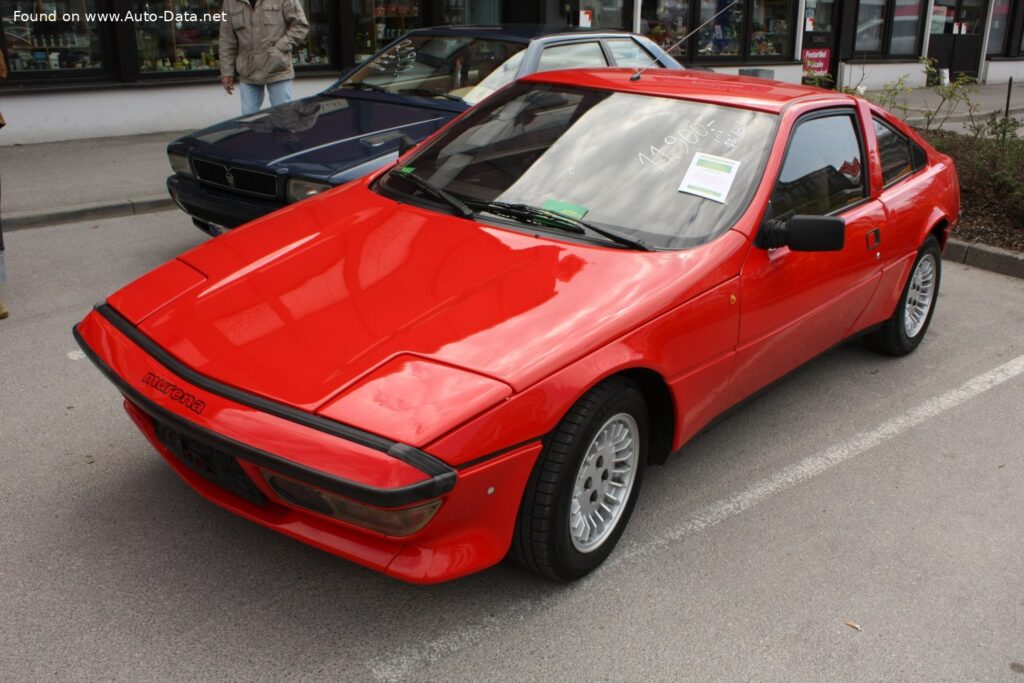
The Talbot Murena 2.1 (116 Hp) stands as a fascinating, albeit often overlooked, chapter in the history of European sports cars. Produced by the French marque Talbot from 1980 to 1984, the Murena was a distinctive mid-engined coupe that aimed to blend spirited performance with practical usability. Developed under the Matra-Simca banner before the brand transitioned to Talbot, the Murena represented an evolution of its predecessor, the Matra Bagheera, inheriting its unique three-abreast seating configuration and innovative fiberglass body construction. Primarily targeting the European market, where it competed with more established sports coupes, the Murena 2.1 offered a compelling package for enthusiasts seeking something beyond the conventional. Its relatively short production run and limited availability outside of its primary markets have cemented its status as a niche classic, admired for its engineering ingenuity and distinctive character.
The Genesis and Vision of the Talbot Murena
The Murena’s lineage traces back to the collaborative efforts between Simca and Matra, a French engineering firm renowned for its aerospace and motorsports endeavors. Following the success of the Matra Bagheera, a groundbreaking three-seater sports car, its successor was envisioned to refine the concept with improved power, reliability, and modern aesthetics. When Chrysler Europe, which owned Simca, was acquired by PSA Peugeot Citroën in 1978, the Simca and Matra brands were absorbed into the newly formed Talbot marque. Thus, the Bagheera’s successor, initially developed as the M550, became the Talbot Murena. Launched in 1980, the Murena entered a competitive European market, aiming to carve out a niche against rivals like the Porsche 924 and the Alfa Romeo GTV. Its appeal lay in its unconventional approach to sports car design, offering a unique blend of exotic looks, accessible performance, and a surprisingly spacious interior for a mid-engined vehicle. The Murena was a testament to Matra’s engineering philosophy, prioritizing lightweight construction and innovative packaging to deliver an engaging driving experience.
Engineering and Performance: The Heart of the Talbot Murena 2.1 (116 Hp)
At the core of the Talbot Murena 2.1 (116 Hp) was a robust and well-proven internal combustion engine, specifically a naturally aspirated, four-cylinder unit derived from the venerable Simca Poissy engine family. For the 2.1-liter variant, Matra engineers significantly enhanced the engine’s displacement and output, delivering a respectable 116 horsepower. This power output, combined with the Murena’s lightweight fiberglass body and mid-engine configuration, provided a lively and engaging driving experience for its era. The engine’s natural aspiration contributed to a linear power delivery and a satisfying exhaust note, characteristic of European sports cars of the early 1980s. Fueling the Murena was standard gasoline, making it practical for everyday use. While 116 horsepower might seem modest by today’s standards, it was more than adequate to propel the Murena with spirited acceleration and capable cruising speeds, particularly on the winding roads for which it was designed. The mid-engine layout also contributed significantly to the car’s balanced handling dynamics, offering excellent weight distribution and a low center of gravity. This setup, often reserved for much more expensive sports cars, made the Murena an intriguing proposition for enthusiasts seeking genuine sports car characteristics without the premium price tag.
Distinctive Design and Innovative Features of the Talbot Murena
The Murena’s design was unmistakably a product of the early 1980s, characterized by its wedge-shaped profile, pop-up headlights, and a sleek, aerodynamic silhouette. As a classic coupe body type, it exuded a sense of sportiness and modernity. However, its most striking feature, inherited from the Bagheera, was its unique three-abreast seating arrangement. Unlike conventional 2+2 configurations, the Murena offered three full-size seats in a single row, providing a genuinely sociable interior for its occupants. This innovative layout was a masterstroke in packaging, maximizing interior space within a relatively compact footprint. The body itself was constructed from polyester resin and fiberglass panels, bonded to a galvanized steel chassis. This advanced construction technique for the time offered several advantages, including excellent corrosion resistance, reduced weight, and design flexibility. The fiberglass body was not only lightweight but also allowed for complex curves and surfaces, contributing to the Murena’s distinctive visual appeal. Inside, the cabin was driver-focused, with a comprehensive instrument panel and controls ergonomically arranged. The emphasis was on a comfortable yet sporty environment, reflecting its dual purpose as a daily driver and a weekend enthusiast’s car. Suspension tuning was optimized for a blend of ride comfort and agile handling, making it a joy on both long journeys and challenging backroads. The Murena represented a bold statement in automotive design, prioritizing innovation and passenger comfort without compromising its sporting credentials.
Legacy and Enduring Appeal of the Talbot Murena
The Talbot Murena’s production run, spanning from 1980 to 1984, was relatively brief, a victim of the broader automotive industry’s consolidation and the challenges faced by the Talbot brand itself. Despite its innovative design and commendable performance, the Murena never achieved the widespread commercial success of some of its rivals. However, its limited numbers and distinctive characteristics have ensured its place as a cult classic among automotive enthusiasts, particularly in Europe. Today, the Murena is celebrated for its forward-thinking engineering, its unique three-seater configuration, and its resilient fiberglass bodywork, which has proven to be remarkably rust-proof compared to many of its contemporaries. It represents a fascinating period in French automotive history, showcasing Matra’s ability to push boundaries and create truly original vehicles. Collectors and fans appreciate the Murena for its engaging driving dynamics, its rarity, and its undeniable charm. It serves as a reminder of a time when manufacturers were willing to experiment with unconventional layouts and materials, resulting in cars that offered a truly distinct driving and ownership experience. The Talbot Murena 2.1 (116 Hp) remains a testament to ingenuity, a car that, while not a sales phenomenon, left an indelible mark on the landscape of European sports car design.
Technical Specifications: Talbot Murena 2.1 (116 Hp)
| Brand | Talbot |
| Model | Murena |
| Generation | Murena |
| Type (Engine) | 2.1 (116 Hp) |
| Start of production | 1980 year |
| End of production | 1984 year |
| Powertrain Architecture | Internal Combustion engine |
| Body type | Coupe |
| Fuel Type | Petrol (Gasoline) |
| Power | 116 Hp |
| Engine aspiration | Naturally aspirated engine |
| What is the body type, Talbot Murena? | Coupe |
| How much power, Talbot Murena Coupe 1980 2.1 (116 Hp)? | 116 Hp |
| What is the drivetrain, Talbot Murena Coupe 1980 2.1 (116 Hp)? | Internal Combustion engine |
