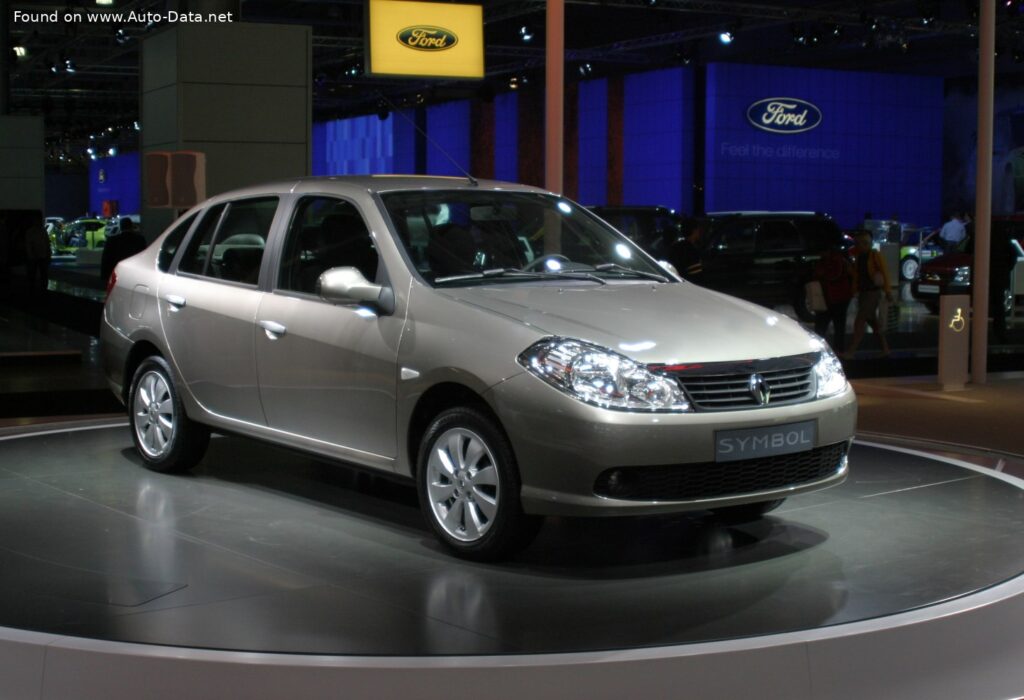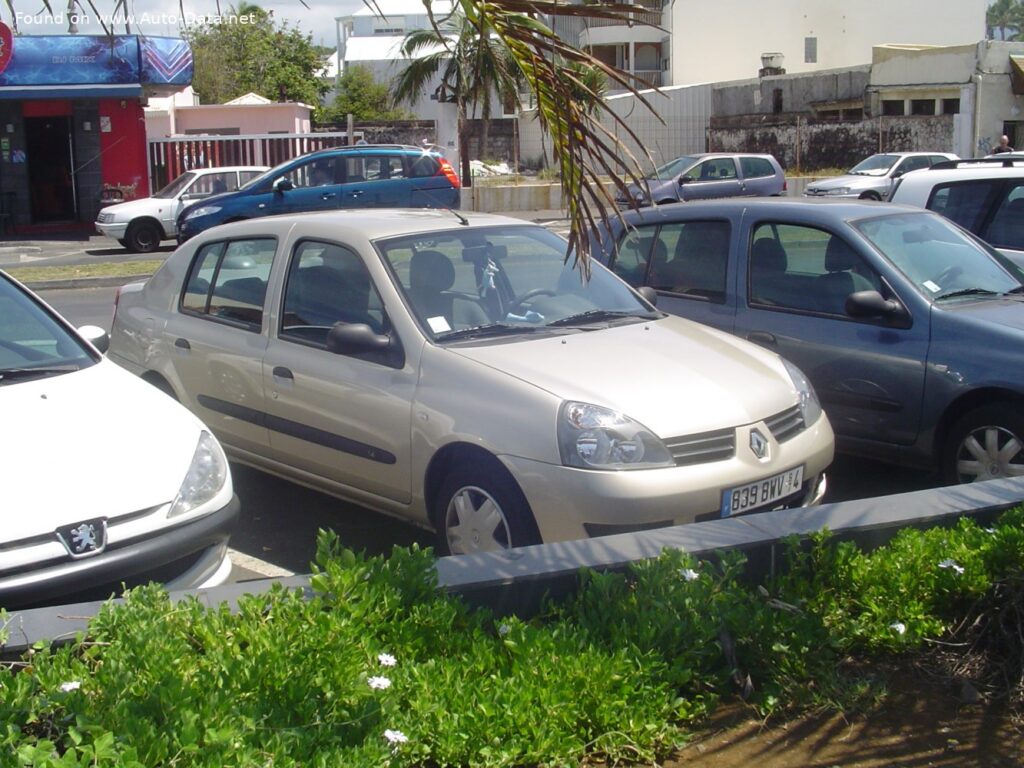
The Renault Symbol I (facelift 2002) 1.6 i 16V (107 Hp) represents a significant offering from the French automaker, Renault, specifically targeting emerging markets and countries where compact sedans are highly valued for their practicality, affordability, and robust design. While never officially imported or sold in the United States, this vehicle played a crucial role in Renault’s strategy to provide a sedan alternative to its popular Clio hatchback in regions like Eastern Europe, Latin America, and parts of Asia and Africa. The Symbol, also known as the Clio Sedan or Thalia in various markets, was essentially a three-box derivative of the second-generation Clio, offering a larger trunk capacity and a more traditional sedan profile preferred by many families and taxi operators in its primary markets. The 2002 facelift introduced a refreshed aesthetic and updated technical specifications, enhancing its appeal and extending its production run through 2008, solidifying its position as a reliable and economical choice.
Engine and Performance: The Heart of the Renault Symbol I (facelift 2002)
At the core of the Renault Symbol I (facelift 2002) 1.6 i 16V (107 Hp) lies a capable and widely utilized powertrain, renowned for its balance of efficiency and spirited performance for a vehicle in its class. This particular variant is equipped with Renault’s K4M 740 engine, a naturally aspirated 1.6-liter (1598 cm3 or 97.52 cu. in.) inline four-cylinder unit. Designed with a Double Overhead Camshaft (DOHC) valvetrain and four valves per cylinder, this engine optimizes airflow for better combustion and efficiency. Fuel delivery is managed by a multi-port manifold injection system, ensuring precise fuel metering across the rev range. With a compression ratio of 10:1, the engine produces a respectable 107 horsepower at 5750 rpm, translating to a power output of approximately 67 horsepower per liter, which is quite competitive for a non-turbocharged engine of its era.
Dynamics and Efficiency of the Renault Symbol I (facelift 2002)
The performance characteristics of the Renault Symbol I (facelift 2002) 1.6 i 16V (107 Hp) are well-suited for both urban commuting and longer highway journeys. The engine generates 148 Nm of torque, equivalent to 109.16 lb.-ft., peaking at a relatively low 3750 rpm. This ample torque at mid-range revolutions contributes to responsive acceleration and reduced need for frequent downshifts, particularly useful in city traffic or when carrying a full load. Power is delivered to the front wheels via a smooth-shifting 5-speed manual transmission, a common and reliable setup for vehicles in this segment. This drivetrain architecture, where the internal combustion engine drives the front wheels, is lauded for its packaging efficiency and predictable handling.
In terms of outright speed, the Symbol 1.6 i 16V can accelerate from 0 to 60 mph in a brisk 9.4 seconds, and reach a maximum speed of 118.68 mph (191 km/h). These figures demonstrate that despite its utilitarian purpose, the car offers sufficient performance for confident overtaking and comfortable highway cruising. Fuel economy is another strong suit, with urban consumption rated at 9.9 liters per 100 km (23.8 US mpg) and an impressive extra-urban figure of 5.6 liters per 100 km (42 US mpg). These efficiency numbers were key selling points in markets where fuel costs are a significant consideration for consumers. The vehicle’s relatively light curb weight of 2116.44 lbs (960 kg) contributes positively to both its performance and fuel economy, resulting in a favorable weight-to-power ratio of 9 kg per horsepower and a weight-to-torque ratio of 6.5 kg per Newton-meter.
Design and Features: Practicality Meets Refinement
The Renault Symbol I (facelift 2002) maintained the core design philosophy of its predecessor while introducing subtle yet impactful updates to keep it contemporary. As a 4-door sedan with seating for five, its design prioritized interior space and a substantial trunk capacity over purely aesthetic flair. The facelift typically brought revised front and rear bumpers, updated headlamp and taillamp designs, and a refreshed grille, aligning its appearance more closely with Renault’s evolving design language of the early 2000s. These changes aimed to give the Symbol a more modern and upscale presence without compromising its inherent practicality.
Dimensions, Comfort, and Safety
Measuring 164.21 inches (4171 mm) in length, 64.53 inches (1639 mm) in width, and 56.57 inches (1437 mm) in height, with a wheelbase of 97.32 inches (2472 mm), the Symbol I offered a compact footprint that was easy to maneuver in congested urban environments. Despite its modest exterior dimensions, the interior was thoughtfully designed to accommodate five occupants comfortably, reflecting its role as a family-oriented vehicle. One of its most compelling features was its cavernous trunk space, offering a minimum of 18.01 cu. ft. (510 liters), which was exceptionally generous for a car of its size and a primary reason for its popularity among families and commercial users.
The chassis and suspension setup were engineered for comfort and durability, featuring coil springs at both the front and rear. This configuration provided a compliant ride quality, capable of absorbing imperfections on varied road surfaces often found in its target markets. Braking performance was handled by ventilated discs at the front, offering effective stopping power, complemented by drum brakes at the rear. For enhanced safety, the Symbol I (facelift 2002) was equipped with ABS (Anti-lock Braking System), a crucial safety feature that prevents wheel lock-up during hard braking, allowing the driver to maintain steering control. The steering system utilized a hydraulic rack and pinion setup, providing direct feedback and assisting the driver with effortless maneuvering. The vehicle rode on 185/60 R14 tires mounted on 14-inch wheel rims, a practical choice offering a good balance of grip, comfort, and replacement cost. The fuel tank capacity of 13.21 US gallons (50 liters) ensured a respectable cruising range, further enhancing its appeal as a practical and economical choice.
Technical Specifications: Renault Symbol I (facelift 2002) 1.6 i 16V (107 Hp)
| Brand | Renault |
| Model | Symbol |
| Generation | Symbol I (facelift 2002) |
| Type (Engine) | 1.6 i 16V (107 Hp) |
| Start of production | 2002 year |
| End of production | 2008 year |
| Powertrain Architecture | Internal Combustion engine |
| Body type | Sedan |
| Seats | 5 |
| Doors | 4 |
| Fuel consumption (economy) – urban | 9.9 l/100 km (23.8 US mpg) |
| Fuel consumption (economy) – extra urban | 5.6 l/100 km (42 US mpg) |
| Fuel Type | Petrol (Gasoline) |
| Acceleration 0 – 100 km/h | 9.9 sec |
| Acceleration 0 – 62 mph | 9.9 sec |
| Acceleration 0 – 60 mph (Calculated) | 9.4 sec |
| Maximum speed | 191 km/h (118.68 mph) |
| Weight-to-power ratio | 9 kg/Hp, 111.5 Hp/tonne |
| Weight-to-torque ratio | 6.5 kg/Nm, 154.2 Nm/tonne |
| Power | 107 Hp @ 5750 rpm. |
| Power per litre | 67 Hp/l |
| Torque | 148 Nm @ 3750 rpm. (109.16 lb.-ft. @ 3750 rpm.) |
| Engine layout | Front, Transverse |
| Engine Model/Code | K4M 740 |
| Engine displacement | 1598 cm3 (97.52 cu. in.) |
| Number of cylinders | 4 |
| Engine configuration | Inline |
| Cylinder Bore | 79.5 mm (3.13 in.) |
| Piston Stroke | 80.5 mm (3.17 in.) |
| Compression ratio | 10:1 |
| Number of valves per cylinder | 4 |
| Fuel injection system | Multi-port manifold injection |
| Engine aspiration | Naturally aspirated engine |
| Valvetrain | DOHC |
| Engine oil capacity | 4.85 l (5.12 US qt) |
| Coolant | 5.7 l (6.02 US qt) |
| Kerb Weight | 960 kg (2116.44 lbs.) |
| Max. weight | 1485 kg (3273.86 lbs.) |
| Max load | 525 kg (1157.43 lbs.) |
| Trunk (boot) space – minimum | 510 l (18.01 cu. ft.) |
| Fuel tank capacity | 50 l (13.21 US gal) |
| Length | 4171 mm (164.21 in.) |
| Width | 1639 mm (64.53 in.) |
| Height | 1437 mm (56.57 in.) |
| Wheelbase | 2472 mm (97.32 in.) |
| Front track | 1406 mm (55.35 in.) |
| Rear (Back) track | 1386 mm (54.57 in.) |
| Drivetrain Architecture | The Internal combustion engine (ICE) drives the front wheels of the vehicle. |
| Drive wheel | Front wheel drive |
| Number of gears and type of gearbox | 5 gears, manual transmission |
| Front suspension | Coil spring |
| Rear suspension | Coil spring |
| Front brakes | Ventilated discs |
| Rear brakes | Drum |
| Assisting systems | ABS (Anti-lock braking system) |
| Steering type | Steering rack and pinion |
| Power steering | Hydraulic Steering |
| Tires size | 185/60 R14 |
| Wheel rims size | 14 |