
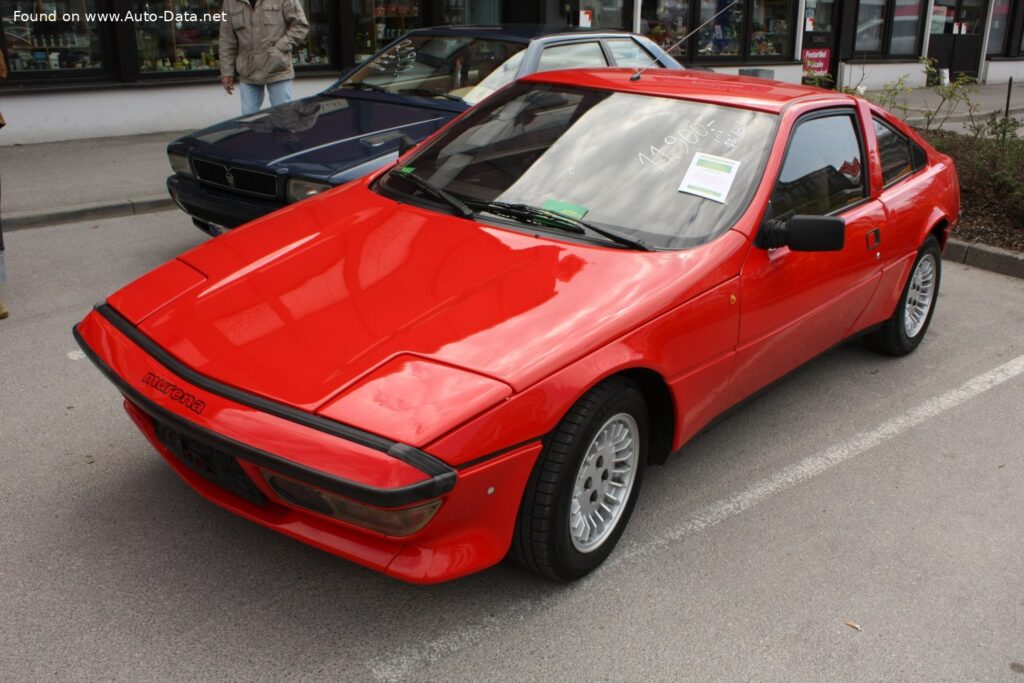
The Talbot Murena 2.1 S (140 Hp) stands as a distinctive and often overlooked European sports coupe from the early 1980s, representing a unique chapter in automotive history. Born from the collaboration between Peugeot, Citroën, and the remnants of the Simca and Matra brands under the PSA Group, the Murena was a successor to the innovative Matra Bagheera. Primarily intended for the European market, where it carved out a niche for accessible, mid-engined performance, the Murena never saw official importation into the United States, cementing its status as an intriguing foreign classic for American enthusiasts. Produced for a relatively brief period between 1983 and 1985, this particular 2.1 S variant represented the pinnacle of the Murena’s performance offerings, combining a potent naturally aspirated engine with a lightweight, aerodynamically efficient body and a chassis optimized for dynamic driving. Its unique design philosophy, including a groundbreaking three-abreast seating arrangement, set it apart from its contemporaries and contributed to its enduring cult status among collectors and automotive historians.
The Talbot Murena: A Mid-Engined European Enigma
The Talbot Murena emerged into a European automotive landscape that was rapidly evolving, yet still held a place for niche sports cars that prioritized driving engagement over outright luxury or brute force. As the spiritual successor to the Matra Bagheera, the Murena inherited Matra’s innovative approach to sports car design, particularly its commitment to a mid-engine layout. This configuration, placing the engine between the driver and the rear axle, is renowned for providing superior weight distribution, enhanced handling balance, and a more direct connection to the road—qualities highly prized by driving enthusiasts. While the “Talbot” badge signaled its integration into the broader PSA Peugeot Citroën empire, the Murena’s engineering and design ethos remained distinctly Matra, a company with a rich heritage in motorsport and composite materials technology. The Murena was developed with a focus on delivering an engaging driving experience at a competitive price point, positioning it against more conventional front-engine, rear-wheel-drive coupes and roadsters of its era.
Beyond its mechanical underpinnings, the Murena’s most striking and unconventional feature was its interior layout. Echoing its Bagheera predecessor, the Murena offered a three-abreast seating arrangement, with three individual bucket seats across the cabin. This unique configuration provided a surprisingly versatile interior for a compact sports coupe, allowing for three occupants to travel in comfort, a rarity in its class. This innovative approach to passenger accommodation underscored Matra’s philosophy of blending practicality with performance, challenging traditional sports car norms. The Murena’s production run was relatively short, a characteristic often seen with specialized vehicles from smaller manufacturers or divisions within larger conglomerates. Its limited numbers contribute to its appeal today as a rare and distinctive classic, a testament to a period when European manufacturers dared to experiment with unconventional designs and engineering solutions.
Powertrain and Performance of the Murena 2.1 S
At the heart of the Talbot Murena 2.1 S (140 Hp) was a robust and eager internal combustion engine, specifically a highly tuned variant of the larger 2.2-liter ‘Type 2’ engine family that powered several other Talbot and Simca models. For the 2.1 S, this naturally aspirated gasoline (petrol) engine was optimized for spirited performance, delivering a respectable 140 horsepower. This power output, especially in a lightweight chassis, translated into a lively and engaging driving experience, characteristic of European sports coupes of the early 1980s. The engine’s natural aspiration meant a linear power delivery, free from the lag associated with early turbochargers, providing a direct and predictable response to throttle inputs. This characteristic was particularly appreciated by drivers seeking a pure connection with their vehicle.
The mid-engine powertrain architecture was fundamental to the Murena’s dynamic capabilities. By centralizing the mass of the engine within the wheelbase, the Murena achieved an ideal weight distribution, significantly reducing polar moment of inertia. This engineering choice resulted in exceptional handling balance, sharp turn-in, and predictable cornering behavior, making the Murena a joy to drive on winding roads. Power was transmitted to the rear wheels, a classic sports car setup that further enhanced the car’s dynamic appeal and driver engagement. The combination of a powerful, free-revving engine and a finely balanced chassis made the 2.1 S variant a formidable performer for its time, capable of holding its own against more expensive and established sports cars. The Murena’s performance was not just about raw speed but also about the tactile feedback and sensory experience it offered, a hallmark of well-engineered enthusiast vehicles.
Design and Engineering Philosophy
The design of the Talbot Murena was a harmonious blend of aerodynamic efficiency and distinctive European styling. As a coupe, its sleek, wedge-shaped profile was characteristic of sports car aesthetics in the late 1970s and early 1980s, but with a unique Matra flair. The bodywork was crafted from a fiberglass composite material, mounted over a galvanized steel chassis. This innovative construction method offered several key advantages: superior resistance to corrosion, a common issue with steel-bodied cars of the era, and a reduction in overall vehicle weight, which contributed directly to the Murena’s agile performance and fuel efficiency. The smooth lines and integrated bumpers gave the Murena a modern and cohesive appearance, eschewing overt ornamentation in favor of functional elegance.
Inside, the Murena continued its theme of thoughtful engineering. The aforementioned three-abreast seating arrangement was not merely a gimmick but a practical solution for a compact sports car, offering surprising interior space and versatility. The cabin was designed with the driver in mind, featuring a clear and comprehensive instrument cluster, ergonomically placed controls, and supportive sport seats. While not opulent, the interior materials and finish were appropriate for its market segment, prioritizing durability and functionality. The large glass area, including a panoramic rear window, provided excellent visibility, a crucial safety and comfort feature. The Murena’s engineering extended to its suspension system, which was tuned to provide a comfortable ride for daily use while maintaining the necessary stiffness for spirited driving. This balance made the Murena a versatile sports car, capable of both touring and enthusiastic weekend drives. Its innovative construction and driver-focused design cemented its place as a technically interesting and aesthetically pleasing classic.
Legacy and Collectibility of the Talbot Murena
Despite its relatively short production run and limited exposure outside of Europe, the Talbot Murena 2.1 S (140 Hp) has cultivated a dedicated following and a significant legacy. It stands as a testament to Matra’s engineering prowess and willingness to challenge automotive conventions, even under the corporate umbrella of Talbot. The Murena represents one of the last truly unique and unconventional European sports cars before market consolidation and increasing regulatory pressures led to more standardized designs. Its mid-engine layout, composite body construction, and distinctive three-abreast seating make it an anomaly, ensuring its place in automotive history as a vehicle that dared to be different.
For collectors and enthusiasts today, the Murena holds a particular appeal. Its rarity, combined with its engaging driving dynamics and unique features, makes it a desirable classic. Owning a Murena is not just about possessing a vintage sports car; it’s about owning a piece of European automotive eccentricity and innovation. While parts availability can be a consideration for such a niche vehicle, the passionate community surrounding the Murena ensures that these cars are preserved and enjoyed. The 2.1 S, as the most powerful and refined variant, is particularly sought after, representing the zenith of the Murena’s development. It embodies a period when creativity and engineering daring were still celebrated, making the Talbot Murena a captivating and rewarding car for those who appreciate its distinctive character and technical ingenuity.
Technical Specifications: Talbot Murena 2.1 S (140 Hp)
| Brand | Talbot |
| Model | Murena |
| Generation | Murena |
| Type (Engine) | 2.1 S (140 Hp) |
| Start of Production | 1983 year |
| End of Production | 1985 year |
| Powertrain Architecture | Internal Combustion engine |
| Body Type | Coupe |
| Fuel Type | Petrol (Gasoline) |
| Power | 140 Hp |
| Engine Aspiration | Naturally aspirated engine |
