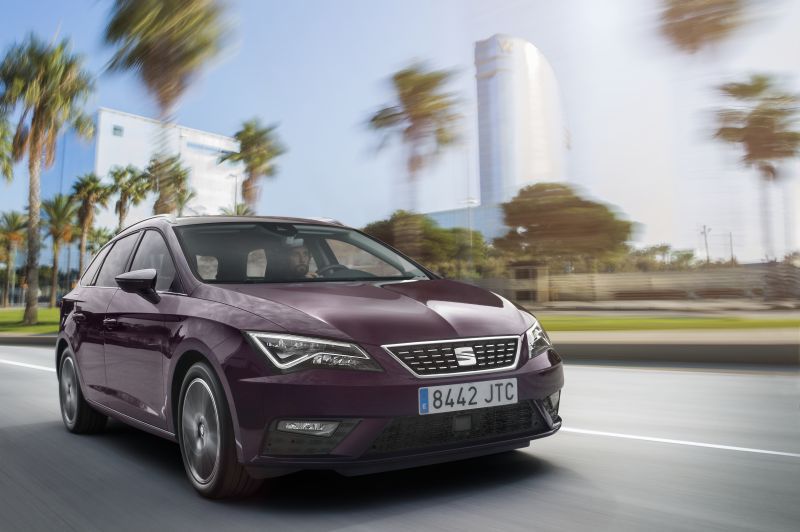
The automotive landscape in Europe is characterized by a diverse range of vehicles that prioritize efficiency, practicality, and dynamic driving characteristics, often tailored to specific regional preferences and infrastructure. Among these, the SEAT Leon stands out as a key player in the compact segment, offering a sportier alternative within the Volkswagen Group’s extensive portfolio. The Seat Leon III ST (facelift 2016) 1.5 EcoTSI (150 Hp) represents a compelling blend of family-friendly utility and spirited performance, specifically designed for the European market where station wagons, or estates as they are known, continue to command significant popularity. This particular iteration, produced between 2018 and 2020, benefited from a mid-cycle refresh that enhanced its aesthetic appeal and integrated updated powertrain technology, making it a highly relevant contender for buyers seeking a versatile and engaging daily driver without venturing into the premium segment.
Engine & Performance: The 1.5 EcoTSI Powertrain in the Seat Leon III ST (facelift 2016) 1.5 EcoTSI (150 Hp)
At the heart of the Seat Leon III ST (facelift 2016) 1.5 EcoTSI (150 Hp) lies a sophisticated 1.5-liter EcoTSI turbocharged gasoline engine, identified by the EA211evo / DADA, DPCA engine codes. This direct-injection, inline four-cylinder unit is a testament to modern engineering, designed to deliver an optimal balance of power, fuel efficiency, and reduced emissions. With an exact displacement of 1498 cubic centimeters (91.41 cubic inches), the engine generates a robust 150 horsepower, available across a broad rev range from 5000 to 6000 rpm. This impressive power output for its size translates to a power-per-liter ratio of 100.1 horsepower per liter, indicating a highly efficient engine design.
Equally critical for real-world driving dynamics is the engine’s torque output. The 1.5 EcoTSI produces 250 Newton-meters (184.39 pound-feet) of torque, accessible from a low 1500 rpm and sustained up to 3500 rpm. This wide torque band ensures strong pulling power from low speeds, making the vehicle feel responsive and effortless in urban driving and when overtaking on highways. The engine’s front, transverse layout drives the front wheels, channeling power through a precise 6-speed manual transmission, offering an engaging driving experience for those who prefer full control over gear changes.
Performance figures for the Leon ST are competitive within its class. The vehicle can accelerate from 0 to 60 mph in a swift 7.8 seconds, with a 0 to 100 km/h sprint completed in 8.2 seconds. Its maximum speed reaches 214 km/h (132.97 mph), demonstrating its capability for sustained high-speed cruising on European autobahns. Fuel efficiency is a strong suit for the EcoTSI engine. In urban driving, it achieves an economy of 36.2 – 35.1 US mpg (6.5-6.7 l/100 km). On extra-urban cycles, it excels with 54.7 – 52.3 US mpg (4.3-4.5 l/100 km), while the combined cycle yields an impressive 46.1 – 44.4 US mpg (5.1-5.3 l/100 km). These figures underscore SEAT’s commitment to economical operation, further enhanced by a sophisticated fuel injection system, turbocharger with intercooler, and a particulate filter to meet strict Euro 6 AG emission standards, with CO2 emissions ranging from 117-120 g/km.
The engine’s design features a cylinder bore of 74.5 mm (2.93 inches) and a piston stroke of 85.9 mm (3.38 inches), with a compression ratio of 10.5:1. Each cylinder utilizes four valves, maximizing volumetric efficiency. With an engine oil capacity of 4.3 liters (4.54 US quarts) and a coolant capacity of 8 liters (8.45 US quarts), maintenance is straightforward. The inclusion of a particulate filter highlights its advanced emissions control, making it a responsible choice for environmentally conscious drivers.
Design & Features: Practicality Meets Style
The Seat Leon III ST (facelift 2016) 1.5 EcoTSI (150 Hp) embodies the quintessential European station wagon, balancing sleek aesthetics with exceptional utility. With its five-door, five-seat configuration, it caters directly to families and individuals requiring significant cargo capacity without sacrificing dynamic styling. The facelift introduced subtle but effective design enhancements, typically involving revised bumpers, updated lighting signatures (often with LED technology), and new wheel designs, all contributing to a sharper and more contemporary look that aligns with SEAT’s youthful brand identity.
Measuring 4548 mm (179.06 inches) in length, 1816 mm (71.5 inches) in width (1975 mm or 77.76 inches including mirrors), and 1439 mm (56.65 inches) in height, the Leon ST maintains a compact footprint that is ideal for navigating crowded European city streets and parking in tight spaces. Despite its relatively modest exterior dimensions, the interior is remarkably spacious. The wheelbase of 2634 mm (103.7 inches) contributes to a stable ride and generous passenger room, particularly for rear occupants. The trunk (boot) space is a standout feature, offering a minimum of 587 liters (20.73 cubic feet) with the rear seats up, expanding to a cavernous 1470 liters (51.91 cubic feet) when the rear seats are folded down. This impressive cargo volume makes it highly versatile for everything from weekly grocery runs to extended road trips with luggage.
Underneath its stylish exterior, the Leon ST is engineered for a comfortable and controlled ride. The front suspension features an independent McPherson type, known for its excellent balance of handling and ride quality. The rear suspension utilizes a semi-independent, coil spring setup, which is cost-effective and space-efficient, contributing to the generous cargo area. Braking performance is assured by ventilated discs measuring 288 mm at the front and solid discs of 272 mm at the rear, complemented by an Anti-lock Braking System (ABS) for enhanced safety. The vehicle rides on 225/40 R18 92Y tires mounted on 7.5J x 18 wheel rims, providing ample grip and a sporty stance.
Driver assistance and comfort features are also well-integrated. The steering system employs an electric power steering rack and pinion, offering precise control and ease of maneuvering, especially in urban environments, with a minimum turning circle of 10.3 meters (33.79 feet). With a curb weight of 1200 kg (2645.55 lbs) and a maximum permissible weight of 1840 kg (4056.51 lbs), the Leon ST is a relatively light vehicle for its class, contributing to its agile handling and fuel efficiency. It also boasts practical considerations like a 50-liter (13.21 US gallon) fuel tank, a maximum roof load of 75 kg (165.35 lbs), and a permitted trailer load with brakes of 1500 kg (3306.93 lbs), further solidifying its credentials as a highly capable and practical family vehicle for the European market.
Technical Specifications
| Brand | Seat |
| Model | Leon |
| Generation | Leon III ST (facelift 2016) |
| Type (Engine) | 1.5 EcoTSI (150 Hp) |
| Start of production | 2018 year |
| End of production | 2020 year |
| Powertrain Architecture | Internal Combustion engine |
| Body type | Station wagon (estate) |
| Seats | 5 |
| Doors | 5 |
| Fuel consumption (economy) – urban | 6.5-6.7 l/100 km (36.2 – 35.1 US mpg) |
| Fuel consumption (economy) – extra urban | 4.3-4.5 l/100 km (54.7 – 52.3 US mpg) |
| Fuel consumption (economy) – combined | 5.1-5.3 l/100 km (46.1 – 44.4 US mpg) |
| CO2 emissions | 117-120 g/km |
| Fuel Type | Petrol (Gasoline) |
| Acceleration 0 – 60 mph | 7.8 sec |
| Acceleration 0 – 100 km/h | 8.2 sec |
| Maximum speed | 214 km/h (132.97 mph) |
| Emission standard | Euro 6 AG |
| Weight-to-power ratio | 8 kg/Hp (125 Hp/tonne) |
| Weight-to-torque ratio | 4.8 kg/Nm (208.3 Nm/tonne) |
| Power | 150 Hp @ 5000-6000 rpm |
| Power per liter | 100.1 Hp/l |
| Torque | 250 Nm @ 1500-3500 rpm (184.39 lb.-ft.) |
| Engine layout | Front, Transverse |
| Engine Model/Code | EA211evo / DADA, DPCA |
| Engine displacement | 1498 cm3 (91.41 cu. in.) |
| Number of cylinders | 4 |
| Engine configuration | Inline |
| Cylinder Bore | 74.5 mm (2.93 in.) |
| Piston Stroke | 85.9 mm (3.38 in.) |
| Compression ratio | 10.5:1 |
| Number of valves per cylinder | 4 |
| Fuel injection system | Direct injection |
| Engine aspiration | Turbocharger, Intercooler |
| Engine oil capacity | 4.3 l (4.54 US qt) |
| Engine oil specification | Not specified |
| Coolant | 8 l (8.45 US qt) |
| Engine systems | Particulate filter |
| Kerb Weight | 1200 kg (2645.55 lbs) |
| Max. weight | 1840 kg (4056.51 lbs) |
| Max load | 640 kg (1410.96 lbs) |
| Trunk (boot) space – minimum | 587 l (20.73 cu. ft.) |
| Trunk (boot) space – maximum | 1470 l (51.91 cu. ft.) |
| Fuel tank capacity | 50 l (13.21 US gal) |
| Max. roof load | 75 kg (165.35 lbs) |
| Permitted trailer load with brakes (12%) | 1500 kg (3306.93 lbs) |
| Permitted trailer load without brakes | 640 kg (1410.96 lbs) |
| Permitted towbar download | 80 kg (176.37 lbs) |
| Length | 4548 mm (179.06 in.) |
| Width | 1816 mm (71.5 in.) |
| Width including mirrors | 1975 mm (77.76 in.) |
| Height | 1439 mm (56.65 in.) |
| Wheelbase | 2634 mm (103.7 in.) |
| Front track | 1549 mm (60.98 in.) |
| Rear (Back) track | 1520 mm (59.84 in.) |
| Minimum turning circle (turning diameter) | 10.3 m (33.79 ft.) |
| Drivetrain Architecture | The Internal combustion engine (ICE) drives the front wheels of the vehicle. |
| Drive wheel | Front wheel drive |
| Number of gears and type of gearbox | 6 gears, manual transmission |
| Front suspension | Independent type McPherson |
| Rear suspension | Semi-independent, coil spring |
| Front brakes | Ventilated discs, 288 mm |
| Rear brakes | Disc, 272 mm |
| Assisting systems | ABS (Anti-lock braking system) |
| Steering type | Steering rack and pinion |
| Power steering | Electric Steering |
| Tires size | 225/40 R18 92Y |
| Wheel rims size | 7.5J x 18 |