
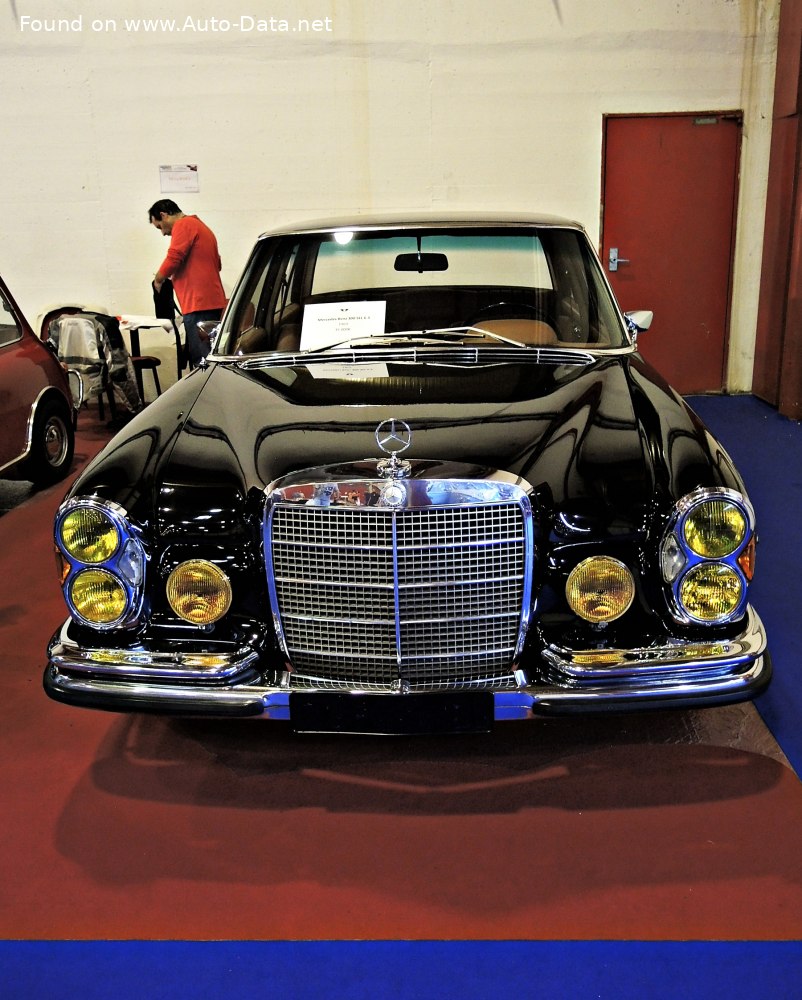
The Mercedes-Benz W109 SEL 300 SEL 4.5 V8 (198 Hp) Automatic represents a significant chapter in the history of luxury automobiles, epitomizing the blend of sophisticated engineering and opulent comfort that defined Mercedes-Benz in the early 1970s. Produced between May 1971 and October 1972, this particular variant of the W109 generation was a high-performance, long-wheelbase sedan designed primarily for discerning markets, most notably North America, where a demand for larger displacement engines and effortless cruising capabilities prevailed. As a direct descendant of the “Fintail” generation and a precursor to the official S-Class nomenclature, the W109 series, and especially its top-tier 300 SEL models, established Mercedes-Benz’s reputation for building robust, comfortable, and technologically advanced luxury vehicles.
The Heritage and Engineering of the Mercedes-Benz W109 SEL 300 SEL 4.5 V8 (198 Hp) Automatic
The W109 generation, alongside its W108 counterpart, marked Mercedes-Benz’s flagship sedans of the late 1960s and early 1970s. While the W108 featured steel coil springs, the W109 distinguished itself with a sophisticated air suspension system, offering an unparalleled level of ride comfort and self-leveling capabilities, a true luxury feature for its time. The 300 SEL 4.5 V8 was developed specifically to cater to export markets, particularly the United States, where stricter emissions regulations and a preference for larger engines necessitated a different approach than the smaller, high-revving European units. This model combined the spaciousness and prestige of the long-wheelbase (SEL) body with a powerful V8 engine, making it a formidable contender in the luxury segment.
The production timeline, though brief, from May 1971 to October 1972, highlights its role as a transitional model, bridging the gap between earlier generations and the upcoming W116 S-Class. Its powertrain architecture, based on an internal combustion engine driving the rear wheels, was conventional for high-end vehicles of the era, emphasizing reliability and a classic driving feel. The sedan body type, with four doors and seating for five, underscored its purpose as a stately and comfortable executive transport or family cruiser, designed for long distances and discerning occupants.
Engine and Performance
At the heart of the Mercedes-Benz W109 SEL 300 SEL 4.5 V8 (198 Hp) Automatic lay the robust M 117 E 45 / 117.981 V8 engine, a powerplant engineered for smooth, authoritative performance. With an engine displacement of 4520 cm³ (275.83 cu. in.), this naturally aspirated V-engine delivered 198 horsepower at a relatively low 4500 rpm, indicative of its long-stroke design favoring torque over peak power. The maximum torque figure of 264.05 lb.-ft. (358 Nm) at just 3000 rpm provided ample pulling power and effortless acceleration, a hallmark of American market preferences. The power-to-liter ratio stood at 43.8 Hp/l, a respectable figure for a large, luxury V8 of the period, emphasizing durability and refinement.
Fuel delivery was handled by a multi-port manifold injection system, a relatively advanced technology for its time that offered more precise fuel metering than carburetors, contributing to better efficiency and emissions control. The engine featured an SOHC (Single Overhead Camshaft) valvetrain with two valves per cylinder, a proven and reliable configuration. With a compression ratio of 8:1, the engine was designed to run smoothly on the petrol (gasoline) available during that era.
Performance figures for such a stately sedan were impressive for the early 1970s. The 300 SEL 4.5 V8 could accelerate from 0 to 60 mph in a swift 9.6 seconds, allowing it to keep pace with many sportier cars of its day. Its maximum speed reached 124.27 mph (200 km/h), demonstrating its autobahn-capable engineering. The power was channeled through a 3-speed automatic transmission, which, while basic by modern standards, provided smooth and seamless shifts, perfectly complementing the car’s luxury character. The vehicle’s curb weight of 3869.11 lbs. (1755 kg) resulted in a weight-to-power ratio of 8.9 kg/Hp (112.8 Hp/tonne), highlighting its solid construction and the substantial power output of its V8 engine. While fuel economy was not its primary selling point, the combined consumption was rated at 15.7 US mpg (15 l/100 km), which was typical for a large V8 luxury sedan of its vintage.
Design and Features
The design of the Mercedes-Benz W109 SEL 300 SEL 4.5 V8 embodied classic Mercedes-Benz elegance: understated, timeless, and substantial. Its long-wheelbase sedan body stretched 196.85 inches (5000 mm) in length, providing generous interior space for its five occupants. With a width of 71.26 inches (1810 mm) and a height of 56.69 inches (1440 mm), the W109 projected a commanding presence on the road. The 112.2-inch (2850 mm) wheelbase contributed significantly to its stable ride and expansive cabin.
A defining characteristic of the W109 series was its advanced air suspension system. Both the front and rear suspensions featured air springs, paired with a double wishbone setup at the front and trailing arms at the rear. This innovative system provided a remarkably smooth ride, effectively isolating occupants from road imperfections, while also maintaining a consistent ride height regardless of load. This technology was a significant differentiator and a clear indicator of the W109’s luxury positioning, offering a level of comfort that few competitors could match.
For braking, the 300 SEL 4.5 V8 was equipped with disc brakes on all four wheels, a crucial safety feature for a vehicle of its size and performance capabilities during that era. Steering was managed by a hydraulic power-assisted cone worm with recirculation balls system, ensuring ease of maneuverability despite the car’s substantial dimensions. The vehicle rode on 6J x 14-inch wheel rims, providing a comfortable balance between handling and ride quality. The fuel tank capacity of 21.66 US gallons (82 liters) ensured a decent cruising range, suitable for the long distances this car was designed to cover. The overall construction and engineering reflected Mercedes-Benz’s commitment to durability, safety, and uncompromising quality, cementing the W109’s legacy as a true luxury icon.
Technical Specifications
| Brand | Mercedes-Benz |
| Model | W109 |
| Generation | W109 SEL |
| Type (Engine) | 300 SEL 4.5 V8 (198 Hp) Automatic |
| Start of production | May, 1971 year |
| End of production | October, 1972 year |
| Powertrain Architecture | Internal Combustion engine |
| Body type | Sedan |
| Seats | 5 |
| Doors | 4 |
| Fuel consumption (economy) – combined | 15 l/100 km (15.7 US mpg) |
| Fuel Type | Petrol (Gasoline) |
| Acceleration 0 – 60 mph | 9.6 sec |
| Acceleration 0 – 100 km/h | 10.1 sec |
| Maximum speed | 200 km/h (124.27 mph) |
| Weight-to-power ratio | 8.9 kg/Hp (112.8 Hp/tonne) |
| Weight-to-torque ratio | 4.9 kg/Nm (204 Nm/tonne) |
| Power | 198 Hp @ 4500 rpm |
| Power per liter | 43.8 Hp/l |
| Torque | 358 Nm (264.05 lb.-ft.) @ 3000 rpm |
| Engine layout | Front, Longitudinal |
| Engine Model/Code | M 117 E 45 / 117.981 |
| Engine displacement | 4520 cm³ (275.83 cu. in.) |
| Number of cylinders | 8 |
| Engine configuration | V-engine |
| Cylinder Bore | 92 mm (3.62 in.) |
| Piston Stroke | 84.99 mm (3.35 in.) |
| Compression ratio | 8:1 |
| Number of valves per cylinder | 2 |
| Fuel injection system | Multi-port manifold injection |
| Engine aspiration | Naturally aspirated engine |
| Valvetrain | SOHC |
| Kerb Weight | 1755 kg (3869.11 lbs.) |
| Max. weight | 2222 kg (4898.67 lbs.) |
| Max load | 467 kg (1029.56 lbs.) |
| Fuel tank capacity | 82 l (21.66 US gal) |
| Length | 5000 mm (196.85 in.) |
| Width | 1810 mm (71.26 in.) |
| Height | 1440 mm (56.69 in.) |
| Wheelbase | 2850 mm (112.2 in.) |
| Front track | 1482 mm (58.35 in.) |
| Rear (Back) track | 1485 mm (58.46 in.) |
| Drivetrain Architecture | Internal combustion engine drives rear wheels |
| Drive wheel | Rear wheel drive |
| Number of gears and type of gearbox | 3 gears, automatic transmission |
| Front suspension | Double wishbone, Air suspension |
| Rear suspension | Air suspension, Trailing arm |
| Front brakes | Disc |
| Rear brakes | Disc |
| Steering type | Cone worm with recirculation balls |
| Power steering | Hydraulic Steering |
| Wheel rims size | 6J x 14 |
