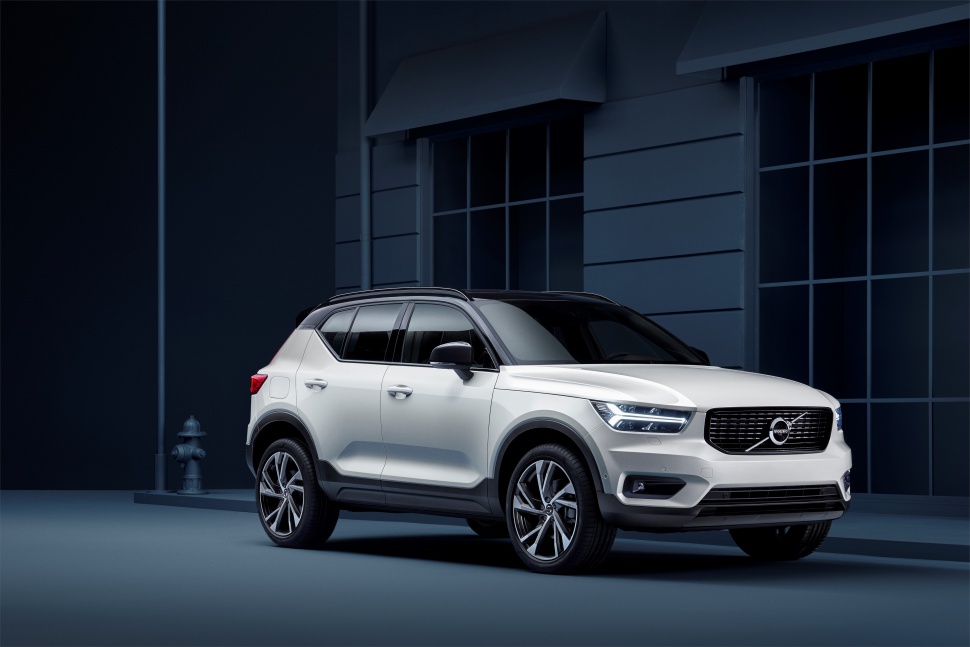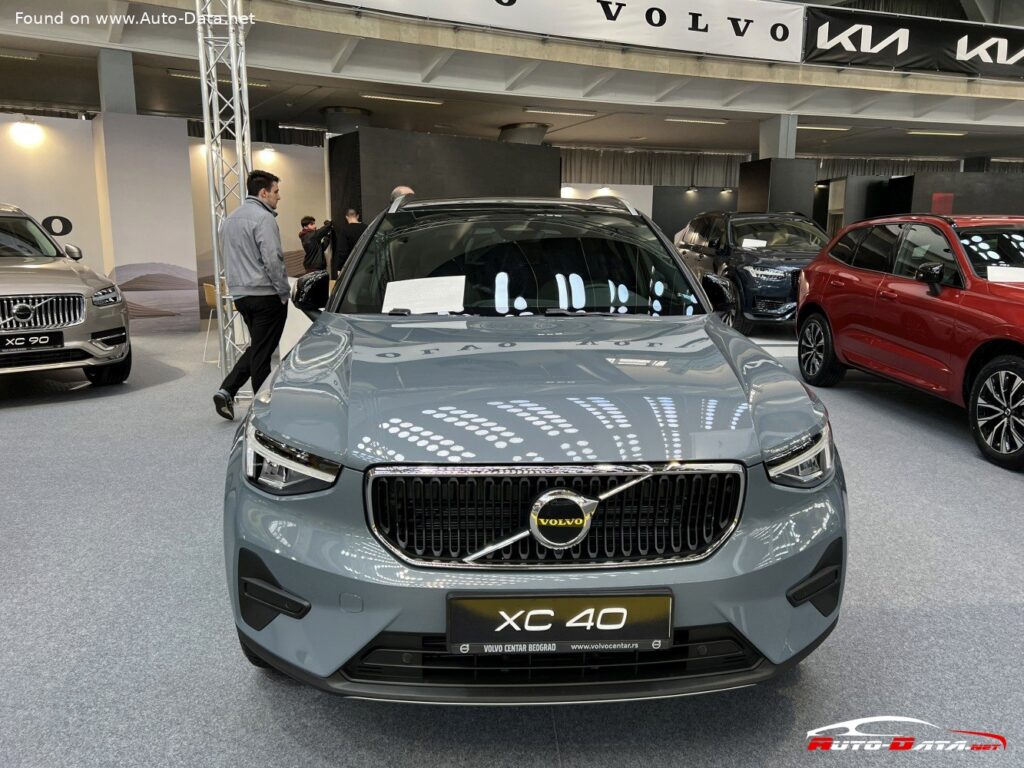
The Volvo XC40 (facelift 2022) 2.0 B3 (163 Hp) Mild Hybrid Automatic represents a significant evolution in Volvo’s compact luxury SUV offering, cementing its position as a highly competitive and technologically advanced vehicle in its segment. Introduced in March 2022, this iteration of the XC40 builds upon the success of its award-winning predecessor by integrating a sophisticated mild-hybrid powertrain and subtle yet impactful design enhancements. While the XC40 enjoys a global presence, this specific 2.0 B3 variant, with its mild-hybrid architecture, is particularly relevant in markets prioritizing efficiency and lower emissions, such as Europe and Asia, though its technical prowess and luxury appeal resonate universally. This model is engineered to deliver a harmonious blend of dynamic performance, fuel efficiency, and the hallmark Scandinavian design and safety features for which Volvo is renowned. As a modern vehicle, its focus lies squarely on cutting-edge technology, sustainable mobility solutions, and an intuitive user experience, making it a compelling choice for discerning drivers seeking a premium compact SUV.
Engine and Performance of the Volvo XC40 (facelift 2022)
At the heart of the Volvo XC40 (facelift 2022) 2.0 B3 Mild Hybrid Automatic lies a meticulously engineered powertrain that combines a robust internal combustion engine with an efficient mild-hybrid electric system. This MHEV (Mild Hybrid Electric Vehicle) architecture, also known as a power-assist or battery-assisted hybrid vehicle (BAHV), is designed to enhance both performance and fuel economy without the need for plug-in charging. The primary power source is a 2.0-liter, four-cylinder inline gasoline engine, identified by the B420T4 code. This engine is equipped with a turbocharger and intercooler, ensuring brisk response and ample power delivery across the rev range. It features direct fuel injection and a DOHC (Double Overhead Camshaft) valvetrain with four valves per cylinder, optimizing combustion efficiency and power output.
The internal combustion engine alone produces a respectable 163 horsepower (Hp) between 4750 and 5250 rpm, translating to a power density of 82.8 Hp per liter. It generates a peak torque of 195.45 lb.-ft. (265 Nm), available from low RPMs, which is crucial for responsive acceleration in city driving and confident highway merging. Complementing this gasoline engine is an electric motor that contributes an additional 14 Hp and a significant 29.5 lb.-ft. (40 Nm) of torque. While the electric motor cannot power the vehicle independently for extended periods, it provides crucial assistance during acceleration, reduces engine load, and enables a smoother, more efficient operation of the Start & Stop system. This integrated approach allows the powertrain to operate primarily in a mixed mode, where both the ICE and electric motor drive the front wheels, optimizing energy usage.
Power is managed through a sophisticated 7-speed automatic transmission, specifically a DCT EVO (Dual-Clutch Transmission), which ensures rapid and seamless gear changes, contributing to both the vehicle’s sporty feel and its overall efficiency. The drivetrain architecture is front-wheel drive, a common configuration for compact SUVs that balances traction, efficiency, and packaging. In terms of performance, the XC40 2.0 B3 Mild Hybrid delivers a confident acceleration from 0 to 60 mph in an estimated 8.2 seconds (0-100 km/h in 8.6 seconds). Its top speed is electronically limited to 111.85 mph (180 km/h), a common practice among modern Volvos, reflecting their commitment to safety and responsible driving. Braking performance is equally robust, with a stopping distance from 100 km/h to 0 in 36 meters, indicating strong and reliable ventilated disc brakes on both front and rear axles.
Fuel efficiency is a strong suit for this mild-hybrid variant, particularly under the stringent WLTP (Worldwide Harmonized Light Vehicles Test Procedure) cycle. The combined fuel consumption ranges from 6.6 to 7.3 liters per 100 km, which translates to an impressive 35.6 to 32.2 US miles per gallon. This efficiency, coupled with CO2 emissions ranging from 150 to 166 grams per kilometer, positions the XC40 2.0 B3 as an environmentally conscious choice, meeting the Euro 6d emission standard. The inclusion of a particulate filter and a Start & Stop system further underscores Volvo’s dedication to minimizing environmental impact.
Design and Features
The Volvo XC40 (facelift 2022) maintains its distinctive and acclaimed design language, characterized by a robust, youthful, and contemporary aesthetic. As an SUV with five doors and five seats, it perfectly embodies the versatility and practicality expected of a premium compact utility vehicle. The 2022 facelift brought subtle refinements, primarily enhancing its visual appeal while retaining the core elements that have made the XC40 a design icon. Its muscular proportions, high ground clearance of 7.72 inches (196 mm), and signature ‘Thor’s Hammer’ LED headlights contribute to a commanding road presence. The vehicle’s dimensions—174.21 inches (4425 mm) in length, 73.35 inches (1863 mm) in width (80.08 inches or 2034 mm including mirrors), and 65.04 inches (1652 mm) in height—ensure it remains agile for urban environments while offering a spacious and comfortable cabin.
The interior of the XC40 is a testament to Scandinavian design principles: minimalist, functional, and user-centric. High-quality materials, intuitive controls, and clever storage solutions define the cabin. The 106.38-inch (2702 mm) wheelbase contributes to generous passenger space, particularly for rear-seat occupants. Practicality is further highlighted by a versatile cargo area, offering a minimum trunk capacity of 15.96 cubic feet (452 liters), expandable to a substantial 46.9 cubic feet (1328 liters) with the rear seats folded, making it suitable for a variety of lifestyles and hauling needs. A fuel tank capacity of 14.27 US gallons (54 liters) provides a respectable driving range.
Underpinning the XC40’s composed ride and handling characteristics is a well-tuned suspension system. The front features an independent McPherson strut setup with coil springs and an anti-roll bar, providing precise steering and excellent road feedback. The rear utilizes an independent multi-link spring suspension with a stabilizer, ensuring comfort and stability even over uneven surfaces. Steering is managed by an electric power steering rack and pinion system, offering light effort at low speeds for maneuverability and greater feedback at higher speeds for confidence. The minimum turning circle of 38.71 feet (11.8 meters) further aids in urban navigation.
Safety, a cornerstone of the Volvo brand, is implicitly integrated into every aspect of the XC40. While the raw data doesn’t list specific advanced driver-assistance systems, it’s understood that a modern Volvo of this caliber would come equipped with a comprehensive suite of active and passive safety features, enhancing occupant protection and accident prevention. The robust body structure, coupled with features like ABS (Anti-lock Braking System) and a suite of airbags, provides a strong foundation for safety. Furthermore, the vehicle boasts impressive off-road capabilities for its segment, with an approach angle of 20.3°, a departure angle of 26.9°, a ramp-over angle of 20.3°, and a wading depth of 17.72 inches (450 mm), making it capable of light adventures beyond paved roads. The availability of multiple wheel rim sizes (16, 17, 18 inches) allows for personalization and optimization based on driver preference for ride comfort or aesthetic appeal.
Technical Specifications
| Brand | Volvo |
| Model | XC40 |
| Generation | XC40 (facelift 2022) |
| Type (Engine) | 2.0 B3 (163 Hp) Mild Hybrid Automatic |
| Start of Production | March, 2022 year |
| Powertrain Architecture | MHEV (Mild Hybrid Electric Vehicle, power-assist hybrid) |
| Body Type | SUV |
| Seats | 5 |
| Doors | 5 |
| Fuel Consumption at Low speed (WLTP) | 25.8 – 24.5 US mpg (9.1-9.6 l/100 km) |
| Fuel Consumption at Medium speed (WLTP) | 38.6 – 34.1 US mpg (6.1-6.9 l/100 km) |
| Fuel Consumption at High speed (WLTP) | 42.0 – 37.9 US mpg (5.6-6.2 l/100 km) |
| Fuel Consumption at Very High speed (WLTP) | 34.6 – 30.9 US mpg (6.8-7.6 l/100 km) |
| Combined Fuel Consumption (WLTP) | 35.6 – 32.2 US mpg (6.6-7.3 l/100 km) |
| CO2 Emissions (WLTP) | 150-166 g/km |
| Fuel Type | Gasoline |
| Acceleration 0 – 62 mph (0-100 km/h) | 8.6 sec |
| Acceleration 0 – 60 mph (Calculated) | 8.2 sec |
| Maximum Speed | 111.85 mph (180 km/h, Electronically limited) |
| Braking 62 mph – 0 (100 km/h – 0) | 36 m |
| Emission Standard | Euro 6d |
| Electric Motor Power | 14 Hp |
| Electric Motor Torque | 29.5 lb.-ft. (40 Nm) |
| Internal Combustion Engine Power | 163 Hp @ 4750-5250 rpm |
| Power per Liter | 82.8 Hp/l |
| Internal Combustion Engine Torque | 195.45 lb.-ft. (265 Nm) |
| Maximum Engine Speed | 6000 rpm |
| Engine Layout | Front, Transverse |
| Engine Model/Code | B420T4 |
| Engine Displacement | 120.16 cu. in. (1969 cm3) |
| Number of Cylinders | 4 |
| Engine Configuration | Inline |
| Cylinder Bore | 3.23 in. (82 mm) |
| Piston Stroke | 3.67 in. (93.2 mm) |
| Compression Ratio | 12:1 |
| Number of Valves per Cylinder | 4 |
| Fuel Injection System | Direct injection |
| Engine Aspiration | Turbocharger, Intercooler |
| Valvetrain | DOHC |
| Engine Systems | Start & Stop System, Particulate filter |
| Trunk (boot) Space – Minimum | 15.96 cu. ft. (452 l) |
| Trunk (boot) Space – Maximum | 46.9 cu. ft. (1328 l) |
| Fuel Tank Capacity | 14.27 US gal (54 l) |
| Max. Roof Load | 165.35 lbs. (75 kg) |
| Permitted Trailer Load with Brakes (12%) | 3527.4 lbs. (1600 kg) |
| Permitted Trailer Load without Brakes | 1653.47 lbs. (750 kg) |
| Length | 174.21 in. (4425 mm) |
| Width | 73.35 in. (1863 mm) |
| Width with Mirrors Folded | 75.20 in. (1910 mm) |
| Width Including Mirrors | 80.08 in. (2034 mm) |
| Height | 65.04 in. (1652 mm) |
| Wheelbase | 106.38 in. (2702 mm) |
| Front Track | 63.03 in. (1601 mm) |
| Rear (Back) Track | 64.02 in. (1626 mm) |
| Front Overhang | 33.66 in. (855 mm) |
| Rear Overhang | 34.17 in. (868 mm) |
| Ride Height (Ground Clearance) | 7.72 in. (196 mm) |
| Drag Coefficient (Cd) | 0.340 |
| Minimum Turning Circle (Turning Diameter) | 38.71 ft. (11.8 m) |
| Approach Angle | 20.3° |
| Departure Angle | 26.9° |
| Ramp-over (Brakeover) Angle | 20.3° |
| Wading Depth | 17.72 in. (450 mm) |
| Drivetrain Architecture | ICE and electric motor drive front wheels in mixed mode |
| Drive Wheel | Front wheel drive |
| Number of Gears and Type of Gearbox | 7 gears, automatic transmission DCT EVO |
| Front Suspension | Independent, type McPherson with coil spring and anti-roll bar |
| Rear Suspension | Independent multi-link spring suspension with stabilizer |
| Front Brakes | Ventilated discs, 296-345×25-30 mm |
| Rear Brakes | Ventilated discs, 280-340×12-20 mm |
| Assisting Systems | ABS (Anti-lock braking system) |
| Steering Type | Steering rack and pinion |
| Power Steering | Electric Steering |
| Wheel Rims Size | 16; 17; 18 |