The Opel Vectra C, particularly its facelifted iteration from 2005, represents a significant chapter in the history of European mid-size sedans. While never officially sold in the United States under the Opel badge, the Vectra C was a cornerstone of General Motors’ European operations, competing fiercely in the D-segment against formidable rivals like the Volkswagen Passat, Ford Mondeo, and Renault Laguna. This generation, specifically the high-performance variant known as the Opel Vectra C (facelift 2005) 2.8i V6 24V Turbo (250 Hp), offered a compelling blend of German engineering, practicality, and unexpected performance. Launched in November 2006 and produced until June 2008, this particular model was designed to cater to a discerning European market seeking a powerful and refined family sedan that could also deliver an engaging driving experience.
Engineering and Performance of the Opel Vectra C (facelift 2005) 2.8i V6 24V Turbo (250 Hp)
At the heart of this potent Vectra C variant was its sophisticated 2.8-liter V6 24V Turbo engine, designated with the internal code Z28NET. This powerplant was a testament to Opel’s ambition to infuse its mainstream sedan with a level of performance typically associated with more premium marques. The engine, configured in a V-shape with six cylinders and four valves per cylinder, boasted a displacement of 2792 cubic centimeters (170.38 cubic inches). Its relatively compact bore of 89 mm (3.5 inches) and a piston stroke of 74.8 mm (2.94 inches) contributed to a responsive and rev-happy character, further enhanced by a compression ratio of 9.5:1.
The key to its impressive output was the inclusion of a turbocharger, paired with an intercooler. This forced induction system allowed the V6 to produce a robust 250 horsepower at 5500 RPM, translating to a specific output of 89.5 horsepower per liter. Equally crucial for real-world driving was the substantial torque figure of 350 Nm (258.15 lb.-ft.), delivered across a broad RPM range, ensuring strong acceleration and effortless overtaking capabilities. Power was efficiently managed through a precise 6-speed manual transmission, sending drive to the front wheels – a common configuration for European family sedans of its era, balancing packaging efficiency with predictable handling characteristics.
The performance metrics of the Opel Vectra C (facelift 2005) 2.8i V6 24V Turbo (250 Hp) were genuinely impressive for a vehicle of its class and segment. It could sprint from 0 to 60 mph in a swift 6.6 seconds, with the 0-100 km/h benchmark achieved in 6.9 seconds. Its top speed was electronically limited to 255 km/h (158.45 mph), underscoring its Autobahn-ready credentials. Despite its formidable power, Opel also paid attention to efficiency, particularly for the European market where fuel prices are a significant consideration. The combined fuel consumption was rated at 10.3 liters per 100 km, which translates to approximately 22.8 US mpg. Urban driving saw consumption rise to 15.4 l/100 km (15.3 US mpg), while extra-urban conditions allowed for a more economical 7.3 l/100 km (32.2 US mpg). These figures, while not groundbreaking by today’s standards, were competitive for a turbocharged V6 performance sedan of the mid-2000s.
Design, Features, and Safety
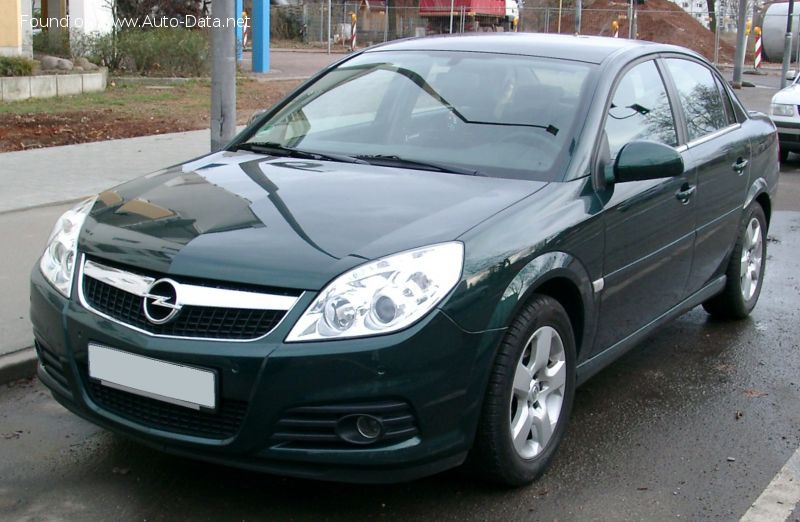
The Opel Vectra C (facelift 2005) presented a refined and mature aesthetic, moving away from some of the more conservative styling cues of its predecessors. As a 4-door sedan designed to accommodate five occupants, its dimensions were generous for the segment. With a length of 4611 mm (181.54 inches), a width of 1798 mm (70.79 inches), and a height of 1460 mm (57.48 inches), the Vectra C offered a commanding presence on the road. The wheelbase, measuring 2700 mm (106.3 inches), was instrumental in providing a spacious cabin and a stable ride, a hallmark of its design philosophy.
The facelift introduced subtle but effective changes, including revised front and rear fascias, updated lighting signatures, and improved interior materials, all aimed at giving the car a more contemporary and upscale feel. The vehicle’s curb weight of 1495 kg (3295.91 lbs.) contributed to its agile handling, while the maximum permissible weight of 2040 kg (4497.43 lbs.) highlighted its capability as a family hauler. Practicality was further emphasized by a generous trunk space of 500 liters (17.66 cubic feet), making it suitable for long journeys or substantial grocery runs. The fuel tank capacity of 61 liters (16.11 US gallons) provided a decent cruising range.
In terms of chassis and safety, the Vectra C featured an independent coil spring suspension system for both the front and rear axles. This setup was chosen to provide a comfortable ride while maintaining competent handling dynamics, crucial for a car with its performance potential. Braking duties were handled by ventilated discs on both the front and rear wheels, ensuring strong and consistent stopping power, an essential feature for a vehicle capable of 158 mph. Standard safety equipment included an Anti-lock Braking System (ABS), a critical active safety feature for preventing wheel lock-up during emergency braking. The car was fitted with 215/55 R16 tires on 16-inch wheel rims, providing a good balance between grip, ride comfort, and tire longevity. While not explicitly detailed in the provided data, a modern European family car of this era would typically include a comprehensive suite of passive safety features such as multiple airbags and active stability control systems, reinforcing its commitment to occupant protection.
The Opel Vectra C (facelift 2005) 2.8i V6 24V Turbo (250 Hp) represented a compelling package for the European market. It combined the practicality and comfort expected of a mid-size sedan with the exhilarating performance of a turbocharged V6 engine, all wrapped in a discreet yet stylish design. Its role was to offer a more accessible performance option in a segment often dominated by diesel engines and smaller displacement gasoline units, providing a distinct proposition for enthusiasts and families alike.
Technical Specifications
| Brand | Opel |
| Model | Vectra |
| Generation | Vectra C (facelift 2005) |
| Type (Engine) | 2.8i V6 24V Turbo (250 Hp) |
| Start of production | November, 2006 year |
| End of production | June, 2008 year |
| Powertrain Architecture | Internal Combustion engine |
| Body type | Sedan |
| Seats | 5 |
| Doors | 4 |
| Fuel consumption (economy) – urban | 15.4 l/100 km (15.3 US mpg) |
| Fuel consumption (economy) – extra urban | 7.3 l/100 km (32.2 US mpg) |
| Fuel consumption (economy) – combined | 10.3 l/100 km (22.8 US mpg) |
| Fuel Type | Petrol (Gasoline) |
| Acceleration 0 – 60 mph | 6.6 sec |
| Acceleration 0 – 100 km/h | 6.9 sec |
| Maximum speed | 255 km/h (158.45 mph) |
| Weight-to-power ratio | 6 kg/Hp, 167.2 Hp/tonne |
| Weight-to-torque ratio | 4.3 kg/Nm, 234.1 Nm/tonne |
| Power | 250 Hp @ 5500 rpm |
| Power per liter | 89.5 Hp/l |
| Torque | 350 Nm (258.15 lb.-ft.) |
| Engine layout | Front, Transverse |
| Engine Model/Code | Z28NET |
| Engine displacement | 2792 cm3 (170.38 cu. in.) |
| Number of cylinders | 6 |
| Engine configuration | V-engine |
| Cylinder Bore | 89 mm (3.5 in.) |
| Piston Stroke | 74.8 mm (2.94 in.) |
| Compression ratio | 9.5:1 |
| Number of valves per cylinder | 4 |
| Fuel injection system | Multi-port manifold injection |
| Engine aspiration | Turbocharger, Intercooler |
| Engine oil capacity | 6 l (6.34 US qt) |
| Coolant | 7.5 l (7.93 US qt) |
| Kerb Weight | 1495 kg (3295.91 lbs.) |
| Max. weight | 2040 kg (4497.43 lbs.) |
| Max load | 545 kg (1201.52 lbs.) |
| Trunk (boot) space – maximum | 500 l (17.66 cu. ft.) |
| Fuel tank capacity | 61 l (16.11 US gal) |
| Length | 4611 mm (181.54 in.) |
| Width | 1798 mm (70.79 in.) |
| Height | 1460 mm (57.48 in.) |
| Wheelbase | 2700 mm (106.3 in.) |
| Front track | 1536 mm (60.47 in.) |
| Rear (Back) track | 1525 mm (60.04 in.) |
| Drivetrain Architecture | Front wheel drive, Internal Combustion engine |
| Drive wheel | Front wheel drive |
| Number of gears and type of gearbox | 6 gears, manual transmission |
| Front suspension | Independent coil spring |
| Rear suspension | Independent coil spring |
| Front brakes | Ventilated discs |
| Rear brakes | Ventilated discs |
| Assisting systems | ABS (Anti-lock braking system) |
| Tires size | 215/55 R16 |
| Wheel rims size | 16 |