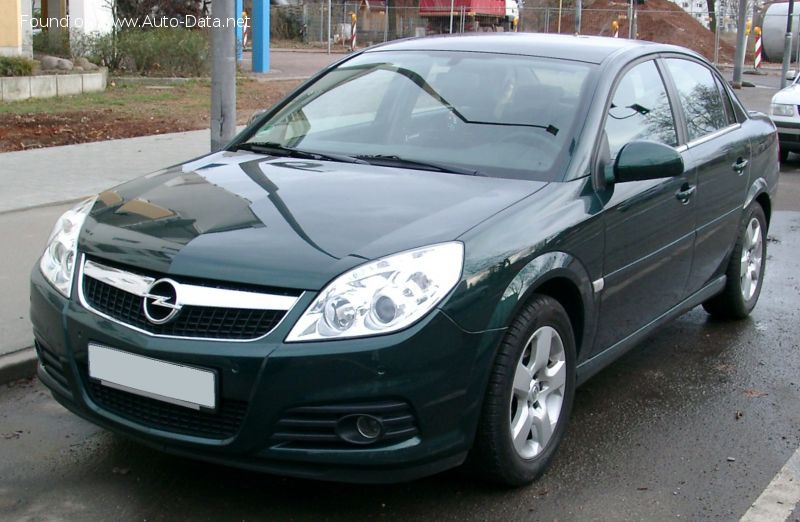
The Opel Vectra C (facelift 2005) 2.8i V6 24V Turbo represents a significant iteration of Opel’s mid-size offering, positioned as a competitor to vehicles like the Ford Mondeo and Volkswagen Passat in the European market. Introduced in 2006 and continuing through 2008, this facelifted version of the Vectra C aimed to refine the model’s styling, improve interior quality, and enhance performance. While not officially sold in the United States, understanding the Vectra C provides insight into the engineering and design philosophies prevalent in the European automotive landscape of the mid-2000s. The 2.8i V6 Turbo variant, with its 250 horsepower output, was a flagship model, offering a blend of comfort and performance for discerning buyers.
Opel Vectra C: A Refined European Sedan
The Vectra C, launched in 2002, was Opel’s attempt to move upmarket and challenge established players in the D-segment (mid-size) car class. The 2005 facelift brought revised front and rear styling, updated interior materials, and importantly, a more potent engine lineup. The 2.8i V6 24V Turbo was the range-topping engine, designed to appeal to drivers seeking a more engaging driving experience. Opel, as a subsidiary of General Motors, leveraged technology and engineering expertise from both sides of the Atlantic, but the Vectra C was primarily developed and marketed for the European market, where sedans and hatchbacks of this size were – and remain – highly popular.
Engine & Performance
The heart of the Vectra C 2.8i V6 Turbo is its 2.8-liter, 24-valve V6 engine, designated the Z28NET. This engine utilizes a turbocharger and intercooler to boost power output to 250 horsepower at 5500 rpm and 350 Nm (258.15 lb.-ft.) of torque. The engine’s transverse front-engine layout contributes to a balanced weight distribution. Power is delivered to the front wheels via a six-speed automatic transmission. This combination allows for a 0-60 mph (0-97 km/h) acceleration time of approximately 6.9 seconds and a top speed electronically limited to 155.34 mph (250 km/h). The engine’s power-to-weight ratio of 6 kg/Hp and torque-to-weight ratio of 4.3 kg/Nm contribute to its responsive feel. Fuel economy, however, is relatively modest, with combined figures around 10 liters per 100 kilometers (23.5 US mpg).
Design & Features
The Vectra C facelift retained the overall silhouette of the original C-generation, but with a more contemporary and refined aesthetic. The sedan body style, with its four doors and five-seat configuration, was the most common variant. Key design elements included a revised front grille, updated headlights, and redesigned taillights. Inside, the facelift brought improvements to material quality and ergonomics. Standard features typically included air conditioning, power windows, central locking, and an audio system. Safety features, increasingly important in the mid-2000s, included ABS (Anti-lock Braking System) and airbags. The trunk offered a practical 500 liters (17.66 cubic feet) of cargo space. The vehicle’s dimensions – 4611 mm (181.54 in) in length, 1798 mm (70.79 in) in width, and 1460 mm (57.48 in) in height – positioned it squarely within the mid-size sedan segment.
Technical Specifications
| Brand | Opel |
| Model | Vectra |
| Generation | Vectra C (facelift 2005) |
| Type (Engine) | 2.8i V6 24V Turbo (250 Hp) Automatic |
| Start of production | November, 2006 |
| End of production | June, 2008 |
| Powertrain Architecture | Internal Combustion engine |
| Body type | Sedan |
| Seats | 5 |
| Doors | 4 |
| Fuel consumption (urban) | 17.1 l/100 km (13.8 US mpg) |
| Fuel consumption (extra urban) | 7.3 l/100 km (32.2 US mpg) |
| Fuel consumption (combined) | 10 l/100 km (23.5 US mpg) |
| Fuel Type | Petrol (Gasoline) |
| Acceleration 0 – 100 km/h | 7.3 sec |
| Acceleration 0 – 62 mph | 7.3 sec |
| Acceleration 0 – 60 mph | 6.9 sec |
| Maximum speed | 250 km/h (155.34 mph) |
| Weight-to-power ratio | 6 kg/Hp |
| Weight-to-torque ratio | 4.3 kg/Nm |
| Power | 250 Hp @ 5500 rpm |
| Torque | 350 Nm (258.15 lb.-ft.) |
| Engine layout | Front, Transverse |
| Engine Model/Code | Z28NET |
| Engine displacement | 2792 cm3 (170.38 cu. in.) |
| Number of cylinders | 6 |
| Engine configuration | V-engine |
| Cylinder Bore | 89 mm (3.5 in.) |
| Piston Stroke | 74.8 mm (2.94 in.) |
| Compression ratio | 9.5:1 |
| Number of valves per cylinder | 4 |
| Fuel injection system | Multi-port manifold injection |
| Engine aspiration | Turbocharger, Intercooler |
| Engine oil capacity | 6 l (6.34 US qt | 5.28 UK qt) |
| Coolant | 7.5 l (7.93 US qt | 6.6 UK qt) |
| Kerb Weight | 1495 kg (3295.91 lbs.) |
| Max. weight | 2040 kg (4497.43 lbs.) |
| Max load | 545 kg (1201.52 lbs.) |
| Trunk (boot) space – maximum | 500 l (17.66 cu. ft.) |
| Fuel tank capacity | 61 l (16.11 US gal | 13.42 UK gal) |
| Length | 4611 mm (181.54 in.) |
| Width | 1798 mm (70.79 in.) |
| Height | 1460 mm (57.48 in.) |
| Wheelbase | 2700 mm (106.3 in.) |
| Front track | 1536 mm (60.47 in.) |
| Rear (Back) track | 1525 mm (60.04 in.) |
| Drivetrain Architecture | Front wheel drive |
| Number of gears and type of gearbox | 6 gears, automatic transmission |
| Front suspension | Independent coil spring |
| Rear suspension | Independent coil spring |
| Front brakes | Ventilated discs |
| Rear brakes | Ventilated discs |
| Assisting systems | ABS (Anti-lock braking system) |
| Tires size | 215/55 R16 |
| Wheel rims size | 16 |
The Opel Vectra C 2.8i V6 Turbo, while not a common sight in North America, represents a well-engineered and capable European sedan. Its combination of a powerful turbocharged engine, comfortable interior, and practical design made it a popular choice for drivers seeking a refined and engaging driving experience in the mid-size segment.