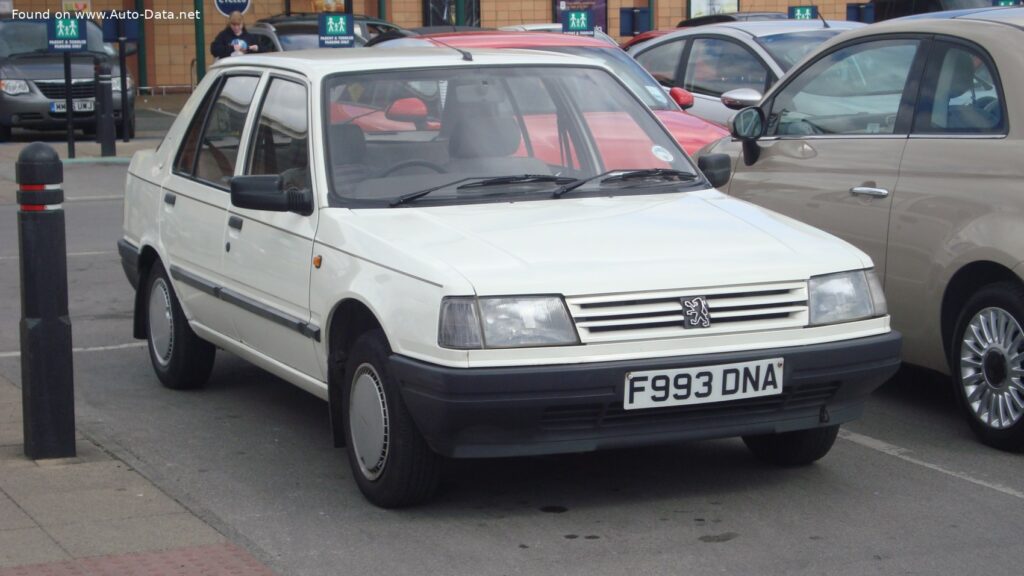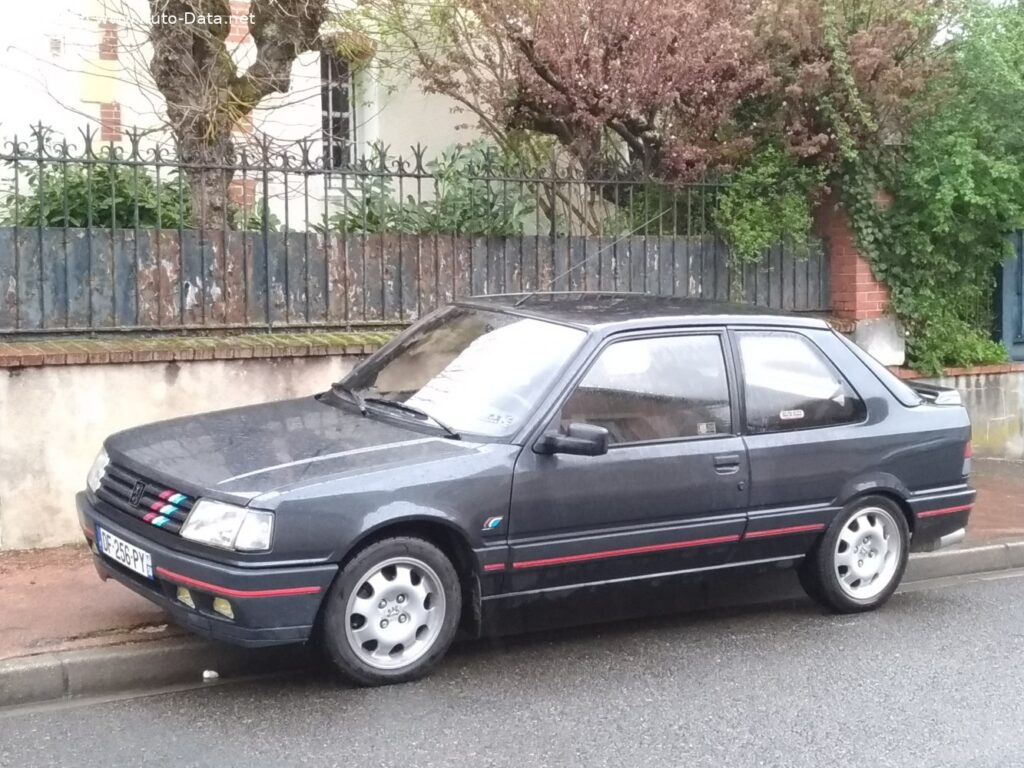
The Peugeot 309 is a small family car produced by the French manufacturer Peugeot between 1985 and 1993. Positioned as a replacement for the Peugeot 104, the 309 was intended to bridge the gap between the smaller 205 and the larger 405. While not officially sold in the United States, the 309 was a significant model in Europe, offering a practical and often sporty alternative in the competitive hatchback segment. The facelifted version introduced in 1989, designated 3C/3A, brought styling updates and mechanical refinements, including the high-performance 1.9 GTI 16V model detailed here. This variant, produced from 1990 to 1993, represents the pinnacle of the 309’s performance capabilities.
Peugeot 309 GTI 16V: A European Hot Hatch
The 309 GTI 16V was designed to appeal to enthusiasts seeking a spirited driving experience. It distinguished itself with a more powerful engine, upgraded suspension, and subtle styling enhancements. While Peugeot was well-known for the 205 GTI, the 309 offered a slightly more mature and spacious package, appealing to buyers who needed a bit more practicality alongside their performance. The 309, despite its relatively short production run, established a reputation for reliability and affordability, making it a popular choice among European drivers.
Engine & Performance
The heart of the 309 GTI 16V is the XU9 engine, a 1.9-liter inline-four cylinder powerplant. This naturally aspirated engine produces 147 horsepower at 6400 rpm and 166 Nm (122.44 lb.-ft.) of torque at 5000 rpm. The engine features multi-port fuel injection and a double overhead camshaft (DOHC) valvetrain, contributing to its responsive performance. Power per liter is a respectable 77.2 hp/l. This engine is coupled with a five-speed manual transmission, delivering power to the front wheels. The 309 GTI 16V achieves a 0 to 100 km/h (0-62 mph) acceleration time of 8.2 seconds, and a 0-60 mph time of 7.8 seconds. Its top speed is rated at 214 km/h (132.97 mph). The weight-to-power ratio of 6.4 kg/hp and weight-to-torque ratio of 5.7 kg/Nm contribute to its lively handling characteristics. Fuel consumption is rated at 11.5 l/100 km (20.5 US mpg) in urban conditions and 6.5 l/100 km (36.2 US mpg) on the open road.
Design & Features
The 309 GTI 16V is a three-door hatchback, offering seating for five passengers. Its design, while somewhat understated, is characterized by clean lines and a practical shape. The facelifted model (3C/3A) features subtle styling revisions compared to the earlier versions, including a revised front grille and updated interior trim. The interior is functional and driver-focused, with supportive seats and a well-placed gear lever. Safety features for the era included an Anti-lock Braking System (ABS), which was becoming increasingly common on performance models. The 309 offers a trunk (boot) space of 397 liters (14.02 cu. ft.) with the rear seats up, expanding to 1279 liters (45.17 cu. ft.) when folded down. The vehicle’s dimensions are: length 4051 mm (159.49 in), width 1628 mm (64.09 in), and height 1380 mm (54.33 in). The wheelbase measures 2469 mm (97.2 in).
Technical Specifications
| Brand | Peugeot |
| Model | 309 |
| Generation | 309 (3C,3A facelift 1989) 3-door |
| Type (Engine) | 1.9 GTI 16V (147 Hp) |
| Start of production | 1990 |
| End of production | 1993 |
| Powertrain Architecture | Internal Combustion engine |
| Body type | Hatchback |
| Seats | 5 |
| Doors | 3 |
| Fuel consumption (urban) | 11.5 l/100 km (20.5 US mpg) |
| Fuel consumption (extra urban) | 6.5 l/100 km (36.2 US mpg) |
| Fuel Type | Petrol (Gasoline) |
| Acceleration 0 – 100 km/h | 8.2 sec |
| Acceleration 0 – 62 mph | 8.2 sec |
| Acceleration 0 – 60 mph | 7.8 sec |
| Maximum speed | 214 km/h (132.97 mph) |
| Weight-to-power ratio | 6.4 kg/Hp |
| Weight-to-torque ratio | 5.7 kg/Nm |
| Power | 147 Hp @ 6400 rpm |
| Power per litre | 77.2 Hp/l |
| Torque | 166 Nm @ 5000 rpm (122.44 lb.-ft. @ 5000 rpm) |
| Engine layout | Front, Transverse |
| Engine Model/Code | XU9 |
| Engine displacement | 1905 cm3 (116.25 cu. in.) |
| Number of cylinders | 4 |
| Engine configuration | Inline |
| Cylinder Bore | 83 mm (3.27 in.) |
| Piston Stroke | 88 mm (3.46 in.) |
| Compression ratio | 9.7:1 |
| Number of valves per cylinder | 4 |
| Fuel injection system | Multi-port manifold injection |
| Engine aspiration | Naturally aspirated engine |
| Valvetrain | DOHC |
| Engine oil capacity | 5 l (5.28 US qt | 4.4 UK qt) |
| Coolant | 8 l (8.45 US qt | 7.04 UK qt) |
| Kerb Weight | 948 kg (2089.98 lbs.) |
| Max. weight | 1400 kg (3086.47 lbs.) |
| Max load | 452 kg (996.49 lbs.) |
| Trunk (boot) space – minimum | 397 l (14.02 cu. ft.) |
| Trunk (boot) space – maximum | 1279 l (45.17 cu. ft.) |
| Fuel tank capacity | 55 l (14.53 US gal | 12.1 UK gal) |
| Permitted trailer load with brakes (12%) | 900 kg (1984.16 lbs.) |
| Length | 4051 mm (159.49 in.) |
| Width | 1628 mm (64.09 in.) |
| Height | 1380 mm (54.33 in.) |
| Wheelbase | 2469 mm (97.2 in.) |
| Front track | 1405 mm (55.31 in.) |
| Rear (Back) track | 1380 mm (54.33 in.) |
| Front overhang | 753 mm (29.65 in.) |
| Rear overhang | 829 mm (32.64 in.) |
| Drag coefficient (Cd) | 0.34 |
| Drivetrain Architecture | Front wheel drive |
| Number of gears and type of gearbox | 5 gears, manual transmission |
| Front suspension | Independent, type McPherson with coil spring and anti-roll bar |
| Rear suspension | Torsion |
| Front brakes | Disc |
| Rear brakes | Drum |
| Assisting systems | ABS (Anti-lock braking system) |
| Steering type | Steering rack and pinion |
| Power steering | Hydraulic Steering |
| Tires size | 195/55 R15 |