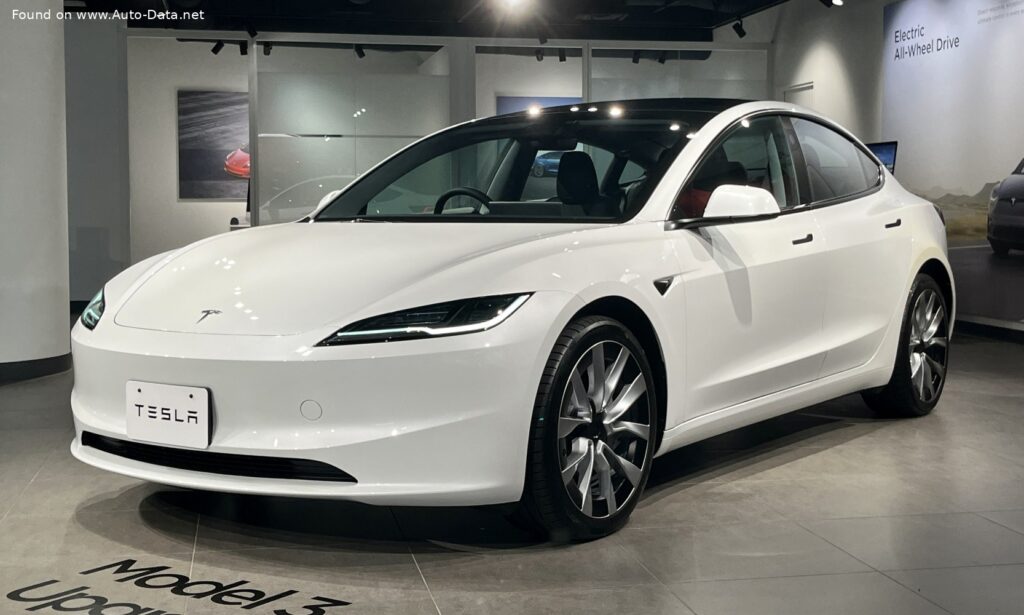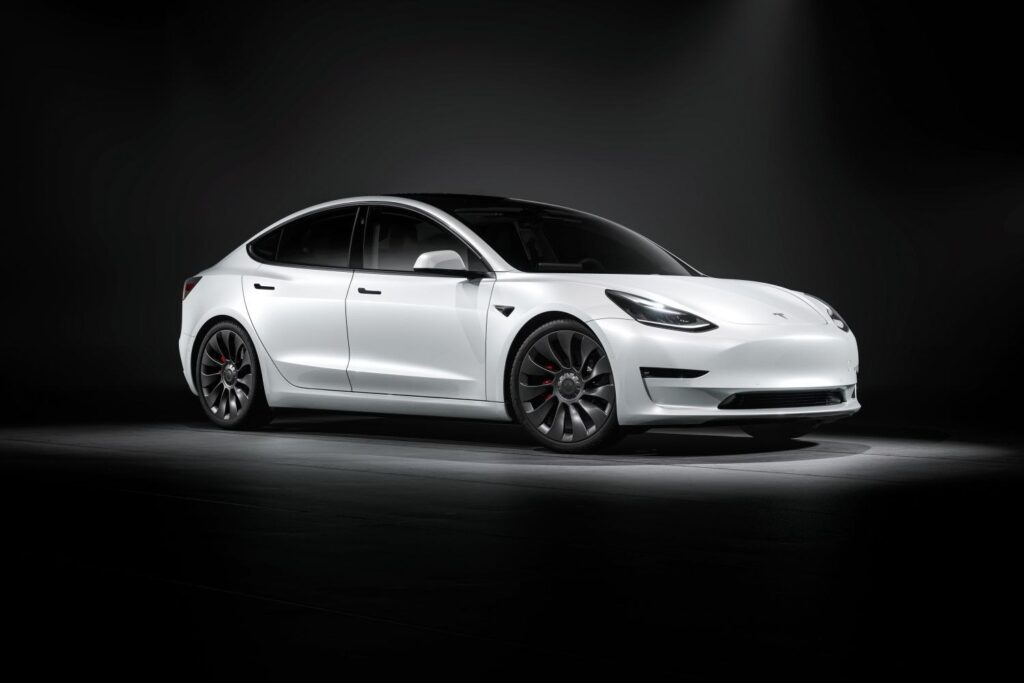
The Tesla Model 3, launched in 2017, quickly became a pivotal vehicle in the electric vehicle (EV) market. The 2020 facelift, specifically the Long Range variant with its 80.5 kWh battery pack, represents a significant refinement of the original design, offering increased range, performance improvements, and updated features. Positioned as a compact executive sedan, the Model 3 aimed to disrupt the established automotive industry by providing a compelling electric alternative to gasoline-powered vehicles, and it has largely succeeded in doing so, becoming one of the best-selling EVs globally. This article details the specifications and characteristics of the 2020 facelift Long Range model, produced from 2022-2023.
Tesla Model 3 (Facelift 2020) Long Range: An Overview
The Model 3 Long Range is a battery electric vehicle (BEV) designed for efficiency and performance. It distinguishes itself with a dual-motor all-wheel-drive (AWD) system, providing enhanced traction and acceleration. The facelift introduced subtle but important changes to the exterior and interior, focusing on build quality and user experience. The vehicle’s core mission remains to accelerate the world’s transition to sustainable energy, and the Long Range model delivers on that promise with its extended range and practical usability.
Engine & Performance
The Tesla Model 3 Long Range utilizes a dual-motor powertrain, with one electric motor powering the front wheels and another powering the rear wheels. This configuration enables all-wheel drive, improving handling and performance in various conditions. The front motor produces 165 horsepower and 163 Nm (120.22 lb.-ft.) of torque, while the rear motor generates 276 horsepower and 330 Nm (243.4 lb.-ft.) of torque. Combined, the system delivers a total output of 441 horsepower and 493 Nm (363.62 lb.-ft.) of torque. This results in a 0-60 mph (0-97 km/h) acceleration time of approximately 4.2 seconds, and a 0-100 km/h (0-62 mph) time of 4.4 seconds. The vehicle has a maximum speed of 233 km/h (144.78 mph). The powertrain is coupled with a single-speed automatic transmission, typical of electric vehicles. The weight-to-power ratio is 4.1 kg/Hp, and the weight-to-torque ratio is 3.7 kg/Nm, indicating a favorable power-to-weight balance.
Design & Features
The Tesla Model 3 is a four-door sedan with a fastback roofline, contributing to its sleek and aerodynamic profile. It seats five passengers and offers a minimalist interior design centered around a large central touchscreen display. The 2020 facelift brought improvements to interior materials and build quality. Key features include a panoramic glass roof, premium audio system, and Tesla’s Autopilot driver-assistance system. Safety is a paramount concern, and the Model 3 incorporates a comprehensive suite of safety features, including automatic emergency braking, lane departure warning, and collision avoidance assist. The vehicle’s battery pack is located beneath the floor, contributing to a low center of gravity and improved handling. Trunk space is a practical 649 liters (22.92 cu. ft.). The Model 3’s design prioritizes aerodynamic efficiency, contributing to its impressive range and energy consumption figures.
Technology and Efficiency
The Model 3 Long Range boasts an 80.5 kWh gross battery capacity, with a usable capacity of 75.0 kWh. Utilizing Lithium nickel manganese cobalt oxides (Li-NMC) battery technology, the vehicle achieves a WLTP-rated all-electric range of 602 km (374.07 mi). Average energy consumption is rated at 14.8 kWh/100 km (23.82 kWh/100 mi), equating to 141 MPGe (miles per gallon equivalent) and 6.8 km/kWh (4.2 mi/kWh). The vehicle supports charging via standard charging ports. The advanced battery management system optimizes performance and longevity, while over-the-air software updates continuously improve the vehicle’s functionality and features.
Technical Specifications
| Brand | Tesla |
| Model | Model 3 |
| Generation | Model 3 (facelift 2020) |
| Type | Long Range 80.5 kWh (441 Hp) Dual Motor AWD |
| Start of production | February, 2022 |
| End of production | 2023 |
| Powertrain Architecture | BEV (Electric Vehicle) |
| Body type | Sedan, Fastback |
| Seats | 5 |
| Doors | 4 |
| Fuel Type | Electricity |
| Acceleration 0 – 100 km/h | 4.4 sec |
| Acceleration 0 – 62 mph | 4.4 sec |
| Acceleration 0 – 60 mph | 4.2 sec |
| Maximum speed | 233 km/h (144.78 mph) |
| Weight-to-power ratio | 4.1 kg/Hp |
| Weight-to-torque ratio | 3.7 kg/Nm |
| Gross battery capacity | 80.5 kWh |
| Net (usable) battery capacity | 75.0 kWh |
| Battery voltage | 360 V |
| Battery technology | Lithium nickel manganese cobalt oxides (Li-NMC) |
| Battery location | Below the floor |
| All-electric range (WLTP) | 602 km (374.07 mi) |
| Average Energy consumption (WLTP) | 14.8 kWh/100 km (23.82 kWh/100 mi) |
| Electric motor 1 Power | 165 Hp @ 8275 rpm |
| Electric motor 1 Torque | 163 Nm @ 125-6375 rpm (120.22 lb.-ft. @ 125-6375 rpm) |
| Electric motor 1 Model/Code | 3D3 |
| Electric motor 1 Location | Front axle, Transverse |
| Electric motor 2 Power | 276 Hp @ 6700 rpm |
| Electric motor 2 Torque | 330 Nm @ 325-5500 rpm (243.4 lb.-ft. @ 325-5500 rpm) |
| Electric motor 2 Model/Code | 3D7 |
| Electric motor 2 Location | Rear axle, Transverse |
| System power | 441 Hp |
| System torque | 493 Nm (363.62 lb.-ft.) |
| Kerb Weight | 1830 kg (4034.46 lbs.) |
| Trunk (boot) space – minimum | 649 l (22.92 cu. ft.) |
| Length | 4694 mm (184.8 in.) |
| Width | 1849 mm (72.8 in.) |
| Width with mirrors folded | 1933 mm (76.1 in.) |
| Width including mirrors | 2088 mm (82.2 in.) |
| Height | 1443 mm (56.81 in.) |
| Wheelbase | 2875 mm (113.19 in.) |
| Front track | 1580 mm (62.2 in.) |
| Rear (Back) track | 1580 mm (62.2 in.) |
| Front overhang | 841 mm (33.11 in.) |
| Rear overhang | 978 mm (38.5 in.) |
| Ride height (ground clearance) | 140 mm (5.51 in.) |
| Minimum turning circle (turning diameter) | 11.6 m (38.06 ft.) |
| Drivetrain Architecture | One electric motor drives the front wheels, one electric motor drives the rear wheels. |
| Drive wheel | All wheel drive (4×4) |
| Number of gears and type of gearbox | 1 gears, automatic transmission |
| Front suspension | Double wishbone |
| Rear suspension | Independent multi-link suspension |
| Front brakes | Ventilated discs, 320×25 mm |
| Rear brakes | Ventilated discs, 335×20 mm |
| Assisting systems | ABS (Anti-lock braking system) |
| Steering type | Steering rack and pinion |
| Power steering | Electric Steering |
| Tires size | 235/45 R18; 235/40 R19 |
| Wheel rims size | 18; 19 |