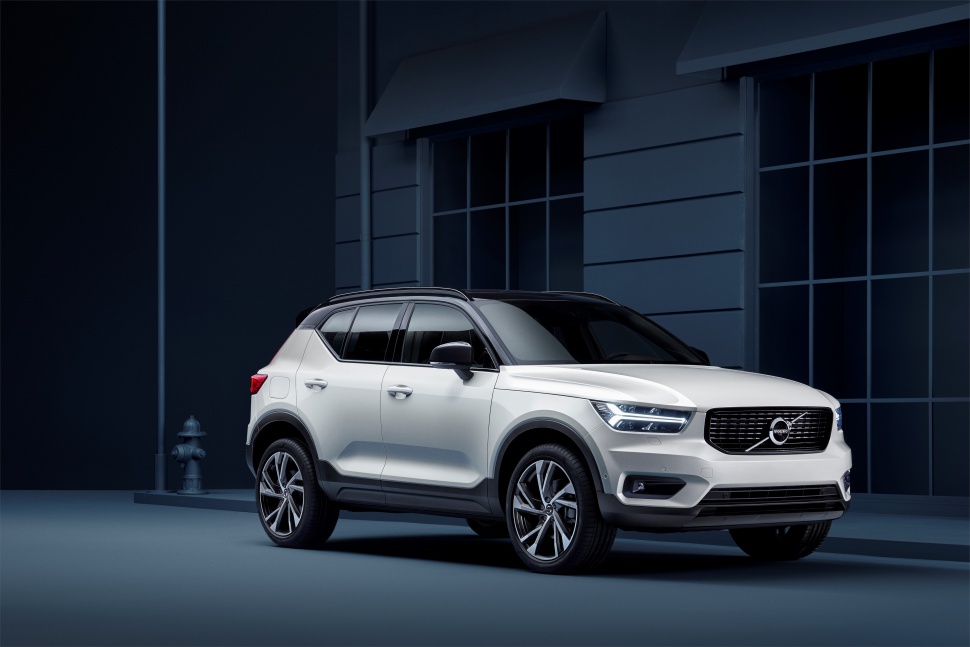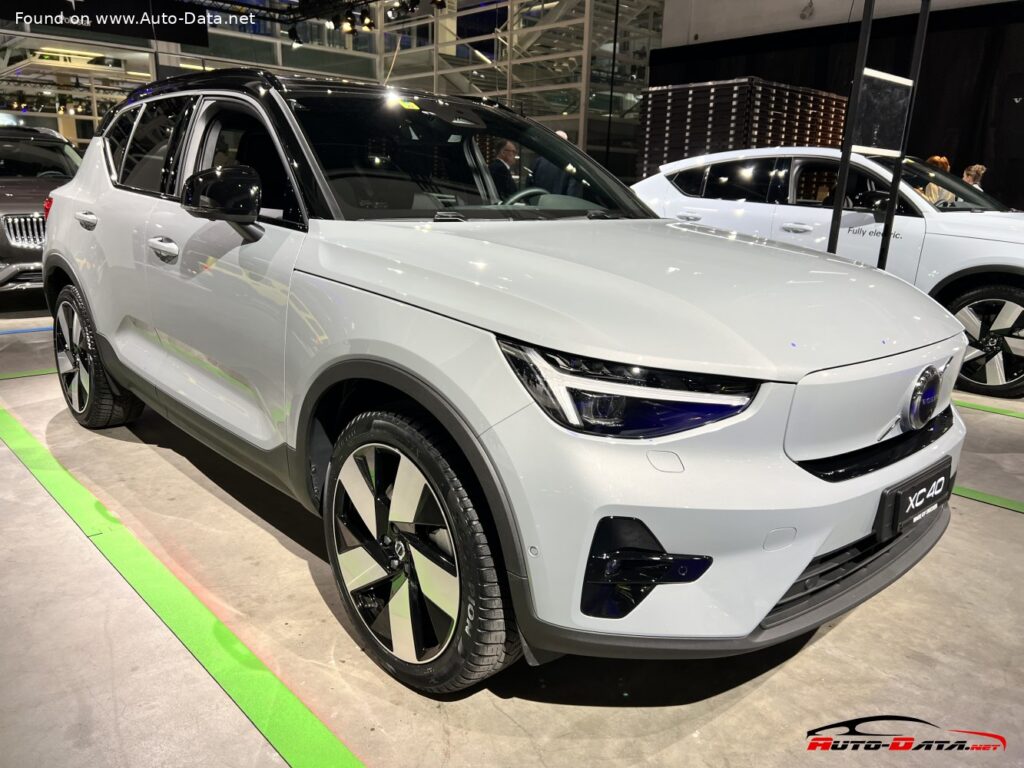
The Volvo XC40, specifically the facelifted 2022 Recharge 82 kWh variant, represents Volvo’s entry into the burgeoning all-electric compact SUV segment. Introduced in November 2022, this model builds upon the success of the original XC40, launched in 2017, offering a fully electric powertrain without compromising the Scandinavian design principles and safety features Volvo is renowned for. The XC40 Recharge is not a direct replacement for internal combustion engine (ICE) versions, but rather a distinct offering aimed at consumers seeking a premium, environmentally conscious vehicle. While the XC40 is globally available, its significance is particularly strong in Europe, where demand for electric vehicles is high and government incentives support their adoption. In the United States, it competes with other luxury electric SUVs like the Tesla Model Y, Audi Q4 e-tron, and BMW iX1.
Volvo XC40 Recharge: An Overview
The 2022 facelift brought subtle but important updates to the XC40 Recharge, primarily focusing on improving range and efficiency. The vehicle maintains its compact dimensions and practical interior, making it well-suited for urban environments while still offering enough space for a small family. The Recharge model distinguishes itself with a dual-motor all-wheel-drive system, providing brisk acceleration and confident handling. Volvo’s commitment to safety remains a core tenet, with a comprehensive suite of advanced driver-assistance systems (ADAS) included as standard or optional equipment.
Engine & Performance
The Volvo XC40 Recharge 82 kWh Twin Motor AWD utilizes a fully electric powertrain, eliminating reliance on fossil fuels. It features two electric motors – one driving the front wheels and one driving the rear wheels – creating an all-wheel-drive configuration. The front motor produces 163 horsepower and 250 Newton-meters (184 lb-ft) of torque, while the rear motor generates 245 horsepower and 420 Newton-meters (309 lb-ft) of torque. Combined, these motors deliver a total system output of 408 horsepower and 670 Newton-meters (494 lb-ft) of torque. This potent power delivery translates to impressive acceleration figures, with a 0-60 mph time of approximately 4.7 seconds and a 0-62 mph (0-100 km/h) time of 4.9 seconds. The top speed is electronically limited to 111.85 mph (180 km/h). The 82 kWh battery pack, positioned under the floor of the vehicle, provides a usable capacity of 78 kWh. This allows for a WLTP-certified all-electric range of between 478 and 503 kilometers (297 to 313 miles). Energy consumption is rated at 17.8-18.7 kWh per 100 kilometers (28.65-30.09 kWh per 100 miles), equating to approximately 118-112 MPGe and 5.6-5.3 km/kWh (3.5-3.3 mi/kWh).
Design & Features
The Volvo XC40 Recharge retains the distinctive Scandinavian design language of the standard XC40, characterized by clean lines, a minimalist aesthetic, and a focus on functionality. As a compact SUV, it offers a practical five-seat configuration and a five-door layout. The exterior features a closed-off grille, signifying its electric nature, and unique wheel designs. Inside, the cabin is spacious and well-appointed, with high-quality materials and a modern infotainment system. A prominent 9-inch touchscreen controls most vehicle functions, including navigation, climate control, and entertainment. The XC40 Recharge prioritizes safety, incorporating features such as automatic emergency braking, lane-keeping assist, and adaptive cruise control. The interior offers 452 liters (15.96 cubic feet) of trunk space with the rear seats up, expanding to 1328 liters (46.9 cubic feet) when the seats are folded down. The vehicle also boasts a maximum roof load capacity of 75 kg (165 lbs) and can tow a braked trailer weighing up to 1800 kg (3968 lbs).
Technical Specifications
| Brand | Volvo |
| Model | XC40 |
| Generation | XC40 (facelift 2022) |
| Type (Engine) | Recharge 82 kWh (408 Hp) Twin Motor AWD |
| Start of production | November, 2022 |
| Powertrain Architecture | BEV (Electric Vehicle) |
| Body type | SUV |
| Seats | 5 |
| Doors | 5 |
| Fuel Type | Electricity |
| Acceleration 0 – 100 km/h | 4.9 sec |
| Acceleration 0 – 62 mph | 4.9 sec |
| Acceleration 0 – 60 mph | 4.7 sec |
| Maximum speed | 180 km/h (111.85 mph) |
| Weight-to-power ratio | 5.1 kg/Hp, 195 Hp/tonne |
| Weight-to-torque ratio | 3.1 kg/Nm, 320.3 Nm/tonne |
| Gross battery capacity | 82 kWh |
| Net (usable) battery capacity | 78 kWh |
| Battery voltage | 400 V |
| Battery technology | Lithium-ion (Li-Ion) |
| Battery location | Below the floor |
| All-electric range (WLTP) | 478-503 km (297.02 – 312.55 mi) |
| Average Energy consumption (WLTP) | 17.8-18.7 kWh/100 km (28.65 – 30.09 kWh/100 mi) |
| Electric motor 1 Power | 163 Hp |
| Electric motor 1 Torque | 250 Nm (184.39 lb.-ft.) |
| Electric motor 1 Location | Front axle, Transverse |
| Electric motor 1 Type | Asynchronous |
| Electric motor 2 Power | 245 Hp |
| Electric motor 2 Torque | 420 Nm (309.78 lb.-ft.) |
| Electric motor 2 Location | Rear axle, Transverse |
| Electric motor 2 Type | Synchronous |
| System power | 408 Hp |
| System torque | 670 Nm (494.17 lb.-ft.) |
| Kerb Weight | 2092 kg (4612.07 lbs.) |
| Max. weight | 2650 kg (5842.25 lbs.) |
| Max load | 558 kg (1230.18 lbs.) |
| Trunk (boot) space – minimum | 452 l (15.96 cu. ft.) |
| Trunk (boot) space – maximum | 1328 l (46.9 cu. ft.) |
| Max. roof load | 75 kg (165.35 lbs.) |
| Permitted trailer load with brakes (12%) | 1800 kg (3968.32 lbs.) |
| Permitted trailer load without brakes | 750 kg (1653.47 lbs.) |
| Permitted towbar download | 100 kg (220.46 lbs.) |
| Length | 4440 mm (174.8 in.) |
| Width | 1863 mm (73.35 in.) |
| Width including mirrors | 2034 mm (80.08 in.) |
| Height | 1647 mm (64.84 in.) |
| Wheelbase | 2702 mm (106.38 in.) |
| Front track | 1601 mm (63.03 in.) |
| Rear (Back) track | 1610-1615 mm (63.39 – 63.58 in.) |
| Front overhang | 870 mm (34.25 in.) |
| Rear overhang | 868 mm (34.17 in.) |
| Ride height (ground clearance) | 175 mm (6.89 in.) |
| Drivetrain Architecture | One electric motor drives the front wheels, one electric motor drives the rear wheels. |
| Drive wheel | All wheel drive (4×4) |
| Number of gears and type of gearbox | 1 gears, automatic transmission |
| Front suspension | Independent, type McPherson with coil spring and anti-roll bar |
| Rear suspension | Independent multi-link spring suspension with stabilizer |
| Front brakes | Ventilated discs |
| Rear brakes | Ventilated discs |
| Assisting systems | ABS (Anti-lock braking system) |
| Steering type | Steering rack and pinion |
| Power steering | Electric Steering |
| Tires size | Front wheel tires: 235/50 R19Rear wheel tires: 255/45 R19 |
| Wheel rims size | Front wheel rims: 19Rear wheel rims: 19 |