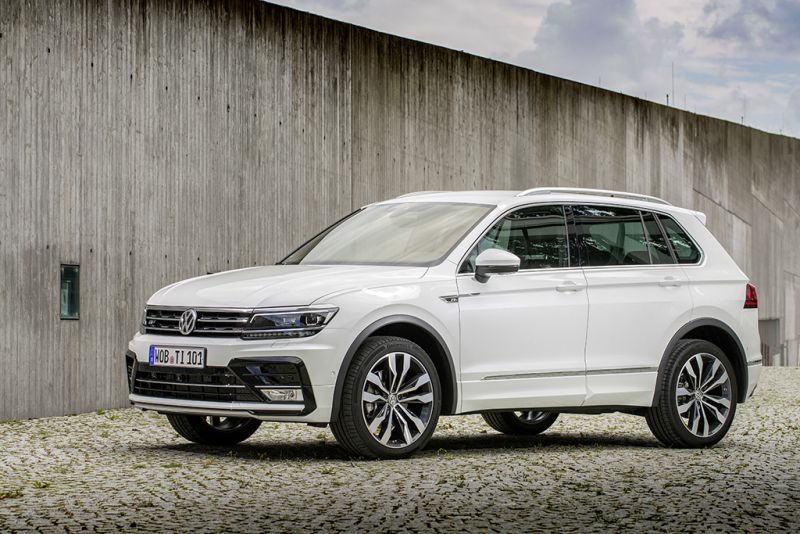
The Volkswagen Tiguan II 2.0 TSI (230 Hp) 4MOTION DSG is a compact SUV produced by the German manufacturer Volkswagen from 2019 to 2020. Representing the second generation of the Tiguan, this model aimed to refine the original’s formula with improved technology, increased space, and enhanced driving dynamics. While not initially a major seller in the US market (the Tiguan sold in North America is a lengthened version based on the Chinese market vehicle), the Tiguan II was a significant player in the European market, competing with vehicles like the Nissan Qashqai, Hyundai Tucson, and Kia Sportage. This particular variant, equipped with the 2.0-liter TSI engine and 4MOTION all-wheel-drive system, offered a balance of performance and practicality for European consumers.
Volkswagen Tiguan II: An Overview
The Tiguan II marked a substantial evolution from its predecessor. Built on the Volkswagen Group’s MQB platform, it offered a more sophisticated driving experience and a more spacious interior. The 2.0 TSI 4MOTION DSG model specifically targeted drivers seeking a responsive and capable SUV, suitable for both daily commutes and longer journeys. The inclusion of the 4MOTION system provided enhanced traction and stability in various weather conditions, a key selling point in many European countries. The DSG (Direct-Shift Gearbox) further contributed to a smooth and efficient driving experience.
Engine & Performance
At the heart of the Tiguan II 2.0 TSI 4MOTION DSG lies a 1.984-liter (121.07 cubic inches) inline-four cylinder engine, turbocharged and direct-injected. This engine produces 230 horsepower at 4500 rpm and 350 Newton-meters (258.15 lb-ft) of torque between 1500 and 4400 rpm. This output translates to a brisk 0-100 km/h (0-62 mph) acceleration time of 6.3 seconds, and a 0-60 mph time of approximately 6 seconds. The engine’s power-to-weight ratio is 7.1 kg/Hp, and the power per liter is 115.9 Hp/l. The engine is paired with a seven-speed dual-clutch DSG transmission, which provides quick and seamless gear changes. The 4MOTION all-wheel-drive system intelligently distributes power between the front and rear axles, optimizing traction and handling. Fuel consumption is rated at 7.4-7.6 liters per 100 kilometers (31.8-30.9 US mpg) combined, with CO2 emissions ranging from 167-174 g/km, meeting Euro 6d-TEMP-EVAP-ISC emission standards.
Design & Features
The Tiguan II features a modern and understated SUV design. Its body style is a traditional five-door SUV with five seats. The vehicle measures 4486 mm (176.61 inches) in length, 1839 mm (72.4 inches) in width, and 1673 mm (65.87 inches) in height. The wheelbase is 2677 mm (105.39 inches). Inside, the Tiguan II offers a practical and well-appointed cabin. Trunk space is generous, ranging from 615 liters (21.72 cubic feet) with the rear seats up to 1655 liters (58.45 cubic feet) with them folded down. Standard features included air conditioning, power windows, and a comprehensive suite of safety systems, including ABS (Anti-lock Braking System). The vehicle’s ride height (ground clearance) is 200 mm (7.87 inches), providing adequate capability for light off-road driving. The Tiguan II also incorporates features like a Start & Stop system and a particulate filter to improve fuel efficiency and reduce emissions.
Technical Specifications
| Brand | Volkswagen |
| Model | Tiguan |
| Generation | Tiguan II |
| Type (Engine) | 2.0 TSI (230 Hp) 4MOTION DSG |
| Start of production | 2019 |
| End of production | 2020 |
| Powertrain Architecture | Internal Combustion engine |
| Body type | SUV |
| Seats | 5 |
| Doors | 5 |
| Fuel consumption (urban) | 8.6-9.0 l/100 km (27.4 – 26.1 US mpg) |
| Fuel consumption (extra urban) | 6.6-6.9 l/100 km (35.6 – 34.1 US mpg) |
| Fuel consumption (combined) | 7.4-7.6 l/100 km (31.8 – 30.9 US mpg) |
| CO2 emissions | 167-174 g/km |
| Fuel Type | Petrol (Gasoline) |
| Acceleration 0 – 100 km/h | 6.3 sec |
| Acceleration 0 – 62 mph | 6.3 sec |
| Acceleration 0 – 60 mph | 6 sec |
| Maximum speed | 228 km/h (141.67 mph) |
| Emission standard | Euro 6d-TEMP-EVAP-ISC |
| Weight-to-power ratio | 7.1 kg/Hp |
| Weight-to-torque ratio | 4.7 kg/Nm |
| Power | 230 Hp @ 4500 rpm |
| Torque | 350 Nm @ 1500-4400 rpm (258.15 lb.-ft. @ 1500-4400 rpm) |
| Engine layout | Front, Transverse |
| Engine Model/Code | DKTA |
| Engine displacement | 1984 cm3 (121.07 cu. in.) |
| Number of cylinders | 4 |
| Engine configuration | Inline |
| Number of valves per cylinder | 4 |
| Fuel injection system | Direct injection |
| Engine aspiration | Turbocharger, Intercooler |
| Engine oil capacity | 5.7 l (6.02 US qt | 5.02 UK qt) |
| Kerb Weight | 1635 kg (3604.56 lbs.) |
| Max. weight | 2280 kg (5026.54 lbs.) |
| Max load | 645 kg (1421.98 lbs.) |
| Trunk (boot) space – minimum | 615 l (21.72 cu. ft.) |
| Trunk (boot) space – maximum | 1655 l (58.45 cu. ft.) |
| Fuel tank capacity | 60 l (15.85 US gal | 13.2 UK gal) |
| Max. roof load | 75 kg (165.35 lbs.) |
| Permitted trailer load with brakes (12%) | 2500 kg (5511.56 lbs.) |
| Permitted trailer load without brakes | 750 kg (1653.47 lbs.) |
| Permitted towbar download | 100 kg (220.46 lbs.) |
| Length | 4486 mm (176.61 in.) |
| Width | 1839 mm (72.4 in.) |
| Width including mirrors | 2099 mm (82.64 in.) |
| Height | 1673 mm (65.87 in.) |
| Wheelbase | 2677 mm (105.39 in.) |
| Front track | 1576-1586 mm (62.05 – 62.44 in.) |
| Rear (Back) track | 1566-1576 mm (61.65 – 62.05 in.) |
| Ride height (ground clearance) | 200 mm (7.87 in.) |
| Minimum turning circle (turning diameter) | 11.5 m (37.73 ft.) |
| Drivetrain Architecture | All wheel drive (4×4). ICE drives front wheels, rear wheels driven by clutch. |
| Number of gears and type of gearbox | 7 gears, automatic transmission DSG |
| Front brakes | Ventilated discs |
| Rear brakes | Disc |
| Steering type | Steering rack and pinion |
| Power steering | Electric Steering |
| Tires size | 235/55 R18 |
| Wheel rims size | 7J x 18 |
The Volkswagen Tiguan II 2.0 TSI 4MOTION DSG represented a well-rounded package for buyers seeking a practical, comfortable, and capable compact SUV. Its combination of a potent engine, sophisticated all-wheel-drive system, and spacious interior made it a popular choice in the European market.