
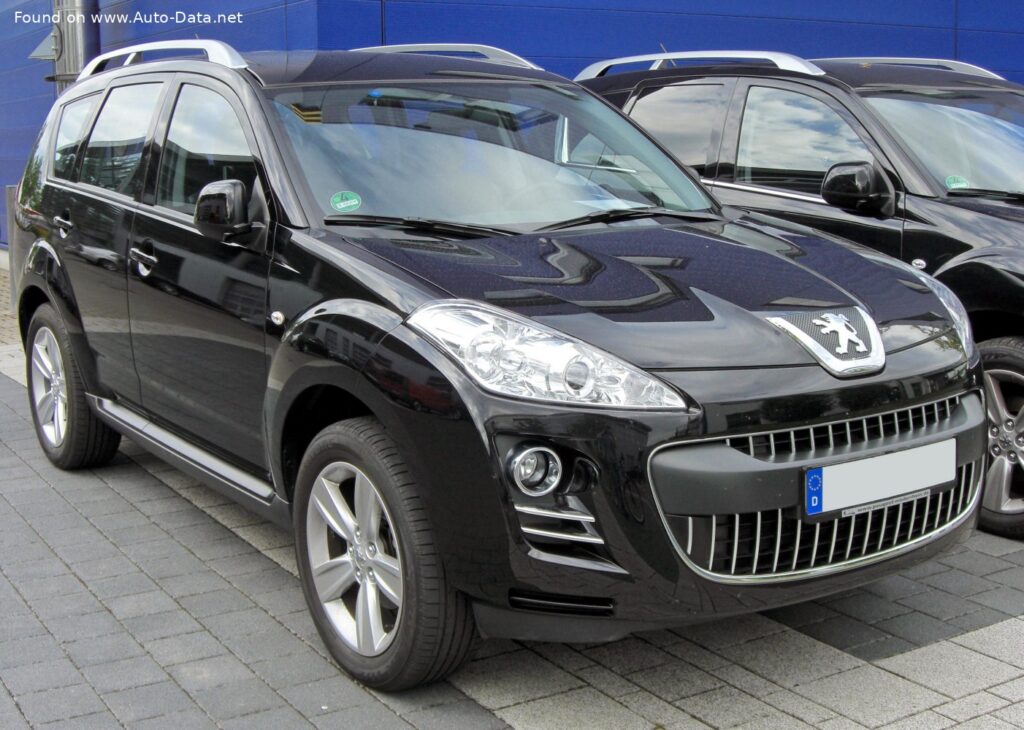
The Peugeot 4007 is a compact SUV produced by the French manufacturer Peugeot between 2007 and 2009. This vehicle represents Peugeot’s entry into the growing SUV market of the late 2000s, and was notable for being a rebadged version of the Mitsubishi Outlander, a result of a collaborative venture between the two automakers. The 4007 was primarily sold in Europe, Australia, and Asia, and was not officially offered in the North American market. It aimed to provide a blend of practicality, comfort, and a degree of off-road capability within a relatively affordable package.
Peugeot 4007: Overview and Market Positioning
The Peugeot 4007 was designed to compete with established players in the compact SUV segment, such as the Honda CR-V, Toyota RAV4, and Nissan X-Trail. Its development stemmed from a strategic partnership between Peugeot Citroën and Mitsubishi Motors, resulting in a shared platform and mechanical components. While marketed under the Peugeot brand, the 4007 shares a significant amount of its architecture with the Mitsubishi Outlander, including its engine, transmission, and all-wheel-drive system. This collaboration allowed Peugeot to quickly enter the SUV market without the substantial investment required for independent development. The 4007 offered a five-seat configuration and a focus on family-oriented practicality.
Engine & Performance
The Peugeot 4007 2.4 l 16V is powered by a 2.4-liter inline-four cylinder gasoline engine. This naturally aspirated engine produces 170 horsepower (Hp) and 232 Newton-meters (171.11 lb.-ft.) of torque. The engine utilizes a multi-port fuel injection system and features 16 valves (four valves per cylinder). Power is delivered to all four wheels via a six-speed manual transmission and an all-wheel-drive system. Acceleration from 0 to 100 km/h (0-62 mph) takes 9.6 seconds, while 0 to 60 mph is achieved in approximately 9.1 seconds. The vehicle has a maximum speed of 191 km/h (118.68 mph). Fuel economy is rated at 9.5 liters per 100 kilometers (24.8 US mpg) combined, with 12.6 l/100 km (18.7 US mpg) in urban conditions and 7.6 l/100 km (30.9 US mpg) on the extra-urban cycle. The engine’s power-to-weight ratio is 10.5 kg/Hp, and the torque-to-weight ratio is 7.7 kg/Nm.
Design & Features
The Peugeot 4007 boasts a typical SUV body style, characterized by a raised ride height, a spacious interior, and a practical cargo area. It features a five-door configuration and offers seating for five passengers. The exterior design incorporates Peugeot’s styling cues of the era, with a prominent front grille and sculpted body lines. Inside, the 4007 provides a comfortable and functional cabin, with a focus on practicality and ease of use. Standard features include air conditioning, power windows, and a basic audio system. Safety features, important for the target family demographic, include ABS (Anti-lock Braking System) and front ventilated disc brakes, with disc brakes on the rear axle. The trunk offers a minimum capacity of 510 liters (18.01 cu. ft.), expanding to 1686 liters (59.54 cu. ft.) with the rear seats folded down. The vehicle’s dimensions are: length 4636 mm (182.52 in.), width 1805 mm (71.06 in.), and height 1715 mm (67.52 in.).
Technical Specifications
| Brand | Peugeot |
| Model | 4007 |
| Generation | 4007 |
| Type (Engine) | 2.4 l 16V (170 Hp) |
| Start of production | 2007 |
| End of production | 2009 |
| Powertrain Architecture | Internal Combustion engine |
| Body type | SUV |
| Seats | 5 |
| Doors | 5 |
| Fuel consumption (urban) | 12.6 l/100 km (18.7 US mpg) |
| Fuel consumption (extra urban) | 7.6 l/100 km (30.9 US mpg) |
| Fuel consumption (combined) | 9.5 l/100 km (24.8 US mpg) |
| Fuel Type | Petrol (Gasoline) |
| Acceleration 0 – 100 km/h | 9.6 sec |
| Acceleration 0 – 62 mph | 9.6 sec |
| Acceleration 0 – 60 mph | 9.1 sec |
| Maximum speed | 191 km/h (118.68 mph) |
| Emission standard | Euro 4 |
| Weight-to-power ratio | 10.5 kg/Hp |
| Weight-to-torque ratio | 7.7 kg/Nm |
| Power | 170 Hp |
| Power per litre | 71.5 Hp/l |
| Torque | 232 Nm (171.11 lb.-ft.) |
| Engine layout | Front, Transverse |
| Engine Model/Code | SFZ 4B12-MMC |
| Engine displacement | 2378 cm3 (145.11 cu. in.) |
| Number of cylinders | 4 |
| Engine configuration | Inline |
| Number of valves per cylinder | 4 |
| Fuel injection system | Multi-port manifold injection |
| Engine aspiration | Naturally aspirated engine |
| Engine oil capacity | 4.5 l (4.76 US qt | 3.96 UK qt) |
| Coolant capacity | 7.5 l (7.93 US qt | 6.6 UK qt) |
| Kerb Weight | 1790 kg (3946.27 lbs.) |
| Max. weight | 2410 kg (5313.14 lbs.) |
| Max load | 620 kg (1366.87 lbs.) |
| Trunk (boot) space – minimum | 510 l (18.01 cu. ft.) |
| Trunk (boot) space – maximum | 1686 l (59.54 cu. ft.) |
| Fuel tank capacity | 60 l (15.85 US gal | 13.2 UK gal) |
| Length | 4636 mm (182.52 in.) |
| Width | 1805 mm (71.06 in.) |
| Height | 1715 mm (67.52 in.) |
| Wheelbase | 2670 mm (105.12 in.) |
| Front track | 1540 mm (60.63 in.) |
| Rear track | 1540 mm (60.63 in.) |
| Minimum turning circle | 12 m (39.37 ft.) |
| Drive wheel | All wheel drive (4×4) |
| Number of gears | 6 gears, manual transmission |
| Front suspension | Independent, type McPherson with coil spring and anti-roll bar |
| Rear suspension | Independent multi-link spring suspension with stabilizer |
| Front brakes | Ventilated discs |
| Rear brakes | Disc |
| Assisting systems | ABS (Anti-lock braking system) |
| Steering type | Steering rack and pinion |
| Power steering | Hydraulic Steering |
| Tires size | 215/70 R16; 225/55 R18 |
The Peugeot 4007, while not a long-lived model, represents an important step for Peugeot into the competitive SUV market. Its reliance on a collaborative platform with Mitsubishi allowed for a relatively quick and cost-effective entry, offering consumers a practical and capable vehicle within its segment.
