
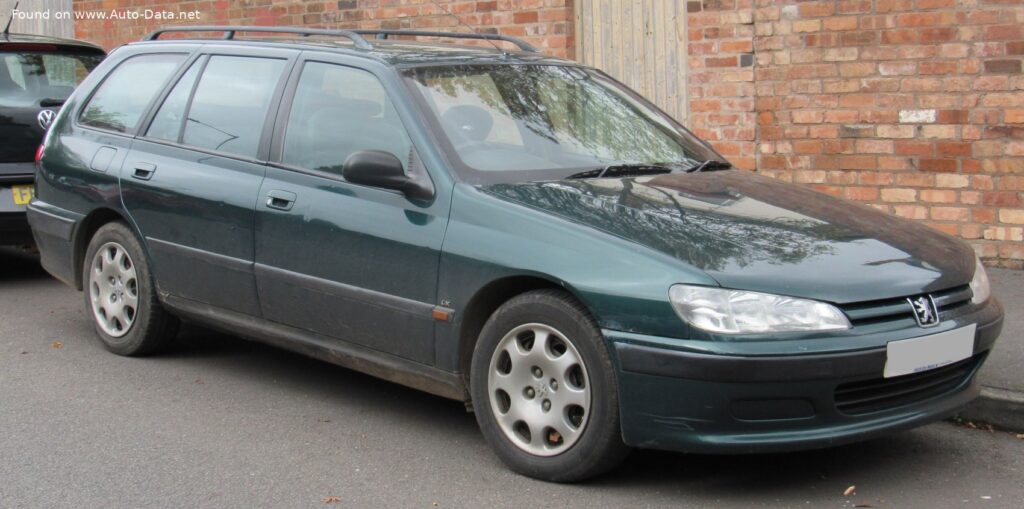
The Peugeot 406 Break (Phase I), introduced in 1996, represents a significant offering from the French automaker in the mid-size family car segment. Specifically, the 1.8-liter variant, producing 90 horsepower, was aimed at buyers seeking a practical and economical station wagon. While not initially sold in the United States, the 406 Break was a popular choice in Europe, known for its comfortable ride, spacious interior, and appealing design. This model, part of the broader 406 range produced between 1995 and 2004, offered a compelling alternative to rivals like the Ford Mondeo Estate and Volkswagen Passat Variant.
The Peugeot 406 Break: A European Family Hauler
The 406 Break, as a station wagon derivative of the 406 sedan, expanded the model’s appeal to families and those requiring increased cargo capacity. The “Break” designation, traditional for Peugeot’s estate cars, signified a focus on practicality without sacrificing the brand’s reputation for style. The Phase I models, produced from 1996 to 1999, established the core design and mechanical features that would define the 406 Break throughout its production run. It was positioned as a more affordable and accessible option within the 406 lineup, catering to a broader customer base.
Engine & Performance
The 1.8-liter inline-four cylinder engine, designated LFX XU7JB, is the heart of this particular 406 Break variant. Producing 90 horsepower at 5000 rpm and 147 Nm (108.42 lb-ft) of torque at 2600 rpm, the engine prioritizes fuel efficiency and drivability over outright performance. The engine features a multi-port fuel injection system and a naturally aspirated configuration, delivering a smooth and predictable power delivery. Paired with a 5-speed manual transmission, the 406 Break achieves a balance between responsiveness and economy. The weight-to-power ratio of 14.4 kg/Hp and weight-to-torque ratio of 8.8 kg/Nm reflect the car’s focus on practicality rather than sporty acceleration. Fuel consumption figures are rated at 11.8 l/100 km (19.9 US mpg) in urban conditions, 6.4 l/100 km (36.8 US mpg) on the extra-urban cycle, and 8.4 l/100 km (28 US mpg) combined. CO2 emissions are rated at 205 g/km.
Design & Features
The Peugeot 406 Break boasts a classic station wagon profile, characterized by a long roofline extending to the rear of the vehicle. The Phase I models feature a distinct front-end design with characteristic Peugeot styling cues of the era. Inside, the 406 Break offers seating for five passengers and a generous cargo area, making it well-suited for family transportation and hauling goods. While not laden with advanced technology by modern standards, the 406 Break offered a reasonable level of equipment for its time, including hydraulic power steering and an anti-lock braking system (ABS) as standard or optional features. The McPherson strut front suspension and independent multi-link rear suspension contribute to a comfortable ride quality. The interior design prioritized ergonomics and practicality, with a focus on providing a comfortable and functional space for both driver and passengers. Safety features, while limited compared to contemporary vehicles, included seatbelts and the aforementioned ABS system.
Technical Specifications
| Brand | Peugeot |
| Model | 406 |
| Generation | 406 Break (Phase I, 1996) |
| Type (Engine) | 1.8 (90 Hp) |
| Start of production | 1997 |
| End of production | 1999 |
| Powertrain Architecture | Internal Combustion engine |
| Body type | Station wagon (estate) |
| Seats | 5 |
| Doors | 5 |
| Fuel consumption (urban) | 11.8 l/100 km (19.9 US mpg) |
| Fuel consumption (extra urban) | 6.4 l/100 km (36.8 US mpg) |
| Fuel consumption (combined) | 8.4 l/100 km (28 US mpg) |
| CO2 emissions | 205 g/km |
| Fuel Type | Petrol (Gasoline) |
| Weight-to-power ratio | 14.4 kg/Hp |
| Weight-to-torque ratio | 8.8 kg/Nm |
| Power | 90 Hp @ 5000 rpm |
| Torque | 147 Nm @ 2600 rpm (108.42 lb.-ft. @ 2600 rpm) |
| Engine layout | Front, Transverse |
| Engine Model/Code | LFX XU7JB |
| Engine displacement | 1761 cm3 (107.46 cu. in.) |
| Number of cylinders | 4 |
| Engine configuration | Inline |
| Cylinder Bore | 83 mm (3.27 in.) |
| Piston Stroke | 81.4 mm (3.2 in.) |
| Number of valves per cylinder | 2 |
| Fuel injection system | Multi-port manifold injection |
| Engine aspiration | Naturally aspirated |
| Valvetrain | OHC |
| Engine oil capacity | 4.5 l (4.76 US qt | 3.96 UK qt) |
| Coolant | 8 l (8.45 US qt | 7.04 UK qt) |
| Kerb Weight | 1300 kg (2866.01 lbs.) |
| Max. weight | 1950 kg (4299.01 lbs.) |
| Max load | 650 kg (1433 lbs.) |
| Permitted trailer load with brakes (12%) | 1150 kg (2535.32 lbs.) |
| Length | 4740 mm (186.61 in.) |
| Width | 1760 mm (69.29 in.) |
| Height | 1505 mm (59.25 in.) |
| Wheelbase | 2700 mm (106.3 in.) |
| Front track | 1500 mm (59.06 in.) |
| Rear track | 1480 mm (58.27 in.) |
| Front overhang | 937 mm (36.89 in.) |
| Rear overhang | 1103 mm (43.43 in.) |
| Drivetrain | Front wheel drive |
| Number of gears | 5, manual transmission |
| Front suspension | Independent, McPherson with coil spring and anti-roll bar |
| Rear suspension | Independent multi-link spring suspension with stabilizer |
| Front brakes | Ventilated discs |
| Rear brakes | Disc |
| Assisting systems | ABS (Anti-lock braking system) |
| Steering type | Steering rack and pinion |
| Power steering | Hydraulic |
| Tires size | 205/60 R15 |
| Wheel rims size | 15 |
The Peugeot 406 Break (Phase I) 1.8 represents a practical and well-rounded family car from the 1990s. While not a performance machine, its focus on comfort, space, and fuel efficiency made it a popular choice for European buyers. Its enduring appeal lies in its blend of French style and functional design, offering a compelling alternative in the competitive mid-size station wagon segment.
