
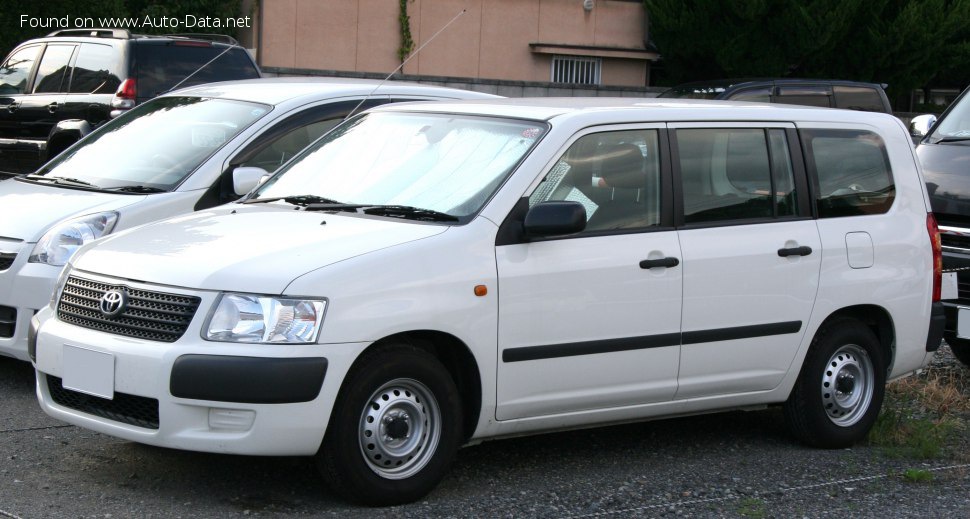
The Toyota Succeed 1.5 i (109 Hp) is a compact station wagon produced by Toyota from 2002 to 2014. While not officially sold in the United States, the Succeed played a significant role in the Japanese domestic market (JDM) as a practical and versatile vehicle aimed at families and commercial users. It served as a direct competitor to other small estate cars popular in Asia and Europe, offering a blend of affordability, fuel efficiency, and cargo space. The Succeed was primarily marketed towards those needing a reliable vehicle for daily commuting and light commercial duties.
Toyota Succeed 1.5 i: An Overview
The Succeed, positioned as a no-frills, utilitarian vehicle, focused on providing maximum functionality within a compact footprint. It was designed to be a workhorse, prioritizing practicality over luxury. The 1.5 i variant, powered by the 1NZ-FE engine, represented the mainstream offering in the Succeed lineup, balancing performance with fuel economy. Its five-door body style and spacious interior made it a popular choice for small businesses and families needing a flexible vehicle for both passenger and cargo transport. The Succeed’s design language was typical of early 2000s Japanese automotive aesthetics – functional and understated.
Engine & Performance
The Toyota Succeed 1.5 i is equipped with the 1NZ-FE 1.5-liter inline-four cylinder gasoline engine. This naturally aspirated engine produces 109 horsepower at 6000 rpm and 141 Nm (104 lb.-ft.) of torque at 4200 rpm. While not a performance-oriented vehicle, the 1NZ-FE provides adequate power for everyday driving conditions. The engine’s power-to-weight ratio of 105.8 Hp/tonne allows for reasonable acceleration, and its torque-to-weight ratio of 136.9 Nm/tonne ensures sufficient pulling power. The engine utilizes a multi-port fuel injection system and a double overhead camshaft (DOHC) valvetrain for efficient combustion and improved performance. The engine’s 10.5:1 compression ratio contributes to its fuel efficiency. The front-engine, front-wheel-drive configuration further enhances fuel economy and simplifies the drivetrain. The engine requires 3.7 liters (3.91 US quarts) of engine oil, specified to Toyota’s standards.
Design & Features
The Toyota Succeed features a traditional station wagon (estate) body style with five doors and seating for five passengers. Its design prioritizes practicality and cargo capacity. The interior is designed with durability and ease of cleaning in mind, reflecting its target market. While not laden with luxury features, the Succeed offered essential amenities such as air conditioning, power steering, and basic audio systems. Safety features, while limited by the standards of the early 2000s, included ventilated disc brakes on the front wheels and drum brakes on the rear. The vehicle’s dimensions – 4300 mm (169.29 in) in length, 1695 mm (66.73 in) in width, and 1525 mm (60.04 in) in height – provide a spacious interior without being overly cumbersome to maneuver. The wheelbase of 2550 mm (100.39 in) contributes to a stable ride. The front and rear track widths are 1455 mm (57.28 in) and 1465 mm (57.68 in) respectively. The vehicle rides on 175/65 R14 tires.
Technical Specifications
| Brand | Toyota |
| Model | Succeed |
| Generation | Succeed |
| Type (Engine) | 1.5 i (109 Hp) |
| Start of production | 2002 year |
| End of production | 2014 year |
| Powertrain Architecture | Internal Combustion engine |
| Body type | Station wagon (estate) |
| Seats | 5 |
| Doors | 5 |
| Fuel Type | Petrol (Gasoline) |
| Weight-to-power ratio | 9.4 kg/Hp |
| Hp/tonne | 105.8 Hp/tonne |
| Weight-to-torque ratio | 7.3 kg/Nm |
| Nm/tonne | 136.9 Nm/tonne |
| Power | 109 Hp @ 6000 rpm |
| Power per litre | 72.8 Hp/l |
| Torque | 141 Nm @ 4200 rpm |
| Torque (lb.-ft.) | 104 lb.-ft. @ 4200 rpm |
| Engine layout | Front, Transverse |
| Engine Model/Code | 1NZ-FE |
| Engine displacement | 1497 cm3 |
| Engine displacement (cu. in.) | 91.35 cu. in. |
| Number of cylinders | 4 |
| Engine configuration | Inline |
| Cylinder Bore | 75 mm |
| Cylinder Bore (in.) | 2.95 in. |
| Piston Stroke | 84.7 mm |
| Piston Stroke (in.) | 3.33 in. |
| Compression ratio | 10.5:1 |
| Number of valves per cylinder | 4 |
| Fuel injection system | Multi-port manifold injection |
| Engine aspiration | Naturally aspirated engine |
| Valvetrain | DOHC |
| Engine oil capacity | 3.7 l |
| Engine oil capacity (US qt) | 3.91 US qt |
| Engine oil capacity (UK qt) | 3.26 UK qt |
| Kerb Weight | 1030 kg |
| Kerb Weight (lbs.) | 2270.76 lbs. |
| Fuel tank capacity | 50 l |
| Fuel tank capacity (US gal) | 13.21 US gal |
| Fuel tank capacity (UK gal) | 11 UK gal |
| Length | 4300 mm |
| Length (in.) | 169.29 in. |
| Width | 1695 mm |
| Width (in.) | 66.73 in. |
| Height | 1525 mm |
| Height (in.) | 60.04 in. |
| Wheelbase | 2550 mm |
| Wheelbase (in.) | 100.39 in. |
| Front track | 1455 mm |
| Front track (in.) | 57.28 in. |
| Rear track | 1465 mm |
| Rear track (in.) | 57.68 in. |
| Drivetrain Architecture | Front wheel drive |
| Front brakes | Ventilated discs |
| Rear brakes | Drum |
| Tires size | 175/65 R14 |
In conclusion, the Toyota Succeed 1.5 i (109 Hp) was a practical and reliable station wagon designed for the demands of the Japanese market. While not known for its performance or luxury, it offered a compelling combination of affordability, fuel efficiency, and cargo space, making it a popular choice for families and businesses alike. Its simple, durable design and efficient engine ensured its longevity and cemented its place as a workhorse vehicle in its segment.

