
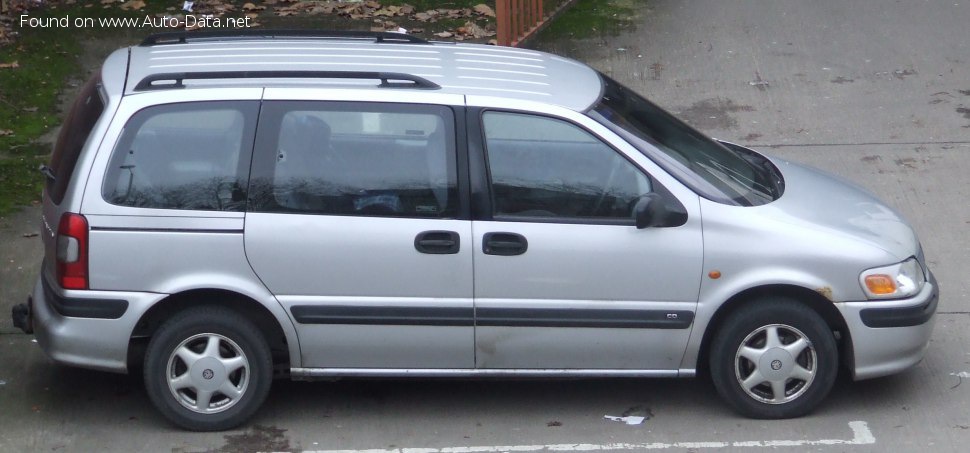
The Vauxhall Sintra 2.2i 16V, produced between 1997 and 1999, was a large, seven-seat minivan aimed at families needing substantial space and practicality. While marketed under the Vauxhall brand in the United Kingdom, the Sintra was a product of a joint venture between Vauxhall (then part of General Motors), Peugeot, and Citroën. This collaboration resulted in three nearly identical vehicles – the Vauxhall Sintra, the Peugeot 806, and the Citroën Evasion/Synergie – each tailored to their respective brand identities and markets. The Sintra, specifically, represented Vauxhall’s entry into the growing European minivan segment, competing with models like the Renault Espace and Ford Galaxy. It was never officially sold in the United States.
The Vauxhall Sintra 2.2i 16V: A European People Carrier
The Sintra was designed to offer a versatile and comfortable transportation solution for larger families. Its key selling points were its spacious interior, flexible seating arrangements, and relatively affordable price point within the premium minivan category. The vehicle’s design prioritized functionality over sporty aesthetics, reflecting the needs of its target demographic. The Sintra’s production run was relatively short, ending in 1999, due in part to evolving market preferences and the introduction of newer, more competitive models from the joint venture partners.
Engine & Performance
The 2.2i 16V variant of the Sintra was powered by a 2.2-liter inline four-cylinder gasoline engine, designated the X22XE. This engine produced 141 horsepower at 5400 rpm and 274 Nm (202.09 lb-ft) of torque at 2600 rpm. While not a performance-oriented vehicle, the engine provided adequate power for everyday driving and highway cruising, especially considering the Sintra’s considerable weight. The engine featured multi-port fuel injection and a double overhead camshaft (DOHC) valvetrain, contributing to its relatively efficient operation. Power delivery was smooth and predictable, prioritizing usability over outright acceleration. The Sintra 2.2i 16V could accelerate from 0 to 60 mph in approximately 12.2 seconds and achieve a maximum speed of 189 km/h (117.44 mph). Fuel economy figures were respectable for its class and size, averaging around 34.1 US mpg (6.9 l/100 km) on a combined cycle.
Design & Features
The Vauxhall Sintra was a five-door minivan with a boxy, utilitarian design. Its large glass area maximized visibility for all occupants, and the sliding rear doors provided easy access to the second and third-row seats. The interior was designed with practicality in mind, offering a configurable seating arrangement that allowed for various cargo and passenger configurations. The seven seats could be folded, tumbled, or even removed entirely to create a large, flat cargo area. Standard features included power steering, central locking, and anti-lock brakes (ABS). Higher trim levels offered additional amenities such as air conditioning, electric windows, and a radio/cassette player. Safety features, while limited by the standards of the time, included seatbelts for all occupants and the aforementioned ABS system. The Sintra’s focus was on providing a comfortable and functional space for families, rather than offering luxurious appointments or cutting-edge technology.
Technical Specifications
| Brand | Vauxhall |
| Model | Sintra |
| Generation | Sintra |
| Type (Engine) | 2.2i 16V (141 Hp) |
| Start of production | 1997 |
| End of production | 1999 |
| Powertrain Architecture | Internal Combustion engine |
| Body type | Minivan |
| Seats | 7 |
| Doors | 5 |
| Fuel consumption (urban) | 8.9 l/100 km (26.4 US mpg) |
| Fuel consumption (extra urban) | 5.2 l/100 km (45.2 US mpg) |
| Fuel consumption (combined) | 6.9 l/100 km (34.1 US mpg) |
| Fuel Type | Petrol (Gasoline) |
| Acceleration 0 – 100 km/h | 12.8 sec |
| Acceleration 0 – 62 mph | 12.8 sec |
| Acceleration 0 – 60 mph | 12.2 sec |
| Maximum speed | 189 km/h (117.44 mph) |
| Weight-to-power ratio | 11.7 kg/Hp |
| Weight-to-torque ratio | 6 kg/Nm |
| Power | 141 Hp @ 5400 rpm |
| Torque | 274 Nm @ 2600 rpm (202.09 lb.-ft. @ 2600 rpm) |
| Engine layout | Front, Transverse |
| Engine Model/Code | X22XE |
| Engine displacement | 2198 cm3 (134.13 cu. in.) |
| Number of cylinders | 4 |
| Engine configuration | Inline |
| Cylinder Bore | 86 mm (3.39 in.) |
| Piston Stroke | 94.6 mm (3.72 in.) |
| Compression ratio | 10.5:1 |
| Number of valves per cylinder | 4 |
| Fuel injection system | Multi-port manifold injection |
| Engine aspiration | Naturally aspirated |
| Engine oil capacity | 4.25 l (4.49 US qt | 3.74 UK qt) |
| Coolant capacity | 5.9 l (6.23 US qt | 5.19 UK qt) |
| Kerb Weight | 1655 kg (3648.65 lbs.) |
| Max. weight | 2345 kg (5169.84 lbs.) |
| Max load | 690 kg (1521.19 lbs.) |
| Trunk (boot) space – minimum | 460 l (16.24 cu. ft.) |
| Trunk (boot) space – maximum | 3763 l (132.89 cu. ft.) |
| Fuel tank capacity | 70 l (18.49 US gal | 15.4 UK gal) |
| Length | 4670 mm (183.86 in.) |
| Width | 1830 mm (72.05 in.) |
| Height | 1711 mm (67.36 in.) |
| Wheelbase | 2845 mm (112.01 in.) |
| Front track | 1562 mm (61.5 in.) |
| Rear track | 1608 mm (63.31 in.) |
| Drag coefficient (Cd) | 0.34 |
| Minimum turning circle | 12 m (39.37 ft.) |
| Drivetrain | Front wheel drive |
| Number of gears | 5 gears, manual transmission |
| Front suspension | Independent, McPherson with coil spring and anti-roll bar |
| Front brakes | Ventilated discs |
| Rear brakes | Disc |
| Assisting systems | ABS (Anti-lock braking system) |
| Steering type | Steering rack and pinion |
| Tires size | 205/65 R15 |
| Wheel rims size | 6J x 15 |
