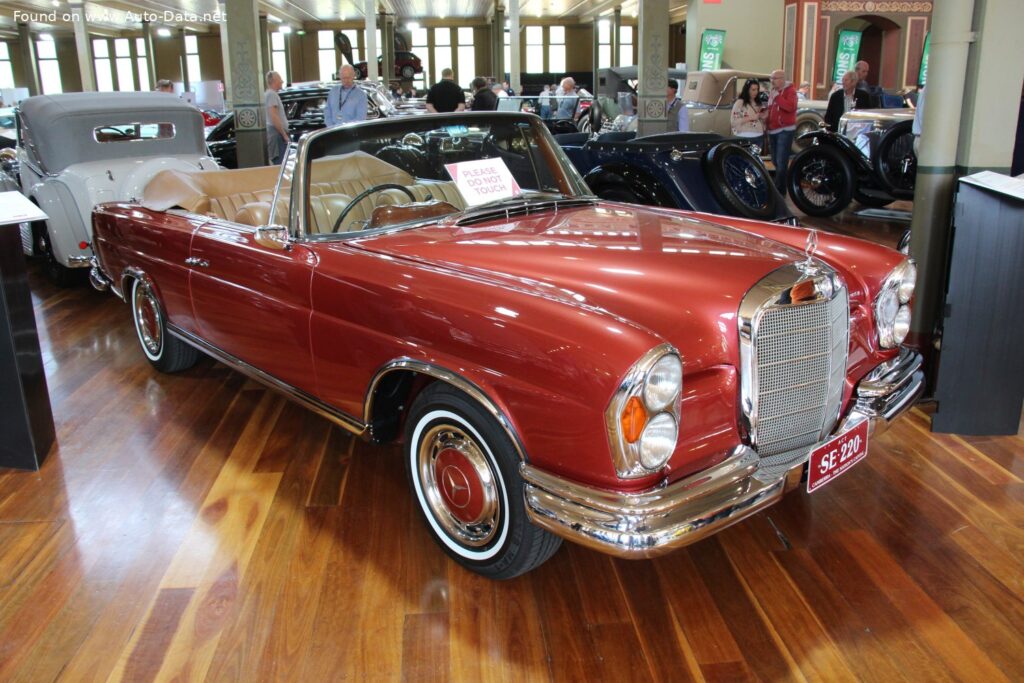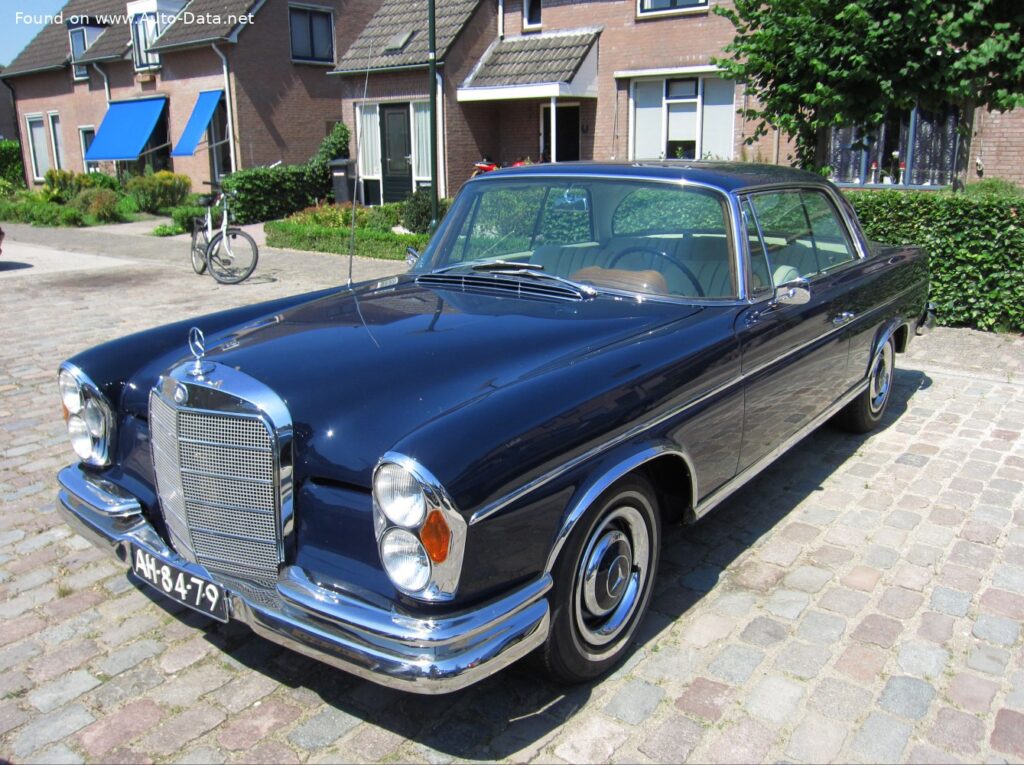
The Mercedes-Benz W112 Coupe 300 SE represents a pinnacle of early 1960s German engineering and luxury. Produced between February 1962 and January 1964, this elegant coupe was part of the larger W112 series, designed to bridge the gap between the more mass-produced “Fintail” sedans (W110) and the ultra-exclusive 300SL “Gullwing.” The 300 SE Coupe, with its sophisticated mechanicals and refined styling, catered to a discerning clientele seeking a grand touring vehicle that combined performance with unparalleled comfort. While not a high-volume seller, the W112 Coupe remains a highly sought-after classic, embodying the Mercedes-Benz commitment to quality and innovation.
The Mercedes-Benz W112 Coupe 300 SE
The W112 series, introduced in 1961, was intended as a more luxurious and technically advanced alternative to the W110. The “SE” designation stood for “Sonderausführung” (Special Edition), indicating a higher level of equipment and refinement. The Coupe variant, distinguished by its two-door body style and flowing lines, further emphasized the car’s sporting character. The 300 SE Coupe was primarily sold in Europe, and to a lesser extent, in North America, appealing to buyers who appreciated a blend of performance, luxury, and exclusivity. It served as a statement of success and good taste, representing the height of automotive sophistication in its era.
Engine & Performance
The heart of the 300 SE Coupe is its 2,996 cc (182.83 cu. in.) inline-six cylinder engine, designated M 189 I / 189.985. This engine produced 160 horsepower at 5000 rpm and 251 Nm (185.13 lb.-ft.) of torque at 3800 rpm. Notably, the engine featured multi-port manifold fuel injection – a relatively advanced technology for the time – which contributed to its smooth power delivery and improved fuel efficiency. Power per liter was a respectable 53.4 Hp/l. The engine’s longitudinal front-mounted layout and naturally aspirated design provided a balanced and responsive driving experience.
Power was transmitted to the rear wheels through a four-speed manual transmission. Acceleration from 0 to 60 mph was achieved in approximately 11.4 seconds, while 0-100 km/h took 12.0 seconds. The car’s top speed was 185 km/h (114.95 mph). The weight-to-power ratio of 9.9 kg/Hp and weight-to-torque ratio of 6.3 kg/Nm indicated a reasonably well-balanced machine for its time. Fuel consumption was rated at 13 l/100 km (18.1 US mpg, 21.7 UK mpg, 7.7 km/l), which was typical for a large, luxurious coupe of the early 1960s.
Design & Features
The W112 Coupe’s design was characterized by its elegant proportions and understated styling. The two-door coupe body offered seating for five passengers, although rear seat space was somewhat limited. The car’s long hood, flowing roofline, and relatively short rear deck created a visually appealing silhouette. The exterior was typically finished in high-quality paint, with chrome accents adding a touch of sophistication.
Inside, the 300 SE Coupe offered a luxurious and well-appointed cabin. The interior featured comfortable seating upholstered in high-quality leather, wood trim, and a comprehensive array of gauges. The car was equipped with disc brakes on all four wheels, a significant safety feature for the era. The suspension system, featuring double wishbones and a transverse stabilizer at the front, and air suspension at both front and rear, provided a smooth and comfortable ride. The steering utilized a cone worm with recirculation balls, offering precise and responsive control. The 5.5J x 13 wheel rims were standard.
Technical Specifications
| Brand | Mercedes-Benz |
| Model | W112 |
| Generation | W112 Coupe |
| Type (Engine) | 300 SE (160 Hp) |
| Start of production | February, 1962 |
| End of production | January, 1964 |
| Powertrain Architecture | Internal Combustion engine |
| Body type | Coupe |
| Seats | 5 |
| Doors | 2 |
| Fuel consumption (combined) | 13 l/100 km |
| Fuel consumption (US mpg) | 18.1 US mpg |
| Fuel consumption (UK mpg) | 21.7 UK mpg |
| Fuel consumption (km/l) | 7.7 km/l |
| Fuel Type | Petrol (Gasoline) |
| Acceleration 0 – 100 km/h | 12.0 sec |
| Acceleration 0 – 62 mph | 12.0 sec |
| Acceleration 0 – 60 mph | 11.4 sec |
| Maximum speed | 185 km/h |
| Maximum speed (mph) | 114.95 mph |
| Weight-to-power ratio | 9.9 kg/Hp |
| Weight-to-torque ratio | 6.3 kg/Nm |
| Power | 160 Hp @ 5000 rpm |
| Power per litre | 53.4 Hp/l |
| Torque | 251 Nm @ 3800 rpm |
| Torque (lb.-ft.) | 185.13 lb.-ft. @ 3800 rpm |
| Engine layout | Front, Longitudinal |
| Engine Model/Code | M 189 I / 189.985 |
| Engine displacement | 2996 cm3 |
| Engine displacement (cu. in.) | 182.83 cu. in. |
| Number of cylinders | 6 |
| Engine configuration | Inline |
| Cylinder Bore | 85 mm |
| Cylinder Bore (in.) | 3.35 in. |
| Piston Stroke | 88 mm |
| Piston Stroke (in.) | 3.46 in. |
| Compression ratio | 8.7:1 |
| Number of valves per cylinder | 2 |
| Fuel injection system | Multi-port manifold injection |
| Engine aspiration | Naturally aspirated engine |
| Valvetrain | SOHC |
| Kerb Weight | 1590 kg |
| Kerb Weight (lbs.) | 3505.35 lbs. |
| Max. weight | 2060 kg |
| Max. weight (lbs.) | 4541.52 lbs. |
| Max load | 470 kg |
| Max load (lbs.) | 1036.17 lbs. |
| Fuel tank capacity | 65 l |
| Fuel tank capacity (US gal) | 17.17 US gal |
| Fuel tank capacity (UK gal) | 14.3 UK gal |
| Length | 4880 mm |
| Length (in.) | 192.13 in. |
| Width | 1845 mm |
| Width (in.) | 72.64 in. |
| Height | 1395 mm |
| Height (in.) | 54.92 in. |
| Wheelbase | 2750 mm |
| Wheelbase (in.) | 108.27 in. |
| Front track | 1482 mm |
| Front track (in.) | 58.35 in. |
| Rear track | 1490 mm |
| Rear track (in.) | 58.66 in. |
| Drivetrain Architecture | The Internal combustion engine (ICE) drives the rear wheels of the vehicle. |
| Drive wheel | Rear wheel drive |
| Number of gears | 4 |
| Type of gearbox | manual transmission |
| Front suspension | Double wishbone, Transverse stabilizer, Air suspension |
| Rear suspension | Air suspension, Trailing arm |
| Front brakes | Disc |
| Rear brakes | Disc |
| Steering type | Cone worm with recirculation balls |
| Wheel rims size | 5.5J x 13 |