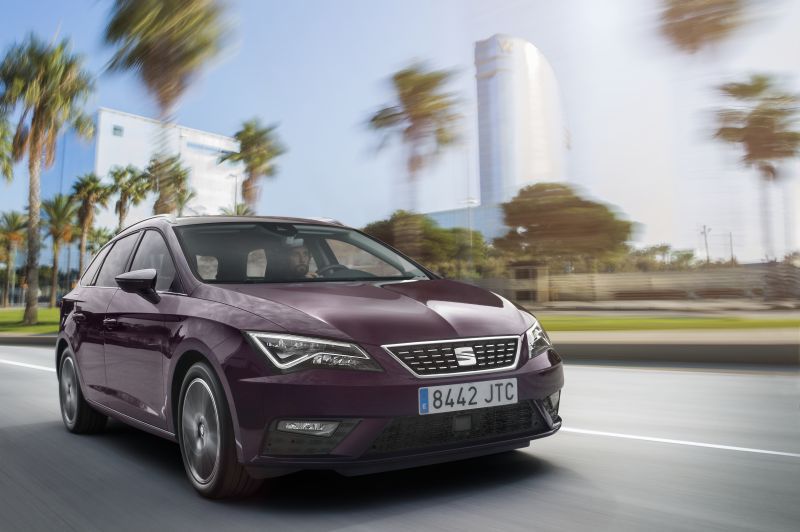
The SEAT Leon III ST Cupra 2.0 TSI (300 Hp) 4Drive DSG, produced from 2018 to 2020, represents a performance-oriented variant of SEAT’s popular compact estate car. The Leon, while not officially sold in the United States, is a significant model within the Volkswagen Group, primarily marketed in Europe. It occupies the hot hatch/sports estate segment, competing with vehicles like the Ford Focus ST and Volkswagen Golf GTI Estate. This particular iteration, the Cupra, is the high-performance version, offering increased power and enhanced handling characteristics compared to the standard Leon ST models. The “ST” designation signifies “SportTourer,” denoting the estate (wagon) body style.
SEAT Leon III ST Cupra: A Performance Estate
The third generation of the SEAT Leon, launched in 2012, brought a significant leap forward in design, technology, and driving dynamics. The facelift in 2016 refined the aesthetics and introduced updated technology. The Cupra variant, positioned as SEAT’s performance flagship, further elevates the driving experience. The 4Drive system, denoting all-wheel drive, and the DSG (Direct-Shift Gearbox) transmission are key components of its performance credentials. The Leon ST Cupra aimed to deliver a compelling blend of practicality, sporty performance, and everyday usability, appealing to drivers seeking a versatile and engaging vehicle.
Engine & Performance
At the heart of the Leon ST Cupra 2.0 TSI 4Drive DSG lies a 2.0-liter turbocharged inline-four cylinder engine. This engine, part of the Volkswagen Group’s EA888 engine family (specifically the DNUE code), produces 300 horsepower at 5,300-6,500 rpm and 400 Nm (295.02 lb.-ft.) of torque between 2,000 and 5,200 rpm. The direct injection system and turbocharger with intercooler contribute to its responsive power delivery. The engine’s 9.3:1 compression ratio is optimized for performance while maintaining reasonable efficiency. Power is transmitted to all four wheels via a sophisticated 4Drive all-wheel-drive system, which utilizes a multi-plate clutch to distribute torque between the front and rear axles as needed. This system enhances traction and stability, particularly in challenging road conditions. The seven-speed DSG dual-clutch transmission provides rapid and seamless gear changes, contributing to the car’s impressive acceleration. The Leon ST Cupra 2.0 TSI 4Drive DSG can accelerate from 0 to 100 km/h (0-62 mph) in just 4.9 seconds, and 0-60 mph in 4.7 seconds, with an electronically limited top speed of 250 km/h (155.34 mph).
Design & Features
The SEAT Leon III ST Cupra is a five-door, five-seat station wagon (estate). The facelifted model features a more aggressive front fascia with a distinctive honeycomb grille and larger air intakes, emphasizing its sporty character. Other exterior styling cues include a rear spoiler, side skirts, and quad exhaust outlets. Inside, the Cupra boasts sport seats with enhanced bolstering, a flat-bottom steering wheel, and aluminum pedals. Standard features include an infotainment system with touchscreen display, climate control, and a range of driver-assistance systems. Safety features include ABS (Anti-lock Braking System), and a comprehensive airbag system. The ST body style provides a generous 587 liters (20.73 cu. ft.) of trunk space, making it a practical choice for families or those requiring ample cargo capacity. The vehicle’s dimensions are 4548 mm (179.06 in.) in length, 1816 mm (71.5 in.) in width, and 1431 mm (56.34 in.) in height. The 4Drive system and DSG transmission are key technological features that define the Cupra’s performance capabilities.
Technical Specifications
| Brand | Seat |
| Model | Leon |
| Generation | Leon III ST (facelift 2016) |
| Type (Engine) | Cupra 2.0 TSI (300 Hp) 4Drive DSG |
| Start of production | 2018 |
| End of production | 2020 |
| Powertrain Architecture | Internal Combustion engine |
| Body type | Station wagon (estate) |
| Seats | 5 |
| Doors | 5 |
| Fuel consumption (economy) – urban (NEDC) | 9 l/100 km (26.1 US mpg, 31.4 UK mpg, 11.1 km/l) |
| Fuel consumption (economy) – extra urban (NEDC) | 6 l/100 km (39.2 US mpg, 47.1 UK mpg, 16.7 km/l) |
| Fuel consumption (economy) – combined (NEDC) | 7.1 l/100 km (33.1 US mpg, 39.8 UK mpg, 14.1 km/l) |
| CO2 emissions (NEDC) | 161 g/km |
| Fuel Type | Petrol (Gasoline) |
| Acceleration 0 – 100 km/h | 4.9 sec |
| Acceleration 0 – 62 mph | 4.9 sec |
| Acceleration 0 – 60 mph | 4.7 sec |
| Maximum speed | 250 km/h (155.34 mph) |
| Emission standard | Euro 6 BG |
| Weight-to-power ratio | 4.9 kg/Hp, 202.4 Hp/tonne |
| Weight-to-torque ratio | 3.7 kg/Nm, 269.9 Nm/tonne |
| Power | 300 Hp @ 5300-6500 rpm |
| Power per litre | 151.2 Hp/l |
| Torque | 400 Nm @ 2000-5200 rpm (295.02 lb.-ft. @ 2000-5200 rpm) |
| Engine layout | Front, Transverse |
| Engine Model/Code | EA888 / DNUE |
| Engine displacement | 1984 cm3 (121.07 cu. in.) |
| Number of cylinders | 4 |
| Engine configuration | Inline |
| Cylinder Bore | 82.5 mm (3.25 in.) |
| Piston Stroke | 92.8 mm (3.65 in.) |
| Compression ratio | 9.3:1 |
| Number of valves per cylinder | 4 |
| Fuel injection system | Direct injection |
| Engine aspiration | Turbocharger, Intercooler |
| Valvetrain | DOHC |
| Engine oil capacity | 5.7 l (6.02 US qt | 5.02 UK qt) |
| Kerb Weight | 1482 kg (3267.25 lbs.) |
| Max. weight | 2090 kg (4607.66 lbs.) |
| Max load | 608 kg (1340.41 lbs.) |
| Trunk (boot) space – minimum | 587 l (20.73 cu. ft.) |
| Fuel tank capacity | 55 l (14.53 US gal | 12.1 UK gal) |
| Max. roof load | 75 kg (165.35 lbs.) |
| Permitted trailer load with brakes (8%) | 750 kg (1653.47 lbs.) |
| Permitted trailer load with brakes (12%) | 750 kg (1653.47 lbs.) |
| Permitted trailer load without brakes | 750 kg (1653.47 lbs.) |
| Permitted towbar download | 80 kg (176.37 lbs.) |
| Length | 4548 mm (179.06 in.) |
| Width | 1816 mm (71.5 in.) |
| Width including mirrors | 1975 mm (77.76 in.) |
| Height | 1431 mm (56.34 in.) |
| Wheelbase | 2631 mm (103.58 in.) |
| Front track | 1536 mm (60.47 in.) |
| Rear (Back) track | 1510 mm (59.45 in.) |
| Front overhang | 860 mm (33.86 in.) |
| Rear overhang | 1057 mm (41.61 in.) |
| Minimum turning circle (turning diameter) | 10.5 m (34.45 ft.) |
| Drivetrain Architecture | The Internal combustion engine (ICE) drives the front wheels permanently, and the rear wheels are driven through an electrically or mechanically operated clutch if necessary. |
| Drive wheel | All wheel drive (4×4) |
| Number of gears and type of gearbox | 7 gears, automatic transmission DSG |
| Front suspension | Independent, type McPherson with coil spring and anti-roll bar |
| Rear suspension | Independent multi-link spring suspension with stabilizer |
| Front brakes | Ventilated discs, 340×30 mm |
| Rear brakes | Disc, 310×22 mm |
| Assisting systems | ABS (Anti-lock braking system) |
| Steering type | Steering rack and pinion |
| Power steering | Electric Steering |
| Tires size | 235/35 R19 |
| Wheel rims size | 8J x 19 |