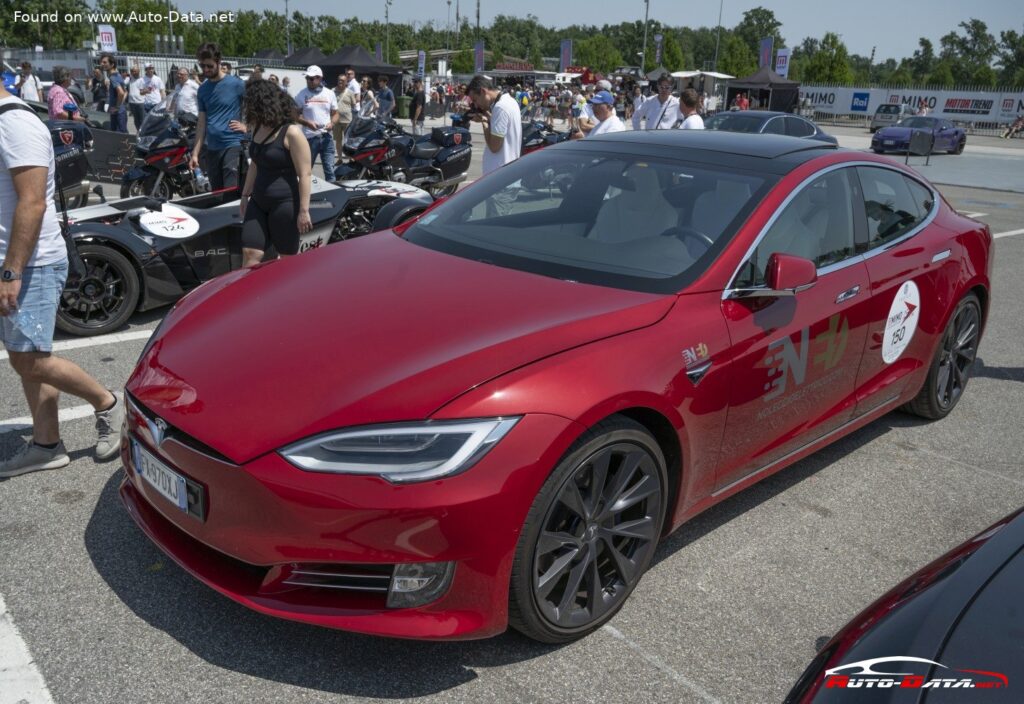
The Tesla Model S, particularly the 100D variant produced from 2017 to 2019, represents a pivotal moment in the adoption of electric vehicles. As Tesla’s flagship sedan, the Model S challenged conventional automotive norms, demonstrating that electric cars could offer both high performance and long range. The 100D, a facelifted version of the original Model S, specifically targeted range anxiety – a major barrier to EV adoption – with its larger 100 kWh battery pack. This model played a crucial role in establishing Tesla as a major player in the automotive industry and accelerating the global shift towards sustainable transportation. It competes in the premium large car segment, directly challenging established luxury brands.
Tesla Model S 100D: A Deep Dive
The 2017-2019 Tesla Model S 100D is a battery electric vehicle (BEV) designed and manufactured by Tesla, Inc. It’s part of the first generation of the Model S, which underwent a significant facelift in 2016. The “100D” designation refers to the battery pack capacity of 100 kilowatt-hours, offering a substantial increase in range compared to earlier Model S versions. The dual-motor, all-wheel-drive (AWD) configuration provides both performance and enhanced traction. The Model S 100D was positioned as a premium offering, emphasizing both luxury and technological innovation.
Engine & Performance
The Tesla Model S 100D eschews the traditional internal combustion engine in favor of a fully electric powertrain. It utilizes two independent electric motors – one driving the front wheels and one driving the rear wheels – creating an all-wheel-drive system. Each motor produces 259 horsepower at 6,100 rpm and 330 Nm (243.4 lb.-ft.) of torque. Combined, these motors deliver a total system output of 422 horsepower and 660 Nm (486.79 lb.-ft.) of torque. This configuration allows for rapid acceleration; the vehicle can achieve 0-60 mph in approximately 4.1 seconds and 0-100 km/h in 4.3 seconds. The top speed is electronically limited to 155.34 mph (250 km/h). The powertrain’s efficiency is notable, with an energy consumption of 15 kWh per 100 km (24.14 kWh per 100 miles), translating to an equivalent MPGe of 140 and a range of 6.7 km/kWh (4.1 miles/kWh). The battery pack, a lithium-ion unit with a voltage of 350V, is located beneath the vehicle floor, contributing to a low center of gravity and improved handling.
Design & Features
The Tesla Model S 100D is a five-door liftback, offering a unique blend of sedan practicality and hatchback versatility. It comfortably seats up to seven passengers, making it a viable option for families. The exterior design is characterized by its sleek, aerodynamic profile, contributing to its low drag coefficient of 0.24. This aerodynamic efficiency plays a significant role in maximizing range. Key features include a large touchscreen display that serves as the central control interface for most vehicle functions, over-the-air software updates that continuously improve the vehicle’s capabilities, and Tesla’s Autopilot system, offering advanced driver-assistance features. Safety is also a priority, with a robust suite of active and passive safety systems. The spacious interior offers a premium feel, with high-quality materials and a minimalist design aesthetic. Trunk space is generous, ranging from 745 liters (26.31 cu. ft.) with the rear seats up to 1645 liters (58.09 cu. ft.) with the seats folded down.
Technical Specifications
| Brand | Tesla |
| Model | Model S |
| Generation | Model S (facelift 2016) |
| Type | 100D 100 kWh (422 Hp) Dual Motor AWD |
| Start of production | 2017 |
| End of production | February, 2019 |
| Powertrain Architecture | BEV (Electric Vehicle) |
| Body type | Liftback |
| Seats | 7 |
| Doors | 5 |
| Fuel Type | Electricity |
| Acceleration 0 – 100 km/h | 4.3 sec |
| Acceleration 0 – 62 mph | 4.3 sec |
| Acceleration 0 – 60 mph | 4.1 sec |
| Maximum speed | 250 km/h (155.34 mph) |
| Weight-to-power ratio | 5.2 kg/Hp, 190.5 Hp/tonne |
| Weight-to-torque ratio | 3.4 kg/Nm, 298 Nm/tonne |
| Gross battery capacity | 100 kWh |
| Battery voltage | 350 V |
| Battery technology | Lithium-ion (Li-Ion) |
| Battery location | Below the floor |
| All-electric range (NEDC) | 632 km (392.71 mi) |
| Average Energy consumption (NEDC) | 15 kWh/100 km (24.14 kWh/100 mi) |
| Electric motor 1 power | 259 Hp @ 6100 rpm |
| Electric motor 1 Torque | 330 Nm (243.4 lb.-ft.) |
| Electric motor 1 Max revolutions | 18000 rpm |
| Electric motor 1 location | Rear axle, Transverse |
| Electric motor 2 power | 259 Hp @ 6100 rpm |
| Electric motor 2 Torque | 330 Nm (243.4 lb.-ft.) |
| Electric motor 2 Max revolutions | 18000 rpm |
| Electric motor 2 location | Front axle, Transverse |
| System power | 422 Hp |
| System torque | 660 Nm (486.79 lb.-ft.) |
| Kerb Weight | 2215 kg (4883.24 lbs.) |
| Max. weight | 2694 kg (5939.25 lbs.) |
| Max load | 479 kg (1056.01 lbs.) |
| Trunk (boot) space – minimum | 745 l (26.31 cu. ft.) |
| Trunk (boot) space – maximum | 1645 l (58.09 cu. ft.) |
| Max. roof load | 75 kg (165.35 lbs.) |
| Length | 4970 mm (195.67 in.) |
| Width | 1964 mm (77.32 in.) |
| Width including mirrors | 2189 mm (86.18 in.) |
| Height | 1445 mm (56.89 in.) |
| Wheelbase | 2960 mm (116.54 in.) |
| Front track | 1662 mm (65.43 in.) |
| Rear (Back) track | 1700 mm (66.93 in.) |
| Front overhang | 929 mm (36.57 in.) |
| Rear overhang | 1081 mm (42.56 in.) |
| Ride height (ground clearance) | 117-160 mm (4.61 – 6.3 in.) |
| Drag coefficient (Cd) | 0.24 |
| Minimum turning circle (turning diameter) | 11.3 m (37.07 ft.) |
| Drivetrain Architecture | One electric motor drives the front wheels, one electric motor drives the rear wheels. |
| Drive wheel | All wheel drive (4×4) |
| Number of gears and type of gearbox | 1 gears, automatic transmission |
| Front suspension | Double wishbone, Transverse stabilizer, Air suspension |
| Rear suspension | Independent multi-link suspension, Air suspension, Transverse stabilizer |
| Front brakes | Ventilated discs, 355×32 mm |
| Rear brakes | Ventilated discs, 365×28 mm |
| Assisting systems | ABS (Anti-lock braking system) |
| Steering type | Steering rack and pinion |
| Power steering | Electric Steering |
| Tires size | Front wheel tires: 245/45 R19; 245/35 R21Rear wheel tires: 245/45 R19; 265/35 R21 |
| Wheel rims size | Front wheel rims: 8J x 19; 8.5J x 21Rear wheel rims: 8J x 19; 9J x 21 |