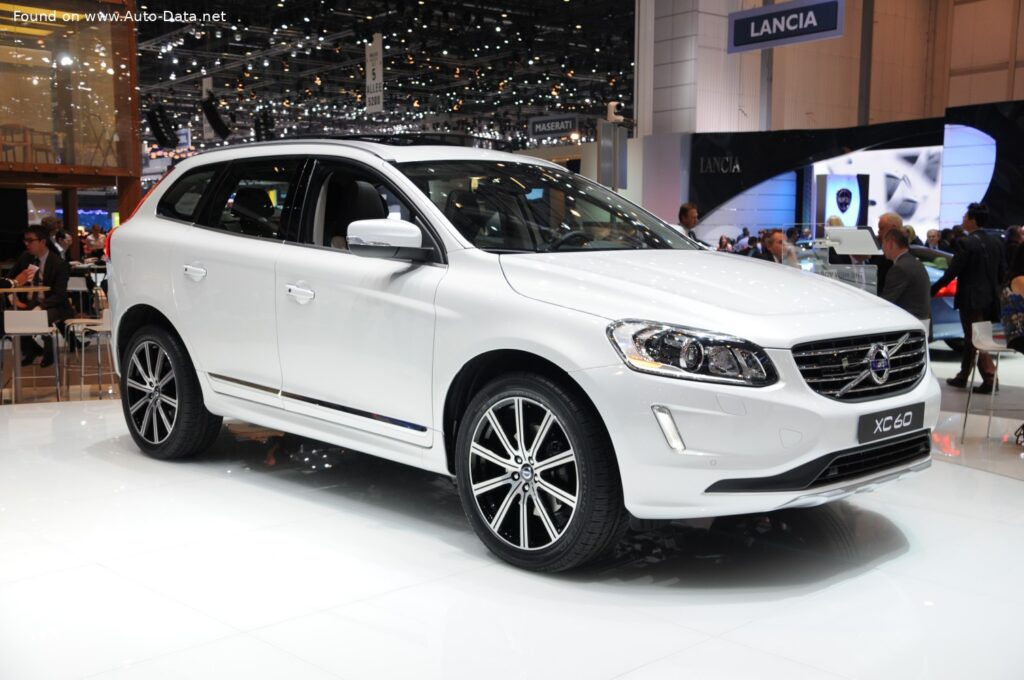
The Volvo XC60 I (2013 facelift) 2.0 D3 Automatic represents Volvo’s entry into the increasingly popular compact luxury crossover segment. Introduced as a facelift to the original XC60, produced from 2015 to 2017, this model aimed to refine the design and improve efficiency while maintaining the brand’s reputation for safety and Scandinavian design. While not initially a major seller in the United States (the XC60 gained significant traction in later generations), the XC60 I was a key model for Volvo in Europe and other international markets, competing with vehicles like the Audi Q5, BMW X3, and Mercedes-Benz GLK.
Volvo XC60 I (2013 Facelift) 2.0 D3: An Overview
The XC60 I, particularly the 2.0 D3 variant, was designed to appeal to buyers seeking a versatile and practical vehicle with a premium feel. The “D3” designation indicates a 2.0-liter diesel engine producing 150 horsepower. This engine choice was particularly popular in Europe due to favorable diesel fuel costs and tax incentives. The facelift brought subtle but noticeable changes to the exterior, including a revised grille, headlights, and taillights, along with interior enhancements focused on improving the user experience and perceived quality. The automatic transmission was a key feature, offering convenience and ease of driving in urban environments.
Engine & Performance
The heart of the XC60 I 2.0 D3 is a 2.0-liter inline-four cylinder diesel engine, identified by the Volvo engine code D4204T4. This engine produces 150 horsepower at 4250 rpm and 350 Nm (258.15 lb.-ft.) of torque between 1500 and 2500 rpm. The turbocharger and intercooler contribute to improved performance and efficiency. Power is delivered to the front wheels via an eight-speed automatic transmission. Acceleration from 0 to 100 km/h (0-62 mph) takes approximately 10 seconds, with a 0-60 mph time calculated at 9.5 seconds. The vehicle has a maximum speed of 190 km/h (118.06 mph). The engine’s relatively high compression ratio of 15.8:1 is typical for diesel engines, contributing to its efficiency. The weight-to-power ratio is 12.2 kg/Hp, and the weight-to-torque ratio is 5.2 kg/Nm, indicating a reasonable balance between power and weight.
Design & Features
The Volvo XC60 I is a five-door SUV/Crossover with seating for five passengers. Its design embodies Volvo’s Scandinavian aesthetic, characterized by clean lines, a focus on functionality, and a premium interior. The 2013 facelift refined the exterior, giving it a more modern and sophisticated appearance. Key features include a spacious interior, a comfortable ride, and a comprehensive suite of safety technologies. The trunk offers 495 liters (17.48 cu. ft.) of space with the rear seats up, expanding to 1455 liters (51.38 cu. ft.) when folded down. Standard safety features included ABS (Anti-lock Braking System), and a robust chassis designed to meet stringent European safety standards. The XC60 I prioritized passenger safety, a hallmark of the Volvo brand. The vehicle’s dimensions are 4644 mm (182.83 in.) in length, 1891 mm (74.45 in.) in width, and 1713 mm (67.44 in.) in height, with a wheelbase of 2774 mm (109.21 in.).
Technical Specifications
| Brand | Volvo |
| Model | XC60 |
| Generation | XC60 I (2013 facelift) |
| Type (Engine) | 2.0 D3 (150 Hp) Automatic |
| Start of production | 2015 |
| End of production | 2017 |
| Powertrain Architecture | Internal Combustion engine |
| Body type | SUV, Crossover |
| Seats | 5 |
| Doors | 5 |
| Fuel consumption (combined) | 4.7 l/100 km (50 US mpg, 60.1 UK mpg, 21.3 km/l) |
| CO2 emissions | 124 g/km |
| Fuel Type | Diesel |
| Acceleration 0 – 100 km/h | 10 sec |
| Acceleration 0 – 62 mph | 10 sec |
| Acceleration 0 – 60 mph | 9.5 sec |
| Maximum speed | 190 km/h (118.06 mph) |
| Power | 150 Hp @ 4250 rpm |
| Torque | 350 Nm @ 1500-2500 rpm (258.15 lb.-ft. @ 1500-2500 rpm) |
| Maximum engine speed | 5000 rpm |
| Engine layout | Front, Transverse |
| Engine Model/Code | D4204T4 |
| Engine displacement | 1969 cm3 (120.16 cu. in.) |
| Number of cylinders | 4 |
| Engine configuration | Inline |
| Cylinder Bore | 82 mm (3.23 in.) |
| Piston Stroke | 93.2 mm (3.67 in.) |
| Compression ratio | 15.8:1 |
| Number of valves per cylinder | 4 |
| Fuel injection system | Diesel Commonrail |
| Engine aspiration | Turbocharger, Intercooler |
| Valvetrain | DOHC |
| Engine oil capacity | 5.2 l (5.49 US qt | 4.58 UK qt) |
| Kerb Weight | 1834-1921 kg (4043.28 – 4235.08 lbs.) |
| Max. weight | 2390-2505 kg (5269.05 – 5522.58 lbs.) |
| Max load | 556-584 kg (1225.77 – 1287.5 lbs.) |
| Trunk (boot) space – minimum | 495 l (17.48 cu. ft.) |
| Trunk (boot) space – maximum | 1455 l (51.38 cu. ft.) |
| Fuel tank capacity | 70 l (18.49 US gal | 15.4 UK gal) |
| Max. roof load | 100 kg (220.46 lbs.) |
| Permitted trailer load with brakes (8%) | 1800 kg (3968.32 lbs.) |
| Permitted trailer load without brakes | 750 kg (1653.47 lbs.) |
| Length | 4644 mm (182.83 in.) |
| Width | 1891 mm (74.45 in.) |
| Width including mirrors | 2120 mm (83.46 in.) |
| Height | 1713 mm (67.44 in.) |
| Wheelbase | 2774 mm (109.21 in.) |
| Front track | 1632 mm (64.25 in.) |
| Rear (Back) track | 1586 mm (62.44 in.) |
| Ride height (ground clearance) | 230 mm (9.06 in.) |
| Drag coefficient (Cd) | 0.35 |
| Minimum turning circle (turning diameter) | 12.1 – 12.6 m (39.7 – 41.34 ft.) |
| Drivetrain Architecture | The Internal combustion engine (ICE) drives the front wheels of the vehicle. |
| Drive wheel | Front wheel drive |
| Number of gears and type of gearbox | 8 gears, automatic transmission |
The Volvo XC60 I (2013 facelift) 2.0 D3 Automatic offered a compelling package for buyers seeking a stylish, safe, and efficient compact crossover. While not a high-volume seller in the US market, it established a foundation for the XC60’s later success and solidified Volvo’s reputation for innovation and quality.