
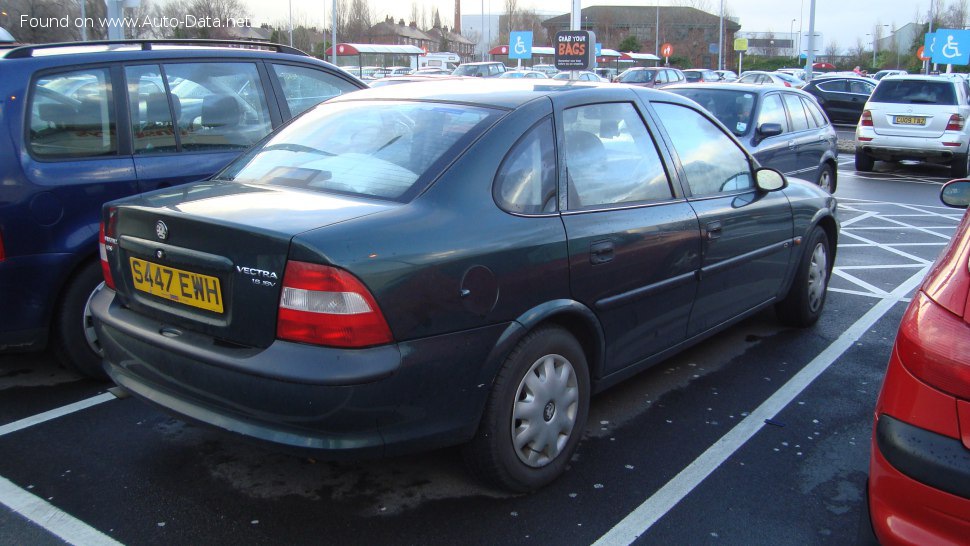
The Vauxhall Vectra B 1.7 TD was a compact executive car produced by Vauxhall, the British arm of General Motors, between 1995 and 1996. Representing the second generation of the Vectra, this model aimed to provide a more refined and modern alternative to the outgoing Vectra A. While not officially sold in the United States, the Vectra B was a significant vehicle in the European market, competing with models like the Ford Mondeo and Peugeot 406. The 1.7 TD variant, powered by a turbocharged diesel engine, focused on fuel efficiency and practicality, appealing to fleet buyers and drivers prioritizing economy.
Vauxhall Vectra B 1.7 TD: An Overview
The Vectra B represented a substantial leap forward for Vauxhall in terms of design, technology, and build quality. It was available in saloon (sedan), hatchback, and estate (wagon) body styles, offering a range of engine options, including petrol and diesel variants. The 1.7 TD model, with its 82 horsepower output, was positioned as the entry-level diesel offering, emphasizing fuel economy over outright performance. This model was particularly popular in the United Kingdom and other European countries where diesel fuel was more affordable and tax incentives favored lower-emission vehicles.
Engine & Performance
The heart of the Vectra B 1.7 TD is its 1686cc inline-four cylinder diesel engine, designated the X17DT. This engine utilizes precombustion chamber injection and is equipped with a turbocharger, allowing it to produce 82 horsepower at 4400 rpm and 168 Nm (123.91 lb.-ft.) of torque at 2400 rpm. While not a performance-oriented engine, the turbocharger provides a noticeable boost in power, improving drivability. The engine’s power-to-litre ratio is 48.6 hp/l. Acceleration from 0 to 100 km/h (0-62 mph) takes 15.5 seconds, and 0 to 60 mph is achieved in approximately 14.7 seconds. The top speed is rated at 175 km/h (108.74 mph). The engine’s design prioritized fuel efficiency, achieving a combined fuel consumption of 6.3 l/100 km (37.3 US mpg, 44.8 UK mpg), and CO2 emissions of 167 g/km.
Design & Features
The Vauxhall Vectra B was styled with a more aerodynamic and contemporary design compared to its predecessor. The sedan body style, as featured in the 1.7 TD variant, offered a practical and spacious interior for five passengers. Key features included hydraulic power steering, ventilated front disc brakes, and disc brakes on the rear axle. The car’s dimensions are 4495 mm (176.97 in) in length, 1710 mm (67.32 in) in width, and 1425 mm (56.1 in) in height, with a wheelbase of 2637 mm (103.82 in). The trunk (boot) space is a generous 550 liters (19.42 cu. ft.). Safety features for the era were relatively basic, focusing on structural integrity and standard braking systems. The interior was designed for practicality and comfort, with a focus on ergonomics and ease of use. The 1.7 TD model typically featured cloth upholstery and a relatively simple trim level, reflecting its position as the entry-level diesel variant.
Technical Specifications
| Brand | Vauxhall |
| Model | Vectra |
| Generation | Vectra B |
| Type (Engine) | 1.7 TD (82 Hp) |
| Start of production | 1995 |
| End of production | 1996 |
| Powertrain Architecture | Internal Combustion engine |
| Body type | Sedan |
| Seats | 5 |
| Doors | 4 |
| Fuel consumption (urban) | 8.1 l/100 km (29 US mpg, 34.9 UK mpg) |
| Fuel consumption (extra urban) | 5.3 l/100 km (44.4 US mpg, 53.3 UK mpg) |
| Fuel consumption (combined) | 6.3 l/100 km (37.3 US mpg, 44.8 UK mpg) |
| CO2 emissions | 167 g/km |
| Fuel Type | Diesel |
| Acceleration 0 – 100 km/h | 15.5 sec |
| Acceleration 0 – 62 mph | 15.5 sec |
| Acceleration 0 – 60 mph | 14.7 sec |
| Maximum speed | 175 km/h (108.74 mph) |
| Weight-to-power ratio | 15.4 kg/Hp |
| Weight-to-torque ratio | 7.5 kg/Nm |
| Power | 82 Hp @ 4400 rpm |
| Torque | 168 Nm @ 2400 rpm (123.91 lb.-ft. @ 2400 rpm) |
| Engine layout | Front, Transverse |
| Engine Model/Code | X17DT |
| Engine displacement | 1686 cm3 (102.89 cu. in.) |
| Number of cylinders | 4 |
| Engine configuration | Inline |
| Cylinder Bore | 79 mm (3.11 in.) |
| Piston Stroke | 86 mm (3.39 in.) |
| Compression ratio | 22:1 |
| Number of valves per cylinder | 2 |
| Fuel injection system | Precombustion chamber injection |
| Engine aspiration | Turbocharger |
| Valvetrain | OHC |
| Engine oil capacity | 5.5 l (5.81 US qt | 4.84 UK qt) |
| Coolant | 6.8 l (7.19 US qt | 5.98 UK qt) |
| Kerb Weight | 1260 kg (2777.82 lbs.) |
| Max. weight | 1790 kg (3946.27 lbs.) |
| Max load | 530 kg (1168.45 lbs.) |
| Trunk (boot) space – maximum | 550 l (19.42 cu. ft.) |
| Fuel tank capacity | 60 l (15.85 US gal | 13.2 UK gal) |
| Length | 4495 mm (176.97 in.) |
| Width | 1710 mm (67.32 in.) |
| Width including mirrors | 1841 mm (72.48 in.) |
| Height | 1425 mm (56.1 in.) |
| Wheelbase | 2637 mm (103.82 in.) |
| Drivetrain Architecture | Front wheel drive |
| Number of gears and type of gearbox | 5 gears, manual transmission |
| Front brakes | Ventilated discs |
| Rear brakes | Disc |
| Steering type | Steering rack and pinion |
| Power steering | Hydraulic Steering |
| Tires size | 175/70 R14 |
| Wheel rims size | 14 |
The Vauxhall Vectra B 1.7 TD, while not a high-performance vehicle, offered a compelling package of fuel efficiency, practicality, and affordability in the European market. It represented a significant step forward for Vauxhall in terms of design and engineering, and it played a role in establishing the brand as a competitive force in the compact executive car segment.
