
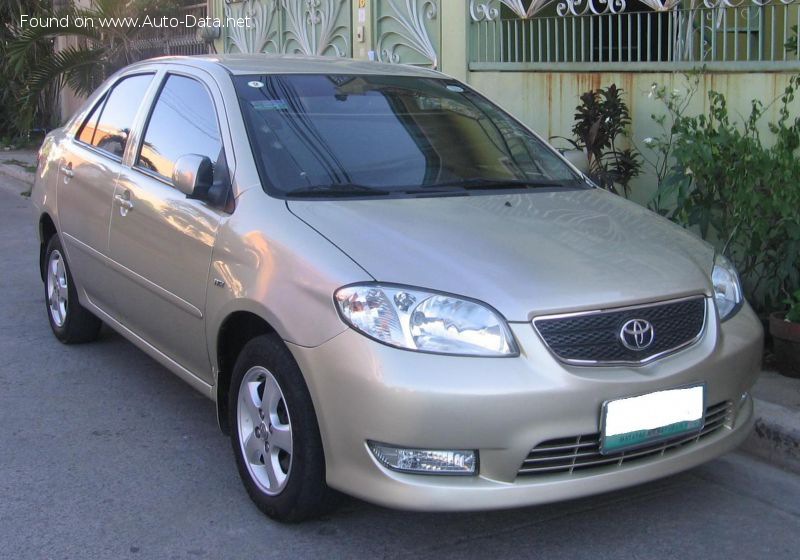
The Toyota Vios, known as the Toyota Yaris Sedan in some markets, represents Toyota’s entry-level sedan offering, primarily targeted towards emerging markets. The first generation, the Vios I, was produced from 2002 to 2007 and was a significant model for Toyota in Southeast Asia, and other regions where compact, affordable sedans were in high demand. While not originally sold in the United States, understanding the Vios I provides insight into Toyota’s global strategy of providing reliable and economical transportation. This article details the specifications and characteristics of the Toyota Vios I 1.3, a popular variant within the range.
Toyota Vios I 1.3: An Overview
The Vios I was designed to replace the Toyota Soluna (also known as the Toyota Corolla EX in some markets) and offered a more modern design and improved features. It quickly gained popularity due to its fuel efficiency, reliability, and relatively spacious interior for its class. The 1.3-liter engine variant was particularly popular for its balance of performance and economy. The Vios I played a crucial role in establishing Toyota’s presence in the competitive compact sedan segment in Asia and beyond.
Engine & Performance
The Toyota Vios I 1.3 is powered by a 1.3-liter (1296 cm3 or 79.09 cu. in.) inline four-cylinder gasoline engine. This naturally aspirated engine produces a maximum power output of 87 horsepower (Hp) at 6000 rpm and 116 Newton-meters (85.56 lb.-ft.) of torque at 4000 rpm. The engine features a multi-port fuel injection system and a compression ratio of 11:1. This configuration delivers a power-to-liter ratio of 67.1 Hp/l. The engine’s front, transverse layout contributes to efficient packaging within the compact sedan chassis. The Vios I 1.3 achieves a maximum speed of 170 km/h (105.63 mph). The weight-to-power ratio is 15.6 kg/Hp, or 64 Hp/tonne, while the weight-to-torque ratio is 11.7 kg/Nm, or 85.3 Nm/tonne. Power is delivered to the front wheels via a 5-speed manual transmission.
Design & Features
The Toyota Vios I is a four-door sedan with a traditional three-box design. It offers seating for five passengers. The vehicle’s dimensions are 4285 mm (168.7 in.) in length, 1695 mm (66.73 in.) in width, and 1435 mm (56.5 in.) in height. The wheelbase measures 2500 mm (98.43 in.). The front and rear tracks are 1455 mm (57.28 in.) and 1430 mm (56.3 in.) respectively, and the ride height (ground clearance) is 143 mm (5.63 in.).
While the Vios I was designed as an affordable vehicle, it offered a reasonable level of features for its time. Standard features typically included air conditioning, power steering, and basic instrumentation. Safety features were relatively basic, reflecting the standards of the early 2000s, and generally included seatbelts and a basic braking system. The trunk (boot) space is a practical 400 liters (14.13 cu. ft.). The interior was designed with practicality and durability in mind, utilizing hard-wearing materials. The focus was on providing a comfortable and reliable transportation solution for families and individuals in emerging markets.
Technical Specifications
| Brand | Toyota |
| Model | Vios |
| Generation | Vios I |
| Type (Engine) | 1.3 (87 Hp) |
| Start of production | 2002 |
| End of production | 2007 |
| Powertrain Architecture | Internal Combustion engine |
| Body type | Sedan |
| Seats | 5 |
| Doors | 4 |
| Fuel Type | Petrol (Gasoline) |
| Maximum speed | 170 km/h (105.63 mph) |
| Weight-to-power ratio | 15.6 kg/Hp |
| Weight-to-torque ratio | 11.7 kg/Nm |
| Power | 87 Hp @ 6000 rpm |
| Power per litre | 67.1 Hp/l |
| Torque | 116 Nm @ 4000 rpm (85.56 lb.-ft. @ 4000 rpm) |
| Engine layout | Front, Transverse |
| Engine displacement | 1296 cm3 (79.09 cu. in.) |
| Number of cylinders | 4 |
| Engine configuration | Inline |
| Cylinder Bore | 72 mm (2.83 in.) |
| Piston Stroke | 79.6 mm (3.13 in.) |
| Compression ratio | 11:1 |
| Number of valves per cylinder | 4 |
| Fuel injection system | Multi-port manifold injection |
| Engine aspiration | Naturally aspirated engine |
| Kerb Weight | 1360 kg (2998.29 lbs.) |
| Max. weight | 1415 kg (3119.54 lbs.) |
| Max load | 55 kg (121.25 lbs.) |
| Trunk (boot) space – minimum | 400 l (14.13 cu. ft.) |
| Fuel tank capacity | 45 l (11.89 US gal | 9.9 UK gal) |
| Length | 4285 mm (168.7 in.) |
| Width | 1695 mm (66.73 in.) |
| Height | 1435 mm (56.5 in.) |
| Wheelbase | 2500 mm (98.43 in.) |
| Front track | 1455 mm (57.28 in.) |
| Rear (Back) track | 1430 mm (56.3 in.) |
| Ride height (ground clearance) | 143 mm (5.63 in.) |
| Drivetrain Architecture | ICE, Front Wheel Drive |
| Drive wheel | Front wheel drive |
| Number of gears and type of gearbox | 5 gears, manual transmission |
| Front suspension | Independent type McPherson |
| Rear suspension | Semi-independent, coil spring |
| Front brakes | Ventilated discs |
| Rear brakes | Disc |
| Tires size | 155/80 R13; 185/60 R15 |
| Wheel rims size | 13; 15 |
The Toyota Vios I 1.3, while not a performance vehicle, offered a compelling package of affordability, reliability, and practicality. It served as a vital model for Toyota in expanding its reach in developing markets and establishing a reputation for durable and economical transportation. Its simple, yet effective design and engineering continue to be appreciated by enthusiasts and owners alike.

