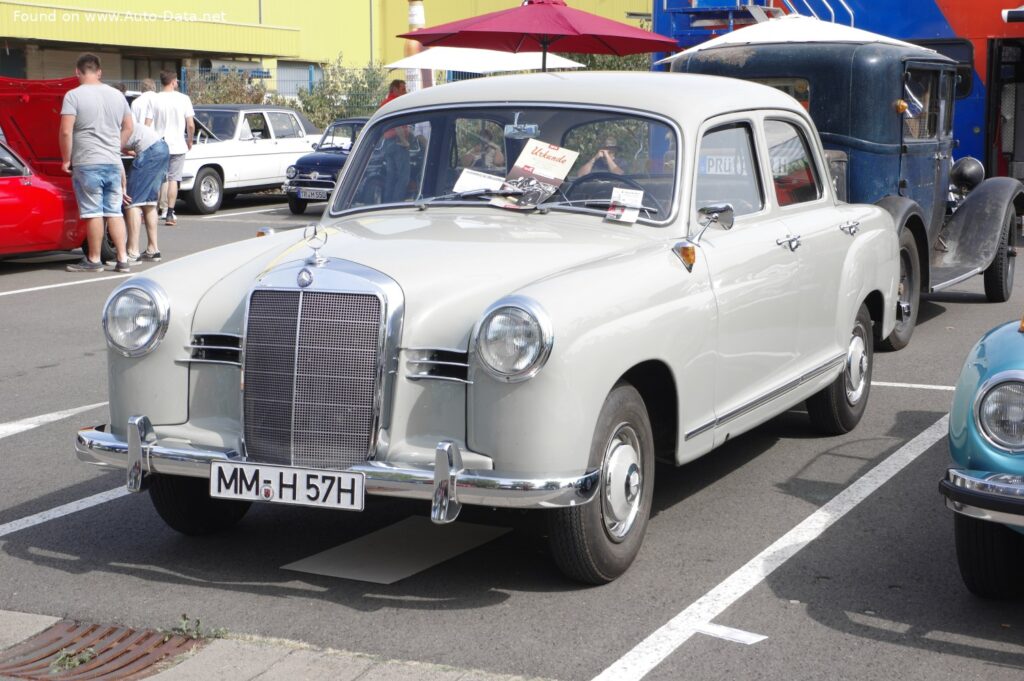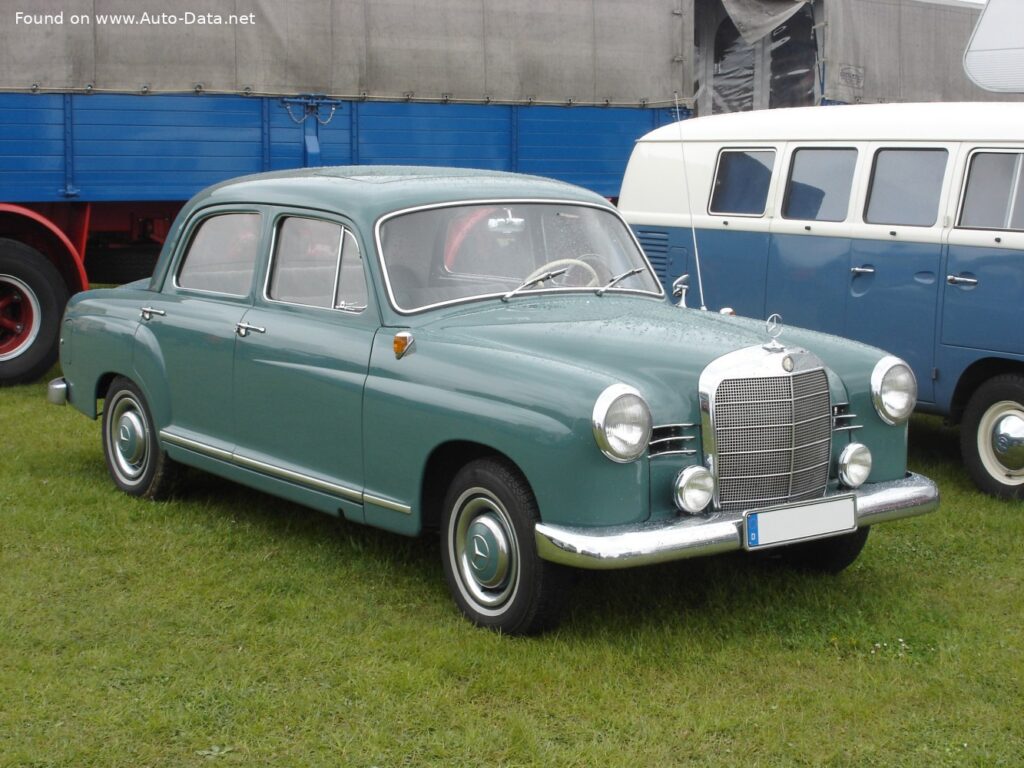
The Mercedes-Benz W120 Sedan, particularly the 1959 facelifted 180 Db model, represents a pivotal moment in the post-war democratization of automotive technology. Introduced in 1958 and produced through 1962, the W120, affectionately known as the “Ponton” due to its pontoon-like, integrated body style, was Mercedes-Benz’s entry-level offering, designed to appeal to a broader market than the traditionally luxurious models. The 180 Db variant, powered by a 1.8-liter diesel engine, was a significant step in offering fuel efficiency and durability, though at the cost of outright performance. This vehicle was primarily sold in Europe and other international markets, establishing Mercedes-Benz as a maker of reliable and accessible automobiles.
The Mercedes-Benz W120 Sedan: A Post-War Icon
The W120 series marked a departure from the pre-war designs of Mercedes-Benz, embracing a more modern, streamlined aesthetic. The “Ponton” styling, with its unpronounced fenders and integrated body panels, was a radical change and influenced automotive design for years to come. The 180 Db, introduced in July 1959, was a diesel-powered version of the W120, aimed at customers prioritizing economy and longevity. It represented a growing interest in diesel technology, particularly in Europe, where fuel costs were higher and long-distance travel was common. While not a high-performance vehicle, the 180 Db offered a comfortable and reliable driving experience, cementing Mercedes-Benz’s reputation for quality engineering.
Engine & Performance
The heart of the 180 Db is its OM 636 VII / 636.930 1.8-liter inline-four diesel engine. This engine, displacing 1767 cm³ (107.83 cu. in.), produced a modest 43 horsepower at 3500 rpm and 101 Nm (74.49 lb.-ft.) of torque at 2000 rpm. The engine featured precombustion chamber injection, a common diesel technology of the era, and a relatively high compression ratio of 19:1. Power per liter was 24.3 Hp/l. The engine’s longitudinal front-engine layout and naturally aspirated design contributed to its simplicity and reliability. Performance figures reflected the engine’s limitations: acceleration from 0 to 100 km/h (0-62 mph) took approximately 36 seconds, and 0 to 60 mph was achieved in around 34.2 seconds. The top speed was limited to 110 km/h (68.35 mph). The weight-to-power ratio was 28.1 kg/Hp, and the weight-to-torque ratio was 12 kg/Nm. Despite its modest power output, the diesel engine provided reasonable fuel economy for the time, achieving 6.8 l/100 km (34.6 US mpg, 41.5 UK mpg, 14.7 km/l).
Design & Features
The 1959 facelift of the W120 Sedan brought subtle but noticeable changes to the exterior, including revised grille and headlight designs. The body style remained a five-door sedan with seating for five passengers. The car’s dimensions were substantial for its time, measuring 4500 mm (177.17 in.) in length, 1740 mm (68.5 in.) in width, and 1560 mm (61.42 in.) in height, with a wheelbase of 2650 mm (104.33 in.). The kerb weight of 1210 kg (2667.59 lbs.) contributed to the car’s solid feel and stability.
Inside, the 180 Db offered a comfortable, if spartan, interior. Features were focused on practicality and durability rather than luxury. The car was equipped with drum brakes on all four wheels and a cone worm with recirculation balls steering system. Suspension consisted of a double wishbone setup with a transverse stabilizer at the front and a trailing arm arrangement at the rear. Safety features were limited by the standards of the time, but the robust construction of the Ponton body provided a degree of crash protection. The 56-liter (14.79 US gal) fuel tank offered a reasonable range for long journeys. The maximum load capacity was 450 kg (992.08 lbs), and the maximum weight was 1660 kg (3659.67 lbs).
Technical Specifications
| Brand | Mercedes-Benz |
| Model | Ponton |
| Generation | W120 Sedan (facelift 1959) |
| Type (Engine) | 180 Db (43 Hp) |
| Start of production | July, 1959 |
| End of production | August, 1961 |
| Powertrain Architecture | Internal Combustion engine |
| Body type | Sedan |
| Seats | 5 |
| Doors | 5 |
| Fuel consumption (combined) | 6.8 l/100 km |
| Fuel consumption (US mpg) | 34.6 US mpg |
| Fuel consumption (UK mpg) | 41.5 UK mpg |
| Fuel consumption (km/l) | 14.7 km/l |
| Fuel Type | Diesel |
| Acceleration 0 – 100 km/h | 36 sec |
| Acceleration 0 – 62 mph | 36 sec |
| Acceleration 0 – 60 mph | 34.2 sec |
| Maximum speed | 110 km/h |
| Maximum speed (mph) | 68.35 mph |
| Weight-to-power ratio | 28.1 kg/Hp |
| Hp/tonne | 35.5 Hp/tonne |
| Weight-to-torque ratio | 12 kg/Nm |
| Nm/tonne | 83.5 Nm/tonne |
| Power | 43 Hp @ 3500 rpm |
| Power per litre | 24.3 Hp/l |
| Torque | 101 Nm @ 2000 rpm |
| Torque (lb.-ft.) | 74.49 lb.-ft. @ 2000 rpm |
| Engine layout | Front, Longitudinal |
| Engine Model/Code | OM 636 VII / 636.930 |
| Engine displacement | 1767 cm3 |
| Engine displacement (cu. in.) | 107.83 cu. in. |
| Number of cylinders | 4 |
| Engine configuration | Inline |
| Cylinder Bore | 75 mm |
| Cylinder Bore (in.) | 2.95 in. |
| Piston Stroke | 100 mm |
| Piston Stroke (in.) | 3.94 in. |
| Compression ratio | 19:1 |
| Number of valves per cylinder | 2 |
| Fuel injection system | Precombustion chamber injection |
| Engine aspiration | Naturally aspirated engine |
| Valvetrain | OHV |
| Kerb Weight | 1210 kg |
| Kerb Weight (lbs.) | 2667.59 lbs. |
| Max. weight | 1660 kg |
| Max. weight (lbs.) | 3659.67 lbs. |
| Max load | 450 kg |
| Max load (lbs.) | 992.08 lbs. |
| Fuel tank capacity | 56 l |
| Fuel tank capacity (US gal) | 14.79 US gal |
| Fuel tank capacity (UK gal) | 12.32 UK gal |
| Length | 4500 mm |
| Length (in.) | 177.17 in. |
| Width | 1740 mm |
| Width (in.) | 68.5 in. |
| Height | 1560 mm |
| Height (in.) | 61.42 in. |
| Wheelbase | 2650 mm |
| Wheelbase (in.) | 104.33 in. |
| Front track | 1430 mm |
| Front track (in.) | 56.3 in. |
| Rear (Back) track | 1475 mm |
| Rear (Back) track (in.) | 58.07 in. |
| Drivetrain Architecture | The Internal combustion engine (ICE) drives the rear wheels of the vehicle. |
| Drive wheel | Rear wheel drive |
| Number of gears and type of gearbox | 4 gears, manual transmission |
| Front suspension | Double wishbone, Transverse stabilizer |
| Rear suspension | Trailing arm |
| Front brakes | Drum |
| Rear brakes | Drum |
| Steering type | Cone worm with recirculation balls |
The Mercedes-Benz W120 Sedan 180 Db, while not a performance leader, played a crucial role in establishing Mercedes-Benz as a manufacturer of accessible, reliable, and well-engineered automobiles. Its innovative design and durable diesel engine made it a popular choice for those seeking a practical and long-lasting vehicle, and it remains a significant piece of automotive history.