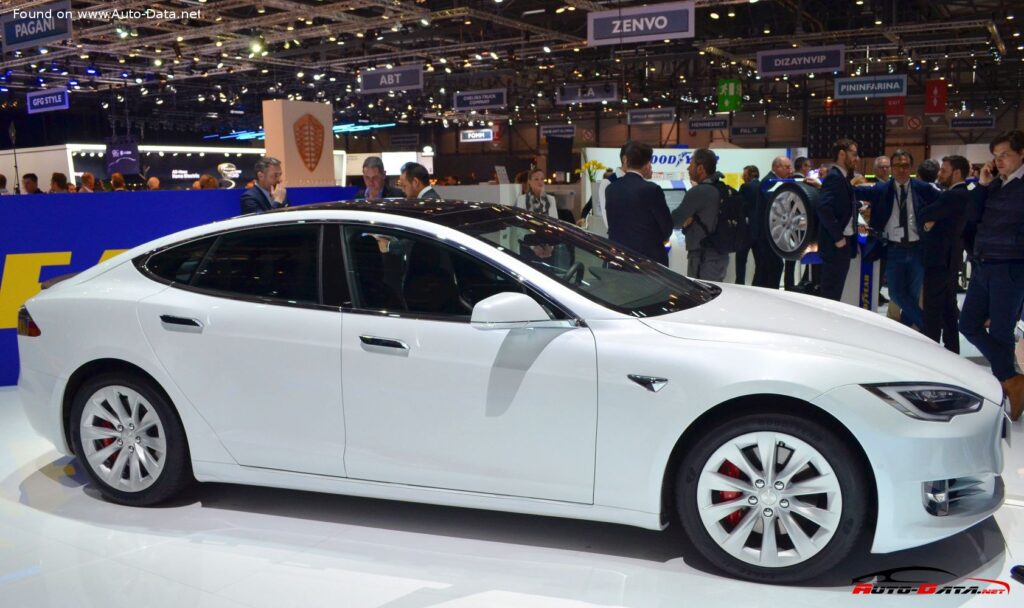
The Tesla Model S 75D, part of the facelifted generation introduced in April 2016 and produced through January 2019, represents a pivotal moment in the adoption of electric vehicles. Positioned within the premium large car segment, the Model S aimed to challenge established luxury automakers by offering a compelling combination of performance, range, and technology. The “75D” designation refers to the battery pack capacity of 75 kWh and the dual-motor, all-wheel-drive configuration. This variant played a crucial role in expanding the Model S lineup, providing a balance between price and capability, and solidifying Tesla’s presence in the burgeoning EV market.
Tesla Model S 75D: An Overview
The Model S was Tesla’s first mass-produced vehicle, and the 2016 facelift brought subtle but significant improvements to its design and features. The 75D model specifically targeted buyers seeking a longer range than the base model, without the higher cost of the 90D or P100D variants. It quickly became a popular choice, demonstrating the growing demand for practical, long-range electric vehicles. The liftback body style offered a unique blend of sedan elegance and hatchback practicality, maximizing cargo space and versatility.
Engine & Performance
The Tesla Model S 75D utilizes a fully electric powertrain, eschewing the internal combustion engine entirely. It features two independent electric motors – one driving the front wheels and one driving the rear wheels – providing all-wheel drive capability. Each motor produces 259 horsepower and 330 Nm (243.4 lb.-ft.) of torque, resulting in a combined system output of 328 horsepower and 525 Nm (387.22 lb.-ft.) of torque. This dual-motor setup allows for precise torque vectoring, enhancing handling and stability. Acceleration from 0 to 60 mph is achieved in 5.2 seconds, with a maximum speed of 139.81 mph (225 km/h). The powertrain’s efficiency is notable, with an energy consumption of 14.8 kWh per 100 km (23.82 kWh per 100 miles), translating to an equivalent of 141 MPGe and a range of 304.47 miles (490 km) based on the New European Driving Cycle (NEDC) standard.
Design & Features
The Model S 75D boasts a sleek, aerodynamic liftback design. Its low profile and flowing lines contribute to a drag coefficient of just 0.24, maximizing efficiency and range. The vehicle seats up to seven passengers, offering a spacious and comfortable interior. Key features include a large touchscreen display that serves as the central control interface for most vehicle functions, over-the-air software updates that continuously improve the car’s capabilities, and Tesla’s Autopilot system, providing advanced driver-assistance features. Safety was a paramount concern, with the Model S incorporating a robust suite of safety technologies, including anti-lock brakes (ABS) and a reinforced safety cell. The air suspension system provides a comfortable ride and allows for adjustable ride height. The spacious trunk offers 26.31 cu. ft. of minimum storage, expanding to 58.09 cu. ft. with the rear seats folded down.
Technical Specifications
| Brand | Tesla |
| Model | Model S |
| Generation | Model S (facelift 2016) |
| Type | 75D 75 kWh (328 Hp) Dual Motor AWD |
| Start of production | April, 2016 |
| End of production | January, 2019 |
| Powertrain Architecture | BEV (Electric Vehicle) |
| Body type | Liftback |
| Seats | 7 |
| Doors | 5 |
| Fuel Type | Electricity |
| Acceleration 0 – 60 mph | 5.2 sec |
| Maximum speed | 139.81 mph (225 km/h) |
| Weight-to-power ratio | 6.4 kg/Hp, 155.6 Hp/tonne |
| Weight-to-torque ratio | 4 kg/Nm, 249.1 Nm/tonne |
| Gross battery capacity | 75 kWh |
| Net (usable) battery capacity | 72.6 kWh |
| Battery voltage | 300 V |
| Battery technology | Lithium-ion (Li-Ion) |
| Battery location | Below the floor |
| All-electric range (NEDC) | 304.47 mi (490 km) |
| Average Energy consumption (NEDC) | 14.8 kWh/100 km, 23.82 kWh/100 mi, 141 MPGe, 6.8 km/kWh, 4.2 mi/kWh |
| Electric motor 1 power | 259 Hp @ 6100 rpm |
| Electric motor 1 Torque | 330 Nm (243.4 lb.-ft.) |
| Electric motor 1 Maximum revolutions | 18000 rpm |
| Electric motor 1 location | Front axle, Transverse |
| Electric motor 2 power | 259 Hp @ 6100 rpm |
| Electric motor 2 Torque | 330 Nm (243.4 lb.-ft.) |
| Electric motor 2 Maximum revolutions | 18000 rpm |
| Electric motor 2 location | Rear axle, Transverse |
| System power | 328 Hp |
| System torque | 525 Nm (387.22 lb.-ft.) |
| Kerb Weight | 4647.34 lbs (2108 kg) |
| Max. weight | 5732.02 lbs (2600 kg) |
| Max load | 1084.67 lbs (492 kg) |
| Trunk (boot) space – minimum | 26.31 cu. ft. (745 l) |
| Trunk (boot) space – maximum | 58.09 cu. ft. (1645 l) |
| Max. roof load | 165.35 lbs (75 kg) |
| Length | 196.02 in. (4979 mm) |
| Width | 77.32 in. (1964 mm) |
| Width including mirrors | 86.18 in. (2189 mm) |
| Height | 56.89 in. (1445 mm) |
| Wheelbase | 116.54 in. (2960 mm) |
| Front track | 65.43 in. (1662 mm) |
| Rear (Back) track | 66.93 in. (1700 mm) |
| Front overhang | 36.89 in. (937 mm) |
| Rear overhang | 42.56 in. (1081 mm) |
| Ride height (ground clearance) | 4.61 – 6.3 in. (117-160 mm) |
| Drag coefficient (Cd) | 0.24 |
| Minimum turning circle (turning diameter) | 40.68 ft (12.4 m) |
| Drivetrain Architecture | One electric motor drives the front wheels, one electric motor drives the rear wheels. |
| Drive wheel | All wheel drive (4×4) |
| Number of gears and type of gearbox | 1 gears, automatic transmission |
| Front suspension | Double wishbone, Transverse stabilizer, Air suspension |
| Rear suspension | Independent multi-link suspension, Air suspension, Transverse stabilizer |
| Front brakes | Ventilated discs, 355×32 mm |
| Rear brakes | Ventilated discs, 365×28 mm |
| Assisting systems | ABS (Anti-lock braking system) |
| Steering type | Steering rack and pinion |
| Power steering | Electric Steering |
| Tires size | Front wheel tires: 245/45 R19; 245/35 R21Rear wheel tires: 245/45 R19; 265/35 R21 |
| Wheel rims size | Front wheel rims: 8J x 19; 8.5J x 21Rear wheel rims: 8J x 19; 9J x 21 |
The Tesla Model S 75D was a significant step forward in electric vehicle technology, offering a compelling alternative to traditional luxury cars. Its combination of performance, range, and innovative features helped to accelerate the adoption of EVs and establish Tesla as a leader in the automotive industry.