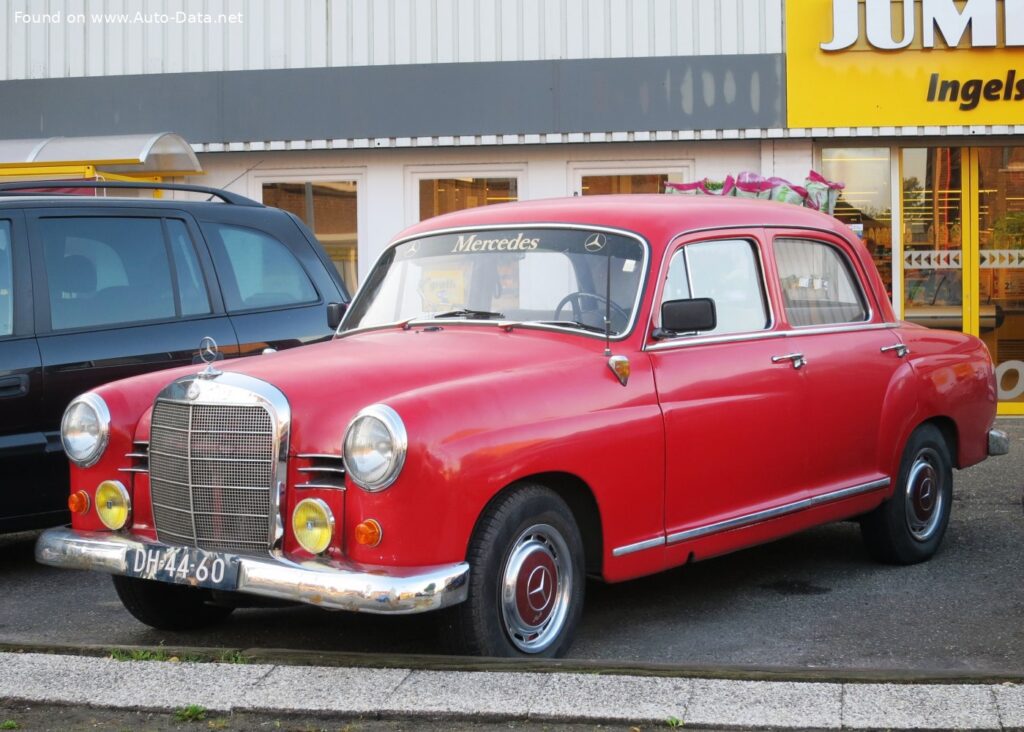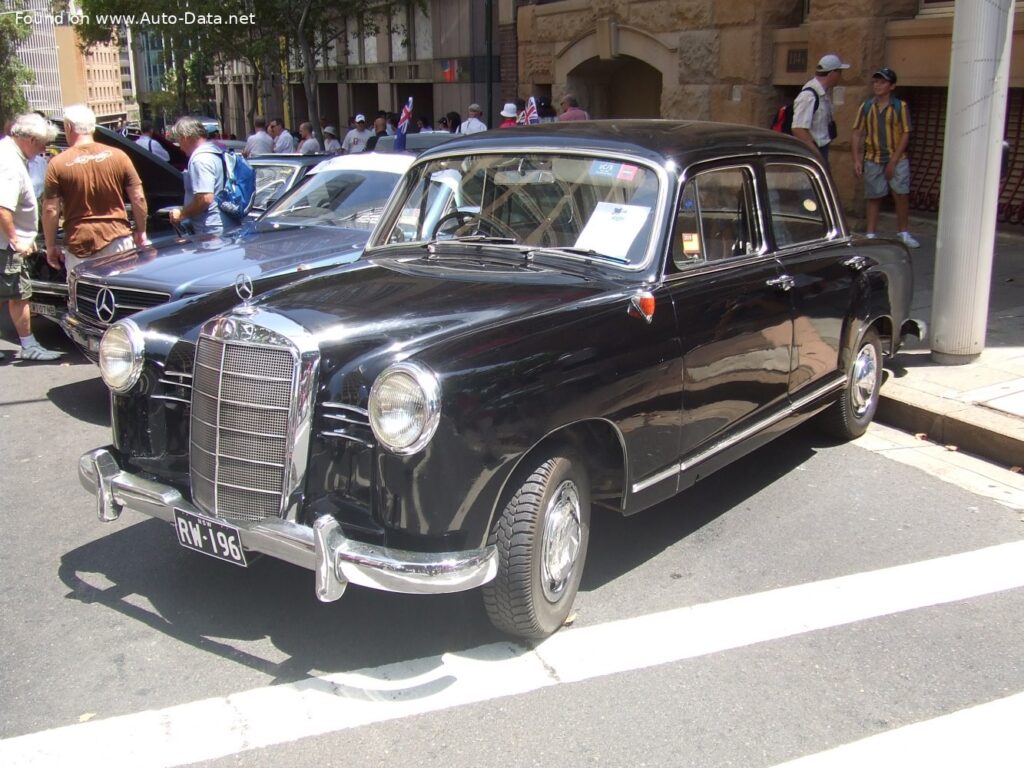
The Mercedes-Benz W121, often referred to as the “Ponton” (meaning “pontoon” in German due to its rounded styling), represents a pivotal moment in post-war Mercedes-Benz history. Produced from 1956 to 1968, the W121 was the first all-new Mercedes-Benz passenger car design after World War II. It moved away from the pre-war styling cues and embraced a more modern, streamlined aesthetic. The 190 D, introduced in August 1958 and produced through July 1959, was a diesel-powered variant of the W121 sedan, offering fuel economy and durability, though at the cost of outright performance. This model played a significant role in establishing Mercedes-Benz as a manufacturer of high-quality, reliable vehicles in a recovering European market and beyond.
Mercedes-Benz W121 Sedan 190 D: A Detailed Overview
The W121 series was designed to be a more accessible and mass-produced Mercedes-Benz, aiming to broaden the company’s customer base. Prior to the Ponton, Mercedes-Benz vehicles were largely hand-built and catered to a more affluent clientele. The 190 D specifically, was positioned as a practical and economical option, particularly appealing to those seeking a durable and fuel-efficient vehicle for everyday use. While not initially a major seller in the United States, the W121 series, including the 190 D, laid the groundwork for the brand’s eventual success in the American market.
Engine & Performance
The heart of the 190 D is its 1.9-liter (1897 cm3) inline-four cylinder diesel engine, designated the OM 621 I / 621.910. This engine produced 50 horsepower at 4000 rpm and 107 Nm (78.92 lb.-ft.) of torque at 2200 rpm. The engine utilized precombustion chamber injection, a common diesel technology of the era. While the power output seems modest by modern standards, the diesel engine offered significantly better fuel economy than gasoline alternatives. The 190 D achieved a combined fuel consumption of 7.1 l/100 km (33.1 US mpg, 39.8 UK mpg, 14.1 km/l). Performance was understandably leisurely, with a 0-100 km/h (0-62 mph) acceleration time of 29 seconds and a top speed of 120 km/h (74.56 mph). The weight-to-power ratio stood at 24.2 kg/Hp, reflecting the engine’s limited output relative to the vehicle’s weight. Power per liter was 26.4 Hp/l.
Design & Features
The W121 sedan, as its nickname suggests, featured a distinctly “pontoon” shape, characterized by its rounded body and integrated fenders. This styling was a significant departure from the more angular designs of the pre-war era. The 190 D was a four-door, five-seater sedan with a longitudinal front engine layout and rear-wheel drive. The car’s suspension employed a double wishbone setup with a transverse stabilizer at the front and a trailing arm configuration at the rear. Braking was handled by drum brakes on all four wheels. Inside, the 190 D offered a relatively spartan but functional interior, typical of the late 1950s. Features were focused on practicality and durability rather than luxury. Safety features were limited by the standards of the time, but the robust construction of the vehicle provided a degree of passive safety. The car’s dimensions were 4485 mm (176.57 in) in length, 1740 mm (68.5 in) in width, and 1560 mm (61.42 in) in height, with a wheelbase of 2650 mm (104.33 in).
Technical Specifications
| Brand | Mercedes-Benz |
| Model | Ponton |
| Generation | W121 Sedan |
| Type (Engine) | 190 D (50 Hp) |
| Start of production | August, 1958 |
| End of production | July, 1959 |
| Powertrain Architecture | Internal Combustion engine |
| Body type | Sedan |
| Seats | 5 |
| Doors | 4 |
| Fuel consumption (combined) | 7.1 l/100 km |
| Fuel consumption (US mpg) | 33.1 US mpg |
| Fuel consumption (UK mpg) | 39.8 UK mpg |
| Fuel consumption (km/l) | 14.1 km/l |
| Fuel Type | Diesel |
| Acceleration 0 – 100 km/h | 29 sec |
| Acceleration 0 – 62 mph | 29 sec |
| Acceleration 0 – 60 mph | 27.6 sec |
| Maximum speed | 120 km/h (74.56 mph) |
| Weight-to-power ratio | 24.2 kg/Hp |
| Weight-to-torque ratio | 11.3 kg/Nm |
| Power | 50 Hp @ 4000 rpm |
| Power per litre | 26.4 Hp/l |
| Torque | 107 Nm @ 2200 rpm (78.92 lb.-ft. @ 2200 rpm) |
| Engine layout | Front, Longitudinal |
| Engine Model/Code | OM 621 I / 621.910 |
| Engine displacement | 1897 cm3 (115.76 cu. in.) |
| Number of cylinders | 4 |
| Engine configuration | Inline |
| Cylinder Bore | 85 mm (3.35 in.) |
| Piston Stroke | 83.6 mm (3.29 in.) |
| Compression ratio | 21:1 |
| Number of valves per cylinder | 2 |
| Fuel injection system | Precombustion chamber injection |
| Engine aspiration | Naturally aspirated |
| Valvetrain | SOHC |
| Engine oil capacity | 4 l (4.23 US qt | 3.52 UK qt) |
| Coolant | 10.3 l (10.88 US qt | 9.06 UK qt) |
| Kerb Weight | 1210 kg (2667.59 lbs.) |
| Max. weight | 1660 kg (3659.67 lbs.) |
| Max load | 450 kg (992.08 lbs.) |
| Fuel tank capacity | 56 l (14.79 US gal | 12.32 UK gal) |
| Length | 4485 mm (176.57 in.) |
| Width | 1740 mm (68.5 in.) |
| Height | 1560 mm (61.42 in.) |
| Wheelbase | 2650 mm (104.33 in.) |
| Front track | 1420 mm (55.91 in.) |
| Rear track | 1470 mm (57.87 in.) |
| Drivetrain Architecture | Rear wheel drive |
| Number of gears | 4 |
| Gearbox type | Manual transmission |
| Front suspension | Double wishbone, Transverse stabilizer |
| Rear suspension | Trailing arm |
| Front brakes | Drum |
| Rear brakes | Drum |
| Steering type | Cone worm with recirculation balls |
The Mercedes-Benz W121 190 D, while not a performance icon, represents a significant step in the evolution of the brand. It demonstrated Mercedes-Benz’s ability to produce a durable, economical, and well-engineered vehicle for a broader market, paving the way for its future success as a global automotive leader.