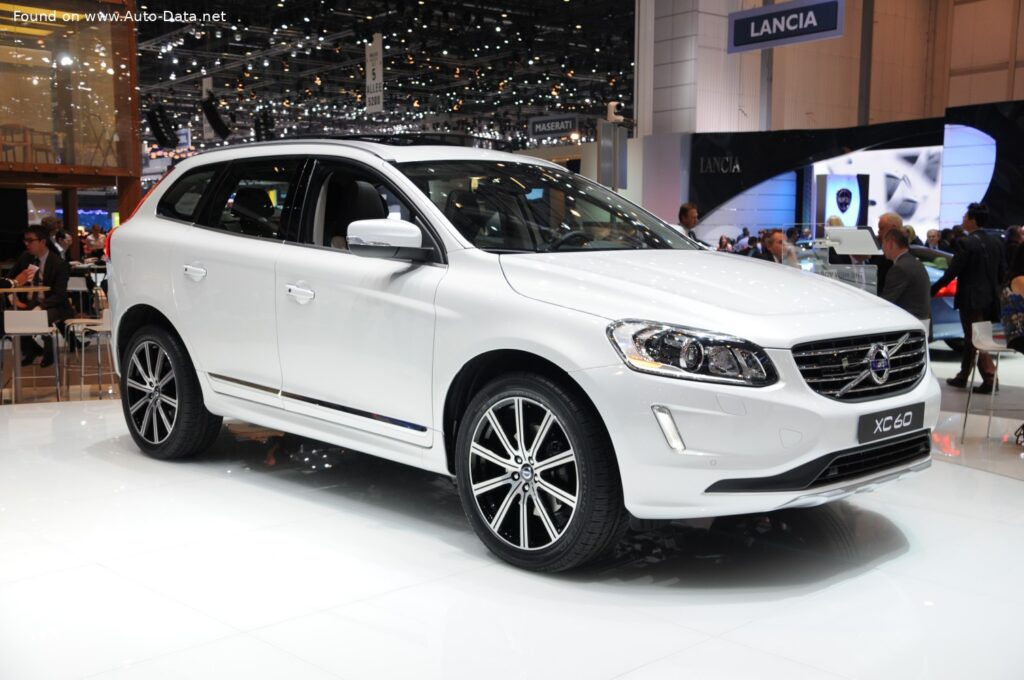
The Volvo XC60 I (2013 facelift) 2.0 D4 Bi-Turbo is a compact luxury crossover SUV produced by the Swedish manufacturer Volvo Cars. Introduced as part of the first generation XC60 lineup, the 2013 facelift brought styling updates and refined powertrain options. This particular variant, powered by a 2.0-liter Bi-Turbo diesel engine producing 190 horsepower, was primarily sold in the European market, where demand for efficient diesel engines remained strong. The XC60 aimed to blend Scandinavian design with practicality and a focus on safety, establishing itself as a popular choice in the premium crossover segment.
Volvo XC60 I (2013 facelift) 2.0 D4 Bi-Turbo: Overview
The XC60, launched in 2008, was Volvo’s first venture into the compact luxury crossover market. The 2013 facelift represented a mid-cycle refresh, updating the exterior styling and interior features. The 2.0 D4 Bi-Turbo model specifically targeted buyers seeking a balance between performance and fuel economy. While not officially sold in the United States during this generation, the XC60 gained recognition globally for its elegant design, comfortable ride, and comprehensive safety features. It competed with vehicles like the Audi Q5, BMW X3, and Mercedes-Benz GLK.
Engine & Performance
The heart of the XC60 I (2013 facelift) 2.0 D4 Bi-Turbo is a 2.0-liter inline-four cylinder diesel engine, designated D4204T14. This engine utilizes a sophisticated Bi-Turbo setup – two turbochargers working in sequence – to deliver a broad torque curve and responsive performance. The engine produces 190 horsepower at 4250 rpm and a substantial 400 Nm (295 lb-ft) of torque between 1750 and 2500 rpm. This torque output provides strong acceleration and effortless cruising. Power is delivered to the front wheels via an eight-speed automatic transmission. Acceleration from 0 to 100 km/h (0-62 mph) takes 8.1 seconds, while 0-60 mph is achieved in approximately 7.7 seconds. The vehicle has a maximum speed of 210 km/h (130.49 mph). The engine’s design prioritizes efficiency, achieving a combined fuel consumption of 4.7 liters per 100 kilometers (50 US mpg or 60.1 UK mpg), with CO2 emissions of 124 g/km.
Design & Features
The XC60 I (2013 facelift) features Volvo’s signature Scandinavian design language, characterized by clean lines, a sculpted profile, and a focus on understated elegance. The 2013 facelift brought revised headlights, a new grille, and updated taillights, giving the vehicle a more contemporary appearance. The body style is a five-door SUV/Crossover, offering seating for five passengers. Inside, the XC60 boasts a comfortable and well-appointed cabin with high-quality materials. Key features include a user-friendly infotainment system, comfortable seating, and a spacious cargo area. Trunk space ranges from 495 liters (17.48 cu ft) with the rear seats up to 1455 liters (51.38 cu ft) with the rear seats folded down. Safety was a paramount concern for Volvo, and the XC60 is equipped with a comprehensive suite of safety features, including ABS, traction control, stability control, and numerous airbags. The vehicle also offers advanced driver-assistance systems, such as City Safety, which helps to mitigate or avoid low-speed collisions.
Technical Specifications
| Brand | Volvo |
| Model | XC60 |
| Generation | XC60 I (2013 facelift) |
| Type (Engine) | 2.0 D4 Bi-Turbo (190 Hp) Automatic |
| Start of production | 2015 |
| End of production | 2017 |
| Powertrain Architecture | Internal Combustion engine |
| Body type | SUV, Crossover |
| Seats | 5 |
| Doors | 5 |
| Fuel consumption (combined) | 4.7 l/100 km (50 US mpg, 60.1 UK mpg, 21.3 km/l) |
| CO2 emissions | 124 g/km |
| Fuel Type | Diesel |
| Acceleration 0 – 100 km/h | 8.1 sec |
| Acceleration 0 – 62 mph | 8.1 sec |
| Acceleration 0 – 60 mph | 7.7 sec |
| Maximum speed | 210 km/h (130.49 mph) |
| Power | 190 Hp @ 4250 rpm |
| Torque | 400 Nm @ 1750-2500 rpm (295.02 lb.-ft. @ 1750-2500 rpm) |
| Maximum engine speed | 5000 rpm |
| Engine layout | Front, Transverse |
| Engine Model/Code | D4204T14 |
| Engine displacement | 1969 cm3 (120.16 cu. in.) |
| Number of cylinders | 4 |
| Engine configuration | Inline |
| Cylinder Bore | 82 mm (3.23 in.) |
| Piston Stroke | 93.2 mm (3.67 in.) |
| Compression ratio | 15.8:1 |
| Number of valves per cylinder | 4 |
| Fuel injection system | Diesel Commonrail |
| Engine aspiration | BiTurbo, Intercooler |
| Valvetrain | DOHC |
| Engine oil capacity | 5.2 l (5.49 US qt | 4.58 UK qt) |
| Kerb Weight | 1834-1921 kg (4043.28 – 4235.08 lbs.) |
| Max. weight | 2390-2505 kg (5269.05 – 5522.58 lbs.) |
| Max load | 556-584 kg (1225.77 – 1287.5 lbs.) |
| Trunk (boot) space – minimum | 495 l (17.48 cu. ft.) |
| Trunk (boot) space – maximum | 1455 l (51.38 cu. ft.) |
| Fuel tank capacity | 70 l (18.49 US gal | 15.4 UK gal) |
| Max. roof load | 100 kg (220.46 lbs.) |
| Permitted trailer load with brakes (8%) | 1800 kg (3968.32 lbs.) |
| Permitted trailer load without brakes | 750 kg (1653.47 lbs.) |
| Length | 4644 mm (182.83 in.) |
| Width | 1891 mm (74.45 in.) |
| Width including mirrors | 2120 mm (83.46 in.) |
| Height | 1713 mm (67.44 in.) |
| Wheelbase | 2774 mm (109.21 in.) |
| Front track | 1632 mm (64.25 in.) |
| Rear (Back) track | 1586 mm (62.44 in.) |
| Ride height (ground clearance) | 230 mm (9.06 in.) |
| Drag coefficient (Cd) | 0.35 |
| Minimum turning circle (turning diameter) | 12.1-12.6 m (39.7 – 41.34 ft.) |
| Drivetrain Architecture | The Internal combustion engine (ICE) drives the front wheels of the vehicle. |
| Drive wheel | Front wheel drive |
| Number of gears and type of gearbox | 8 gears, automatic transmission |