
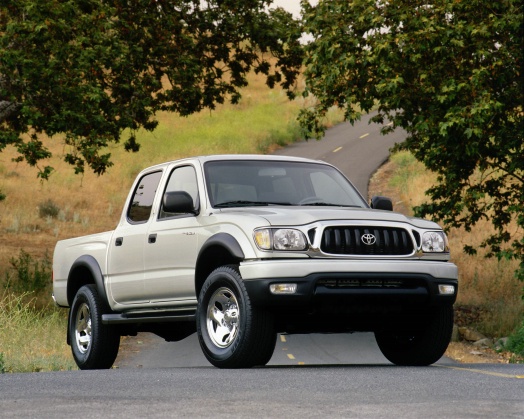
The Toyota Tacoma I Double Cab (facelift 2000) 2.7 4WD represents a significant iteration of Toyota’s popular compact pickup truck, specifically tailored for the North American market. Introduced as part of the first-generation Tacoma (1995-2004), the 2000 facelift brought updated styling and refinements to an already successful formula. This model distinguished itself by offering a four-door, double-cab configuration, providing increased passenger space compared to the standard cab and extended cab options. Positioned within the compact pickup segment, the Tacoma competed with vehicles like the Ford Ranger, Nissan Frontier, and Chevrolet S-10, appealing to buyers seeking a versatile vehicle capable of both work and family duties. The 2.7-liter engine option provided a balance of affordability and capability, making it a popular choice for a wide range of customers.
Toyota Tacoma I Double Cab (facelift 2000): A Detailed Overview
The first-generation Toyota Tacoma, launched in 1995, was a complete redesign of the Hilux, Toyota’s globally recognized pickup truck. While the Hilux was sold in many international markets, the Tacoma was specifically engineered and marketed for North America. The 2000 facelift brought subtle but noticeable changes to the exterior, including a revised grille, headlights, and taillights. More importantly, the Double Cab configuration, introduced in 1998, gained traction, offering a practical solution for families needing pickup truck utility with passenger comfort. The 2.7-liter engine, while not the most powerful option available in the Tacoma lineup, provided reliable performance and fuel efficiency, making it a sensible choice for everyday use. The 4WD system further enhanced its versatility, allowing it to tackle various terrains and weather conditions.
Engine & Performance
The 2000 Toyota Tacoma I Double Cab 2.7 4WD is powered by the 3RZ-FE 2.7-liter inline-four cylinder gasoline engine. This naturally aspirated engine produces 182 horsepower at 4800 rpm and 240 Newton-meters (177.01 lb.-ft.) of torque at 4000 rpm. The engine features a double overhead camshaft (DOHC) valvetrain with four valves per cylinder and utilizes a multi-port fuel injection system. This configuration contributes to a relatively smooth and responsive driving experience. The engine’s power-to-weight ratio is 146 horsepower per tonne, and its torque-to-weight ratio is 192.5 Nm per tonne. The engine’s displacement of 2694 cm3 (164.4 cubic inches) and a compression ratio of 9.5:1 contribute to its balance of power and efficiency. Power is delivered to all four wheels through a five-speed manual transmission, providing the driver with direct control over gear selection. The longitudinal engine layout optimizes space utilization within the chassis.
Design & Features
The 2000 Toyota Tacoma I Double Cab is a four-door pickup truck with a seating capacity of five passengers. Its body-on-frame construction provides durability and robustness, essential for a vehicle designed for both on- and off-road use. The Double Cab configuration significantly expands the rear passenger space compared to the standard cab and extended cab models, making it a more practical option for families. The truck’s exterior design is characterized by its relatively compact dimensions and functional styling. The facelifted model features updated front and rear fascias, giving it a more modern appearance. Standard features included ventilated disc brakes on the front wheels and drum brakes on the rear, providing adequate stopping power. The Tacoma’s 4WD system offers enhanced traction in challenging conditions. Ride height, or ground clearance, is a notable 215 mm (8.46 inches), allowing for moderate off-road capability. Available tire sizes included 205/75 R15 and 235/55 R16, mounted on 15 or 16-inch wheel rims. Safety features for the era were relatively basic, focusing on structural integrity and passive safety measures.
Technical Specifications
| General Information | |
| Brand | Toyota |
| Model | Tacoma |
| Generation | Tacoma I Double Cab (facelift 2000) |
| Type (Engine) | 2.7 (182 Hp) 4WD |
| Start of production | 2000 |
| End of production | 2004 |
| Powertrain Architecture | Internal Combustion engine |
| Body type | Pick-up |
| Seats | 5 |
| Doors | 4 |
| Performance Specs | |
| Fuel Type | Petrol (Gasoline) |
| Weight-to-power ratio | 6.9 kg/Hp |
| Hp/tonne | 146 Hp/tonne |
| Weight-to-torque ratio | 5.2 kg/Nm |
| Nm/tonne | 192.5 Nm/tonne |
| Engine Specs | |
| Power | 182 Hp @ 4800 rpm |
| Power per litre | 67.6 Hp/l |
| Torque | 240 Nm @ 4000 rpm / 177.01 lb.-ft. @ 4000 rpm |
| Engine layout | Front, Longitudinal |
| Engine Model/Code | 3RZ-FE |
| Engine displacement | 2694 cm3 / 164.4 cu. in. |
| Number of cylinders | 4 |
| Engine configuration | Inline |
| Cylinder Bore | 95 mm / 3.74 in. |
| Piston Stroke | 95 mm / 3.74 in. |
| Compression ratio | 9.5:1 |
| Number of valves per cylinder | 4 |
| Fuel injection system | Multi-port manifold injection |
| Engine aspiration | Naturally aspirated engine |
| Valvetrain | DOHC |
| Engine oil capacity | 5.4 l / 5.71 US qt | 4.75 UK qt |
| Coolant | 8.2 l / 8.66 US qt | 7.21 UK qt |
| Space, Volume and Weights | |
| Kerb Weight | 1247 kg / 2749.16 lbs |
| Max. weight | 1928 kg / 4250.51 lbs |
| Max load | 681 kg / 1501.35 lbs |
| Fuel tank capacity | 70 l / 18.49 US gal | 15.4 UK gal |
| Dimensions | |
| Length | 5138 mm / 202.28 in |
| Width | 1781 mm / 70.12 in |
| Height | 1715 mm / 67.52 in |
| Wheelbase | 3096 mm / 121.89 in |
| Front track | 1461 mm / 57.52 in |
| Rear (Back) track | 1455 mm / 57.28 in |
| Ride height (ground clearance) | 215 mm / 8.46 in |
| Drivetrain, Brakes and Suspension Specs | |
| Drive wheel | All wheel drive (4×4) |
| Number of gears and type of gearbox | 5 gears, manual transmission |
| Front brakes | Ventilated discs |
| Rear brakes | Drum |
| Tires size | 205/75 R15; 235/55 R16 |
| Wheel rims size | 15; 16 |

