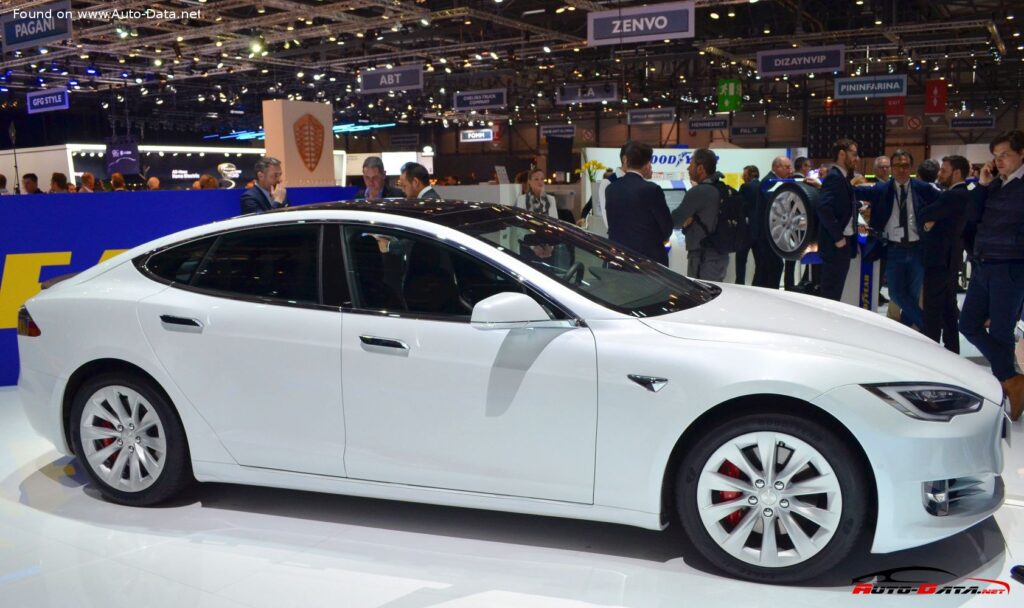
The Tesla Model S P100D, a facelifted version released in August 2016 and produced through February 2019, represents a pivotal moment in the evolution of electric vehicles. Positioned within the premium large car segment, the Model S challenged established luxury automakers with its blend of performance, range, and technology. The P100D variant, specifically, was the flagship offering during its production run, boasting the largest battery pack and highest performance figures available in the Model S lineup at the time. It solidified Tesla’s reputation for innovation and accelerated the adoption of battery electric vehicles (BEVs) globally.
Tesla Model S P100D: A Technological Leap
The 2016 facelift brought subtle but significant changes to the Model S, primarily focusing on refining the existing design and improving efficiency. However, the core appeal of the Model S remained its groundbreaking electric powertrain. The P100D distinguished itself with a 100 kWh battery pack, providing a substantial increase in range compared to earlier models. This, coupled with its dual-motor all-wheel-drive (AWD) system, delivered exhilarating acceleration and handling characteristics. The P100D wasn’t just about speed; it was a demonstration of what was possible with electric vehicle technology, showcasing the potential for long-range, high-performance, and environmentally conscious transportation.
Engine & Performance
The Tesla Model S P100D utilizes a dual-motor, all-wheel-drive (AWD) powertrain. Unlike traditional internal combustion engine vehicles, it doesn’t have an “engine” in the conventional sense. Instead, it employs two independent electric motors – one driving the front wheels and the other powering the rear wheels. The rear motor is the primary power source, producing 510 horsepower (Hp) at 5900 rpm and 650 Newton-meters (Nm) of torque. The front motor contributes an additional 262 Hp at 6100 rpm and 330 Nm of torque. Combined, the system delivers a total output of 605 Hp and a remarkable 920 Nm (678.56 lb.-ft.) of torque. This potent combination allows for blistering acceleration: 0 to 60 mph in just 2.5 seconds, 0 to 62 mph in 2.7 seconds, and 0 to 100 km/h also in 2.7 seconds. The P100D achieves a maximum speed of 250 km/h (155.34 mph). The weight-to-power ratio is an impressive 3.7 kg/Hp, or 270 Hp per tonne, highlighting the vehicle’s performance capabilities. The single-speed automatic transmission provides seamless power delivery.
Design & Features
The Tesla Model S P100D is a five-door liftback, offering a unique blend of sedan practicality and hatchback versatility. It comfortably seats up to seven passengers, making it a viable option for families. The exterior design is characterized by its sleek, aerodynamic profile, contributing to its low drag coefficient of 0.24. This aerodynamic efficiency plays a crucial role in maximizing range. The interior is minimalist and technology-focused, dominated by a large central touchscreen that controls most vehicle functions. Key features include a panoramic glass roof, advanced autopilot capabilities (depending on software version and options), and over-the-air software updates that continuously improve the vehicle’s functionality. Safety features were also a priority, with a comprehensive suite of active and passive safety systems designed to protect occupants. The large trunk offers significant cargo space, ranging from 745 liters (26.31 cu. ft.) with the rear seats up to 1645 liters (58.09 cu. ft.) with them folded down.
Technical Specifications
| Brand | Tesla |
| Model | Model S |
| Generation | Model S (facelift 2016) |
| Type | P100D 100 kWh (605 Hp) Dual Motor AWD |
| Start of production | August, 2016 |
| End of production | February, 2019 |
| Powertrain Architecture | BEV (Electric Vehicle) |
| Body type | Liftback |
| Seats | 7 |
| Doors | 5 |
| Fuel Type | Electricity |
| Acceleration 0 – 100 km/h | 2.7 sec |
| Acceleration 0 – 62 mph | 2.7 sec |
| Acceleration 0 – 60 mph | 2.5 sec |
| Maximum speed | 250 km/h (155.34 mph) |
| Weight-to-power ratio | 3.7 kg/Hp, 270 Hp/tonne |
| Weight-to-torque ratio | 2.4 kg/Nm, 410.5 Nm/tonne |
| Gross battery capacity | 100 kWh |
| Battery voltage | 350 V |
| Battery technology | Lithium-ion (Li-Ion) |
| Battery location | Below the floor |
| All-electric range (NEDC) | 613 km (380.9 mi) |
| Average Energy consumption (NEDC) | 15.5 kWh/100 km (24.94 kWh/100 mi) |
| MPGe | 135 |
| km/kWh | 6.5 |
| mi/kWh | 4 |
| Electric motor 1 Power | 510 Hp @ 5900 rpm |
| Electric motor 1 Torque | 650 Nm (479.42 lb.-ft.) |
| Electric motor 1 Max RPM | 16000 rpm |
| Electric motor 1 Location | Rear axle, Transverse |
| Electric motor 2 Power | 262 Hp @ 6100 rpm |
| Electric motor 2 Torque | 330 Nm (243.4 lb.-ft.) |
| Electric motor 2 Max RPM | 18000 rpm |
| Electric motor 2 Location | Front axle, Transverse |
| System power | 605 Hp |
| System torque | 920 Nm (678.56 lb.-ft.) |
| Kerb Weight | 2241 kg (4940.56 lbs.) |
| Max. weight | 2720 kg (5996.57 lbs.) |
| Max load | 479 kg (1056.01 lbs.) |
| Trunk (boot) space – minimum | 745 l (26.31 cu. ft.) |
| Trunk (boot) space – maximum | 1645 l (58.09 cu. ft.) |
| Max. roof load | 75 kg (165.35 lbs.) |
| Length | 4979 mm (196.02 in.) |
| Width | 1964 mm (77.32 in.) |
| Width including mirrors | 2189 mm (86.18 in.) |
| Height | 1445 mm (56.89 in.) |
| Wheelbase | 2960 mm (116.54 in.) |
| Front track | 1662 mm (65.43 in.) |
| Rear (Back) track | 1700 mm (66.93 in.) |
| Front overhang | 937 mm (36.89 in.) |
| Rear overhang | 1081 mm (42.56 in.) |
| Ride height (ground clearance) | 117-160 mm (4.61 – 6.3 in.) |
| Drag coefficient (Cd) | 0.24 |
| Minimum turning circle (turning diameter) | 12.4 m (40.68 ft.) |
| Drivetrain Architecture | One electric motor drives the front wheels, one electric motor drives the rear wheels. |
| Drive wheel | All wheel drive (4×4) |
| Number of gears and type of gearbox | 1 gears, automatic transmission |
| Front suspension | Double wishbone, Transverse stabilizer, Air suspension |
| Rear suspension | Independent multi-link suspension, Air suspension, Transverse stabilizer |
| Front brakes | Ventilated discs, 355×32 mm |
| Rear brakes | Ventilated discs, 365×28 mm |
| Assisting systems | ABS (Anti-lock braking system) |
| Steering type | Steering rack and pinion |
| Power steering | Electric Steering |
| Tires size Front | 245/45 R19; 245/35 R21 |
| Tires size Rear | 245/45 R19; 265/35 R21 |
| Wheel rims size Front | 8J x 19; 8.5J x 21 |
| Wheel rims size Rear | 8J x 19; 8.5J x 21; 9J x 21 |