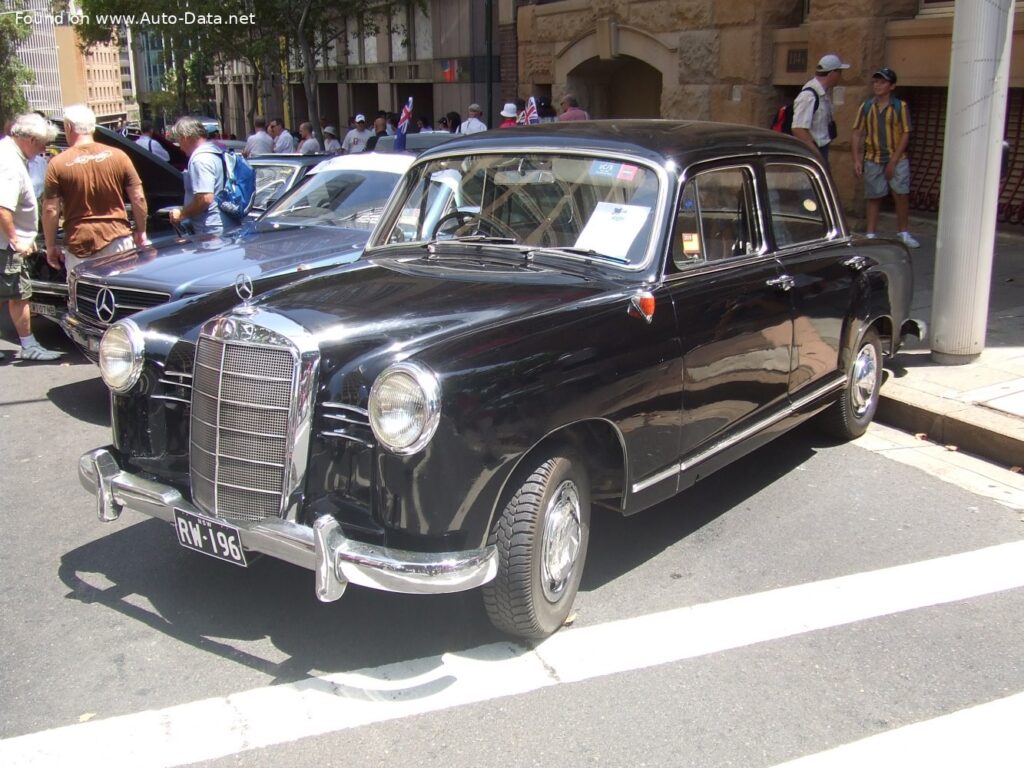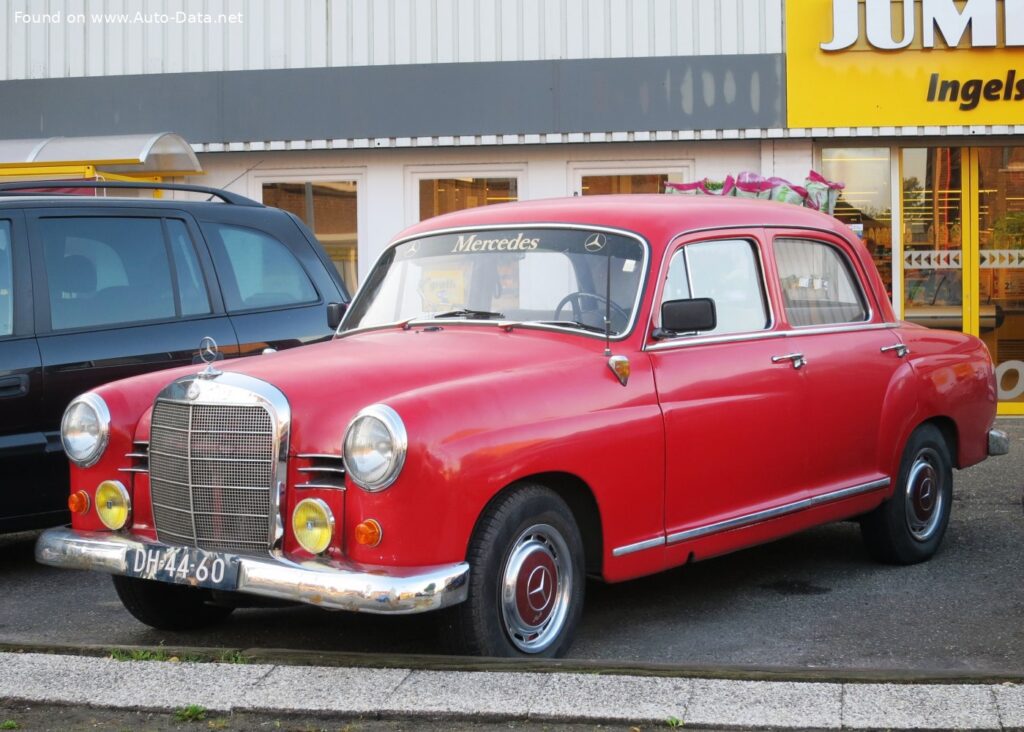
The Mercedes-Benz W121, often referred to as the “Ponton” series, represents a pivotal moment in the post-war history of Mercedes-Benz. Produced from 1956 to 1961, the W121 was the first all-new Mercedes-Benz passenger car design after World War II. The 190 b, a facelifted version introduced in 1959, continued the Ponton’s legacy, offering a blend of practicality, comfort, and the burgeoning engineering reputation of the German automaker. This model occupied the compact luxury sedan segment, aimed at providing a more accessible entry point into the Mercedes-Benz range while maintaining the brand’s commitment to quality and durability.
Mercedes-Benz W121 Sedan (Facelift 1959) 190 b
The 1959 facelift of the W121 Sedan, specifically the 190 b variant, brought subtle but important refinements to the original Ponton design. These changes included alterations to the grille, bumpers, and interior trim, enhancing the car’s aesthetic appeal and modernizing its appearance. The “b” designation indicated a slightly upgraded version of the 1.9-liter engine, offering a modest increase in power. While not a radical departure from its predecessor, the 190 b represented a continued evolution of the Ponton, solidifying its position as a popular and reliable family sedan.
Engine & Performance
The heart of the 190 b is a 1.9-liter (1897 cm3 or 115.76 cu. in.) inline-four cylinder engine, designated the M 121 B I b / 121.920. This naturally aspirated engine produces 80 horsepower at 4800 rpm and 140 Nm (103.26 lb.-ft.) of torque at 2800 rpm. Power per liter is rated at 42.2 Hp/l. The engine utilizes a single carburetor fuel injection system and a single overhead camshaft (SOHC) valvetrain with two valves per cylinder. Power is delivered to the rear wheels via a four-speed manual transmission.
Performance figures for the 190 b are modest by modern standards. Acceleration from 0 to 100 km/h (0-62 mph) takes approximately 19 seconds, while 0 to 60 mph is achieved in around 18.1 seconds. The top speed is rated at 145 km/h (90.1 mph). The weight-to-power ratio is 15 kg/Hp, or 66.7 Hp/tonne, and the weight-to-torque ratio is 8.6 kg/Nm, or 116.7 Nm/tonne. Fuel consumption is rated at 11 liters per 100 kilometers (21.4 US mpg, 25.7 UK mpg, or 9.1 km/l).
Design & Features
The W121 Sedan, including the 190 b, is a five-door, five-seater sedan characterized by its pontoon-like styling – a design trend popular in the 1950s and early 1960s, giving the car a low-slung, streamlined appearance. The unibody construction was a significant advancement for Mercedes-Benz, contributing to the car’s strength and rigidity. The 1959 facelift brought a revised front grille with a more prominent star emblem, updated bumpers, and refined interior appointments.
Inside, the 190 b offered a comfortable and well-appointed cabin for its time. While lacking many of the modern safety features found in contemporary vehicles, the Ponton series prioritized passenger comfort and a sense of luxury. Features included comfortable seating, a spacious interior for its class, and a relatively large trunk. The car’s suspension – featuring double wishbones with a transverse stabilizer at the front and a trailing arm setup at the rear – aimed to provide a smooth and controlled ride. Braking duties are handled by drum brakes on all four wheels. The steering system utilizes a cone worm with recirculation balls.
Technical Specifications
| Brand | Mercedes-Benz |
| Model | Ponton |
| Generation | W121 Sedan (facelift 1959) |
| Type (Engine) | 190 b (80 Hp) |
| Start of production | June, 1959 |
| End of production | August, 1961 |
| Powertrain Architecture | Internal Combustion engine |
| Body type | Sedan |
| Seats | 5 |
| Doors | 5 |
| Fuel consumption (combined) | 11 l/100 km |
| Fuel consumption (US mpg) | 21.4 US mpg |
| Fuel consumption (UK mpg) | 25.7 UK mpg |
| Fuel consumption (km/l) | 9.1 km/l |
| Fuel Type | Petrol (Gasoline) |
| Acceleration 0 – 100 km/h | 19 sec |
| Acceleration 0 – 62 mph | 19 sec |
| Acceleration 0 – 60 mph | 18.1 sec |
| Maximum speed | 145 km/h |
| Maximum speed (mph) | 90.1 mph |
| Weight-to-power ratio | 15 kg/Hp |
| Weight-to-torque ratio | 8.6 kg/Nm |
| Power | 80 Hp @ 4800 rpm |
| Power per litre | 42.2 Hp/l |
| Torque | 140 Nm @ 2800 rpm |
| Torque (lb.-ft.) | 103.26 lb.-ft. @ 2800 rpm |
| Engine layout | Front, Longitudinal |
| Engine Model/Code | M 121 B I b / 121.920 |
| Engine displacement | 1897 cm3 |
| Engine displacement (cu. in.) | 115.76 cu. in. |
| Number of cylinders | 4 |
| Engine configuration | Inline |
| Cylinder Bore | 85 mm |
| Cylinder Bore (in.) | 3.35 in. |
| Piston Stroke | 83.6 mm |
| Piston Stroke (in.) | 3.29 in. |
| Compression ratio | 8.5:1 |
| Number of valves per cylinder | 2 |
| Fuel injection system | Carburettor |
| Engine aspiration | Naturally aspirated engine |
| Valvetrain | SOHC |
| Kerb Weight | 1200 kg |
| Kerb Weight (lbs.) | 2645.55 lbs. |
| Max. weight | 1650 kg |
| Max. weight (lbs.) | 3637.63 lbs. |
| Max load | 450 kg |
| Max load (lbs.) | 992.08 lbs. |
| Fuel tank capacity | 56 l |
| Fuel tank capacity (US gal) | 14.79 US gal |
| Fuel tank capacity (UK gal) | 12.32 UK gal |
| Length | 4500 mm |
| Length (in.) | 177.17 in. |
| Width | 1740 mm |
| Width (in.) | 68.5 in. |
| Height | 1560 mm |
| Height (in.) | 61.42 in. |
| Wheelbase | 2650 mm |
| Wheelbase (in.) | 104.33 in. |
| Front track | 1430 mm |
| Front track (in.) | 56.3 in. |
| Rear track | 1475 mm |
| Rear track (in.) | 58.07 in. |
| Drivetrain Architecture | Rear wheel drive |
| Number of gears | 4 |
| Type of gearbox | manual transmission |
| Front suspension | Double wishbone, Transverse stabilizer |
| Rear suspension | Trailing arm |
| Front brakes | Drum |
| Rear brakes | Drum |
| Steering type | Cone worm with recirculation balls |
The Mercedes-Benz W121 190 b, while not a performance icon, holds a significant place in automotive history. It represented a crucial step in Mercedes-Benz’s recovery after the war, establishing the brand as a maker of reliable, comfortable, and increasingly sophisticated automobiles. The Ponton series, and the 190 b in particular, laid the groundwork for the future success of Mercedes-Benz in the global automotive market.