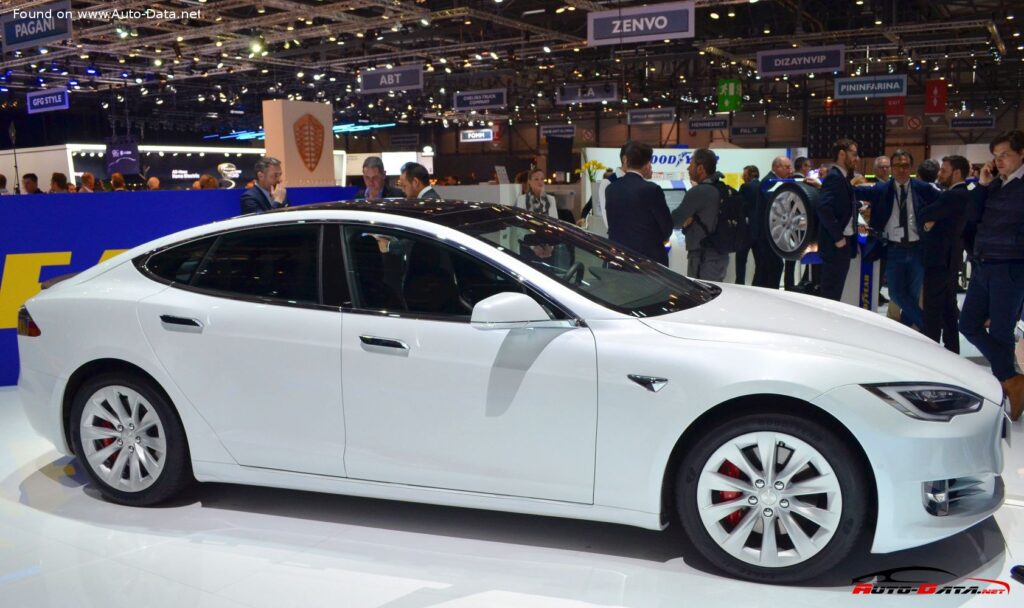
The Tesla Model S P90D, a facelifted version released in April 2016 and produced through 2017, represents a pivotal moment in the evolution of electric vehicles. Positioned within the premium large car segment, the Model S challenged established luxury automakers with its blend of performance, range, and technology. The P90D variant, specifically, was a high-performance iteration boasting dual motors and a 90 kWh battery pack, solidifying Tesla’s reputation for innovative electric powertrains. This model was primarily sold in North America, Europe, and Asia, becoming a flagship vehicle for Tesla’s expanding global presence.
Tesla Model S P90D: A Technological Leap
The 2016 facelift brought subtle but significant improvements to the Model S, enhancing its aerodynamic efficiency and overall refinement. The P90D, however, remained focused on delivering exhilarating performance. Its dual-motor all-wheel-drive (AWD) system was a key differentiator, providing instant torque and exceptional traction. This configuration allowed for rapid acceleration and confident handling in various driving conditions. The “D” in P90D signifies the dual-motor setup, a defining characteristic of Tesla’s performance models at the time.
Engine & Performance
The Tesla Model S P90D utilizes a fully electric powertrain, eschewing the internal combustion engine entirely. It features two independent electric motors – one driving the front wheels and one powering the rear. The rear motor produces 503 horsepower at 5950 rpm and 650 Nm (479.42 lb.-ft.) of torque, while the front motor contributes 259 horsepower at 6100 rpm and 330 Nm (243.4 lb.-ft.) of torque. Combined, the system delivers a total output of 463 horsepower and a substantial 967 Nm (713.22 lb.-ft.) of torque. This potent combination enables the P90D to accelerate from 0 to 60 mph in just 3.1 seconds and 0 to 100 km/h in 3.3 seconds, with a top speed of 155.34 mph (250 km/h). The battery, a 90 kWh lithium-ion unit located beneath the floor, provides a New European Driving Cycle (NEDC) range of 505 km (313.79 miles). Energy consumption is rated at 16.9 kWh per 100 km (27.2 kWh per 100 miles), equating to 124 MPGe and 5.9 km/kWh (3.7 mi/kWh).
Design & Features
The Model S P90D is a five-door liftback, offering a practical and stylish body style. It comfortably seats seven passengers, making it a versatile option for families. The liftback design provides easy access to a generous cargo area, with a minimum capacity of 745 liters (26.31 cu. ft.) expanding to 1645 liters (58.09 cu. ft.) with the rear seats folded down. The vehicle’s aerodynamic profile, evidenced by its drag coefficient of 0.24, contributes to its efficiency and range. Key features included Tesla’s Autopilot system (a precursor to full self-driving capabilities), a large touchscreen interface controlling most vehicle functions, over-the-air software updates, and a premium interior with available options like leather upholstery and advanced sound systems. The suspension utilizes double wishbones at the front and an independent multi-link setup at the rear, both incorporating air suspension and a transverse stabilizer for a comfortable and controlled ride. Safety features were also paramount, with standard ABS and a focus on active safety systems through Autopilot.
Technical Specifications
| General Information | |
| Brand | Tesla |
| Model | Model S |
| Generation | Model S (facelift 2016) |
| Type | P90D 90 kWh (463 Hp) Dual Motor AWD |
| Start of production | April, 2016 |
| End of production | 2017 |
| Powertrain | |
| Architecture | BEV (Electric Vehicle) |
| Fuel Type | Electricity |
| Gross battery capacity | 90 kWh |
| Battery voltage | 350 V |
| Battery technology | Lithium-ion (Li-Ion) |
| Battery location | Below the floor |
| Performance | |
| Acceleration 0 – 60 mph | 3.1 sec |
| Acceleration 0 – 100 km/h | 3.3 sec |
| Maximum speed | 155.34 mph (250 km/h) |
| Weight-to-power ratio | 4.7 kg/Hp |
| Weight-to-torque ratio | 2.3 kg/Nm |
| Electric Motors | |
| Motor 1 Power | 503 Hp @ 5950 rpm |
| Motor 1 Torque | 650 Nm (479.42 lb.-ft.) |
| Motor 1 Max RPM | 16000 rpm |
| Motor 1 Location | Rear axle, Transverse |
| Motor 2 Power | 259 Hp @ 6100 rpm |
| Motor 2 Torque | 330 Nm (243.4 lb.-ft.) |
| Motor 2 Max RPM | 18000 rpm |
| Motor 2 Location | Front axle, Transverse |
| System Power | 463 Hp |
| System Torque | 967 Nm (713.22 lb.-ft.) |
| Dimensions & Weights | |
| Kerb Weight | 2196 kg (4841.35 lbs.) |
| Max. weight | 2670 kg (5886.34 lbs.) |
| Max load | 474 kg (1044.99 lbs.) |
| Trunk (boot) space – minimum | 745 l (26.31 cu. ft.) |
| Trunk (boot) space – maximum | 1645 l (58.09 cu. ft.) |
| Length | 4979 mm (196.02 in.) |
| Width | 1964 mm (77.32 in.) |
| Height | 1445 mm (56.89 in.) |
| Wheelbase | 2960 mm (116.54 in.) |
The Tesla Model S P90D was more than just a fast electric car; it was a statement. It demonstrated that electric vehicles could be both practical and exhilarating, challenging the conventional wisdom of the automotive industry and paving the way for the widespread adoption of electric mobility. Its advanced technology, impressive performance, and luxurious features established a new benchmark for electric vehicles and cemented Tesla’s position as a leader in the automotive revolution.