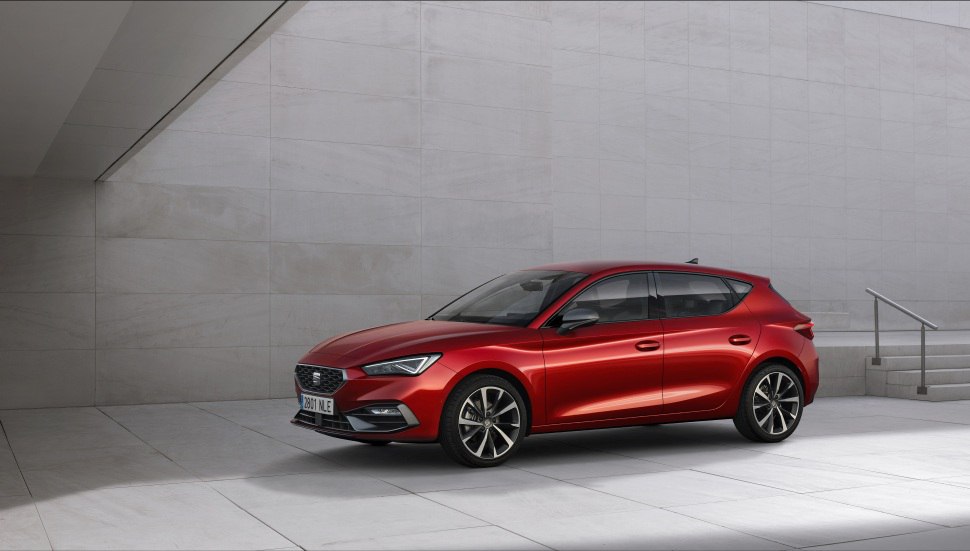
The SEAT Leon IV 1.5 TSI (150 Hp) is a compact hatchback that represents the fourth generation of SEAT’s popular Leon model. Introduced in 2020, it’s a key vehicle in SEAT’s lineup, primarily aimed at the European market. While SEAT vehicles are not officially sold in the United States, the Leon is a significant competitor in the highly competitive European C-segment, going up against rivals like the Volkswagen Golf, Ford Focus, and Peugeot 308. The fourth-generation Leon brought a substantial overhaul in terms of technology, design, and efficiency, building upon the success of its predecessors. This particular variant, powered by a 1.5-liter turbocharged gasoline engine producing 150 horsepower, offers a balance of performance and fuel economy.
SEAT Leon IV 1.5 TSI: Overview and Market Position
The SEAT Leon has long been a cornerstone of the Spanish automaker’s identity, known for its sporty handling and value proposition. The fourth generation, built on the Volkswagen Group’s MQB Evo platform, represents a significant leap forward. The MQB Evo platform allows for greater flexibility in powertrain options and improved structural rigidity. In Europe, the Leon is positioned as a more youthful and dynamic alternative to the more conservative Volkswagen Golf, sharing many of the same underlying technologies but with a distinct design language and often a more affordable price point. The 1.5 TSI engine is a popular choice, offering a good compromise between performance and running costs for everyday driving.
Engine & Performance
The heart of the SEAT Leon IV 1.5 TSI is a 1.5-liter inline-four cylinder gasoline engine, designated DPCA. This engine utilizes direct fuel injection and is equipped with a turbocharger and intercooler to boost power and efficiency. It produces a maximum power output of 150 horsepower at 5000-6000 rpm, and a torque figure of 250 Nm (184.39 lb.-ft.) between 1500-3500 rpm. This provides a broad torque band, making the car responsive in a variety of driving situations. The engine’s power-to-liter ratio is an impressive 100.1 hp/l. Power is delivered to the front wheels via a six-speed manual transmission in this configuration. Performance figures include a 0-100 km/h (0-62 mph) acceleration time of 8.4 seconds, and a 0-60 mph time of approximately 8 seconds. The maximum speed is electronically limited to 221 km/h (137.32 mph). The engine also incorporates a Start & Stop system to further improve fuel economy and reduce emissions. The engine meets EURO 6 DG emission standards.
Design & Features
The SEAT Leon IV boasts a modern and dynamic exterior design. The hatchback body style offers practicality and versatility, with five seats and five doors. Key design elements include sharp lines, a distinctive front grille, and full LED headlights and taillights. Inside, the Leon IV features a minimalist and technology-focused interior. A prominent feature is the digital cockpit, incorporating a digital instrument cluster and a central infotainment touchscreen. The interior materials are of good quality, and the overall design is driver-focused. Safety features are comprehensive, including ABS (Anti-lock Braking System), and a suite of driver-assistance systems. The trunk (boot) space is a practical 380 liters (13.42 cu. ft.) with the rear seats up, expanding to 1301 liters (45.94 cu. ft.) when the rear seats are folded down. The vehicle’s kerb weight is 1241 kg (2735.94 lbs), with a maximum weight of 1840 kg (4056.51 lbs) and a maximum load capacity of 599 kg (1320.57 lbs).
Technical Specifications
| Brand | Seat |
| Model | Leon |
| Generation | Leon IV |
| Type (Engine) | 1.5 TSI (150 Hp) |
| Start of production | 2020 |
| Powertrain Architecture | Internal Combustion engine |
| Body type | Hatchback |
| Seats | 5 |
| Doors | 5 |
| Combined fuel consumption (WLTP) | 5.5-6.3 l/100 km (42.8 – 37.3 US mpg, 51.4 – 44.8 UK mpg, 18.2 – 15.9 km/l) |
| CO2 emissions (WLTP) | 125 – 143 g/km |
| Fuel Type | Petrol (Gasoline) |
| Acceleration 0 – 100 km/h | 8.4 sec |
| Acceleration 0 – 62 mph | 8.4 sec |
| Acceleration 0 – 60 mph | 8 sec |
| Maximum speed | 221 km/h (137.32 mph) |
| Emission standard | EURO 6 DG |
| Weight-to-power ratio | 8.3 kg/Hp, 120.9 Hp/tonne |
| Weight-to-torque ratio | 5 kg/Nm, 201.5 Nm/tonne |
| Power | 150 Hp @ 5000-6000 rpm |
| Power per litre | 100.1 Hp/l |
| Torque | 250 Nm @ 1500-3500 rpm (184.39 lb.-ft. @ 1500-3500 rpm) |
| Engine layout | Front, Transverse |
| Engine Model/Code | DPCA |
| Engine displacement | 1498 cm3 (91.41 cu. in.) |
| Number of cylinders | 4 |
| Engine configuration | Inline |
| Cylinder Bore | 74.5 mm (2.93 in.) |
| Piston Stroke | 85.9 mm (3.38 in.) |
| Compression ratio | 10.5:1 |
| Number of valves per cylinder | 4 |
| Fuel injection system | Direct injection |
| Engine aspiration | Turbocharger, Intercooler |
| Engine oil capacity | 4.3 l (4.54 US qt | 3.78 UK qt) |
| Coolant | 8 l (8.45 US qt | 7.04 UK qt) |
| Kerb Weight | 1241 kg (2735.94 lbs.) |
| Max. weight | 1840 kg (4056.51 lbs.) |
| Max load | 599 kg (1320.57 lbs.) |
| Trunk (boot) space – minimum | 380 l (13.42 cu. ft.) |
| Trunk (boot) space – maximum | 1301 l (45.94 cu. ft.) |
| Fuel tank capacity | 50 l (13.21 US gal | 11 UK gal) |
| Length | 4368 mm (171.97 in.) |
| Width | 1800 mm (70.87 in.) |
| Height | 1456 mm (57.32 in.) |
| Wheelbase | 2686 mm (105.75 in.) |
| Front track | 1545 mm (60.83 in.) |
| Rear (Back) track | 1516 mm (59.69 in.) |
| Minimum turning circle (turning diameter) | 10.5 m (34.45 ft.) |
| Drivetrain Architecture | Front wheel drive |
| Number of gears and type of gearbox | 6 gears, manual transmission |
| Front suspension | Independent, type McPherson with coil spring and anti-roll bar |
| Rear suspension | Independent multi-link suspension |
| Front brakes | Ventilated discs, 288 mm |
| Rear brakes | Disc, 272 mm |
| Tires size | 195/65 R15 91H; 205/55 R16 91V; 225/45 R17 91W; 205/50R17 93V; 225/40 R18 92Y |
| Wheel rims size | 6J x 15; 6; 5J x 16; 7J x 16; 7; 5J x 17; 7; 5J x 18 |