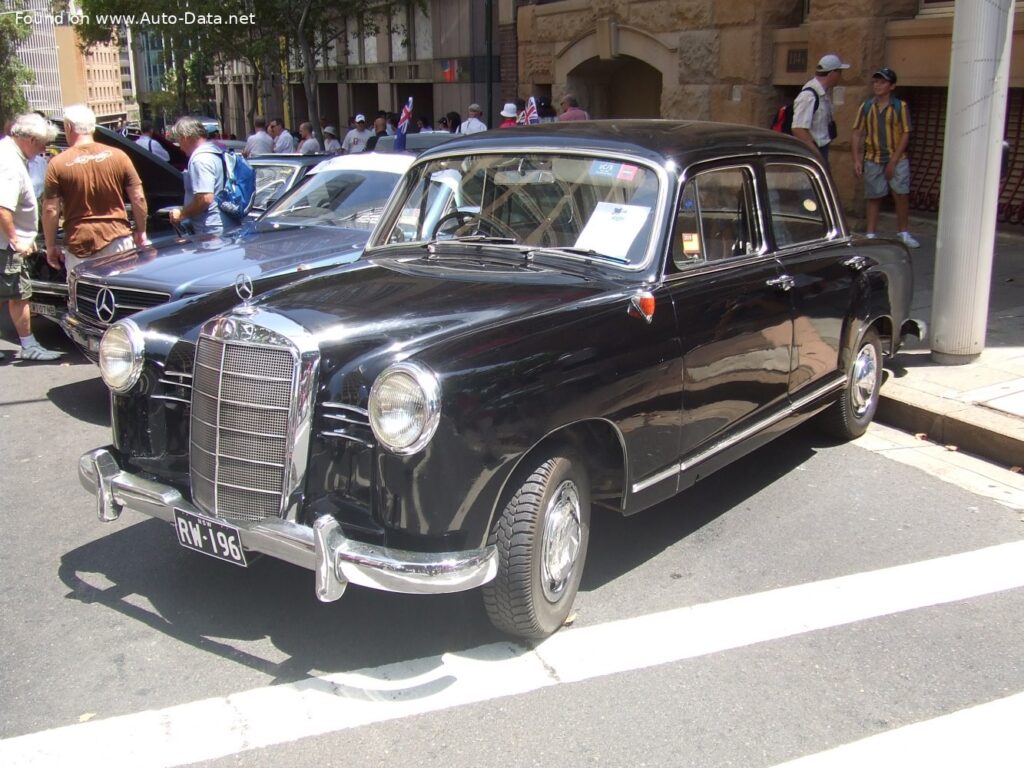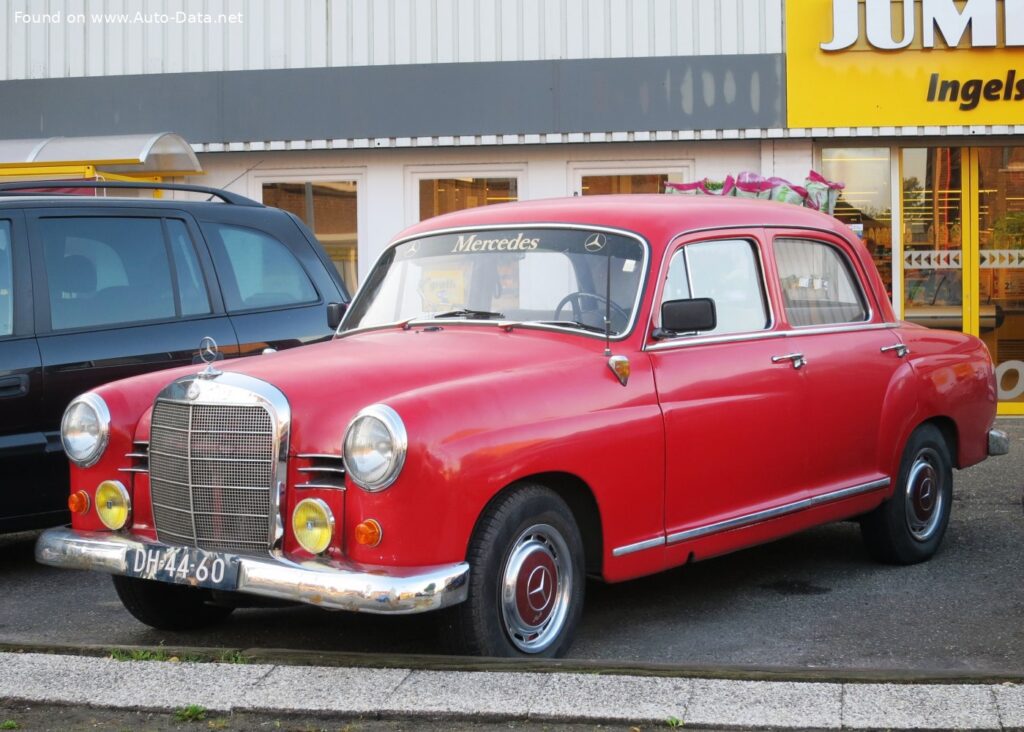
The Mercedes-Benz W121, often referred to as the “Ponton” series, represents a pivotal moment in the post-war history of Mercedes-Benz. Produced from 1956 to 1961, the W121 was the first all-new Mercedes-Benz passenger car design after World War II. The 190 Db, a facelifted version introduced in 1959, was a significant iteration, offering a diesel-powered option within the Ponton range. This model, while not initially intended for the American market, played a crucial role in establishing Mercedes-Benz as a manufacturer of high-quality, reliable automobiles in Europe and beyond. The “Db” designation signified the diesel-powered variant, catering to a growing demand for fuel-efficient vehicles.
The Mercedes-Benz W121 Sedan: A Post-War Icon
The Ponton name derives from the German word for pontoon, referencing the car’s unibody construction – a departure from the separate chassis and body construction common at the time. This design contributed to a lower center of gravity, improved handling, and increased passenger space. The 1959 facelift brought subtle but noticeable changes to the exterior, including revised grille detailing and updated trim. The 190 Db specifically targeted buyers seeking economy and durability, offering a practical and robust alternative to the gasoline-powered models. It was a car built for everyday use, prioritizing reliability and longevity over outright performance.
Engine & Performance
The heart of the 190 Db is its 1.9-liter (1897 cc) inline-four cylinder diesel engine, designated OM 621 I / 621.910. This engine produced 50 horsepower at 4000 rpm and 108 Nm (79.66 lb.-ft.) of torque at 2200 rpm. While the horsepower figure may seem modest by modern standards, the diesel engine’s torque characteristics provided reasonable performance for its time, particularly in everyday driving situations. The engine featured a high compression ratio of 21:1 and utilized a carburetor fuel injection system. Power delivery was managed through a four-speed manual transmission, driving the rear wheels. Acceleration from 0 to 100 km/h (0-62 mph) took approximately 29 seconds, and the car reached a top speed of 120 km/h (74.56 mph). The fuel consumption was a respectable 7.1 liters per 100 kilometers (33.1 US mpg), making it an economical choice for its era.
Design & Features
The 190 Db is a five-seater sedan with a five-door body style. Its design embodies the understated elegance of the late 1950s. The Ponton’s styling was characterized by clean lines, a relatively low roofline, and integrated fenders. The interior was functional and comfortable, reflecting the car’s focus on practicality. While not lavishly appointed, the cabin offered adequate space for passengers and luggage. Safety features were relatively basic by today’s standards, consisting primarily of robust construction and reliable braking systems. The suspension system comprised double wishbones with a transverse stabilizer at the front and a trailing arm setup at the rear, providing a comfortable ride quality. Braking duties were handled by drum brakes on all four wheels. The steering system employed a cone worm with recirculation balls, offering precise control.
Technical Specifications
| Brand | Mercedes-Benz |
| Model | Ponton |
| Generation | W121 Sedan (facelift 1959) |
| Type (Engine) | 190 Db (50 Hp) |
| Start of production | June, 1959 |
| End of production | September, 1961 |
| Powertrain Architecture | Internal Combustion engine |
| Body type | Sedan |
| Seats | 5 |
| Doors | 5 |
| Fuel consumption (combined) | 7.1 l/100 km |
| Fuel consumption (US mpg) | 33.1 US mpg |
| Fuel consumption (UK mpg) | 39.8 UK mpg |
| Fuel consumption (km/l) | 14.1 km/l |
| Fuel Type | Diesel |
| Acceleration 0 – 100 km/h | 29 sec |
| Acceleration 0 – 62 mph | 29 sec |
| Acceleration 0 – 60 mph | 27.6 sec |
| Maximum speed | 120 km/h |
| Maximum speed (mph) | 74.56 mph |
| Weight-to-power ratio | 24.2 kg/Hp |
| Hp/tonne | 41.3 Hp/tonne |
| Weight-to-torque ratio | 11.2 kg/Nm |
| Nm/tonne | 89.3 Nm/tonne |
| Power | 50 Hp @ 4000 rpm |
| Power per litre | 26.4 Hp/l |
| Torque | 108 Nm @ 2200 rpm |
| Torque (lb.-ft.) | 79.66 lb.-ft. @ 2200 rpm |
| Engine layout | Front, Longitudinal |
| Engine Model/Code | OM 621 I / 621.910 |
| Engine displacement | 1897 cm3 |
| Engine displacement (cu. in.) | 115.76 cu. in. |
| Number of cylinders | 4 |
| Engine configuration | Inline |
| Cylinder Bore | 85 mm |
| Cylinder Bore (in.) | 3.35 in. |
| Piston Stroke | 83.6 mm |
| Piston Stroke (in.) | 3.29 in. |
| Compression ratio | 21:1 |
| Number of valves per cylinder | 2 |
| Fuel injection system | Carburettor |
| Engine aspiration | Naturally aspirated engine |
| Valvetrain | SOHC |
| Kerb Weight | 1210 kg |
| Kerb Weight (lbs.) | 2667.59 lbs. |
| Max. weight | 1660 kg |
| Max. weight (lbs.) | 3659.67 lbs. |
| Max load | 450 kg |
| Max load (lbs.) | 992.08 lbs. |
| Fuel tank capacity | 56 l |
| Fuel tank capacity (US gal) | 14.79 US gal |
| Fuel tank capacity (UK gal) | 12.32 UK gal |
| Length | 4500 mm |
| Length (in.) | 177.17 in. |
| Width | 1740 mm |
| Width (in.) | 68.5 in. |
| Height | 1560 mm |
| Height (in.) | 61.42 in. |
| Wheelbase | 2650 mm |
| Wheelbase (in.) | 104.33 in. |
| Front track | 1430 mm |
| Front track (in.) | 56.3 in. |
| Rear (Back) track | 1475 mm |
| Rear (Back) track (in.) | 58.07 in. |
| Drivetrain Architecture | The Internal combustion engine (ICE) drives the rear wheels of the vehicle. |
| Drive wheel | Rear wheel drive |
| Number of gears and type of gearbox | 4 gears, manual transmission |
| Front suspension | Double wishbone, Transverse stabilizer |
| Rear suspension | Trailing arm |
| Front brakes | Drum |
| Rear brakes | Drum |
| Steering type | Cone worm with recirculation balls |
The Mercedes-Benz W121 190 Db, while not a performance car, represents a significant step forward in post-war automotive engineering. Its robust construction, fuel efficiency, and comfortable ride made it a popular choice for families and commuters in Europe. It laid the groundwork for the continued success of Mercedes-Benz as a manufacturer of premium automobiles, and its legacy can still be seen in the design and engineering of modern Mercedes-Benz vehicles.