
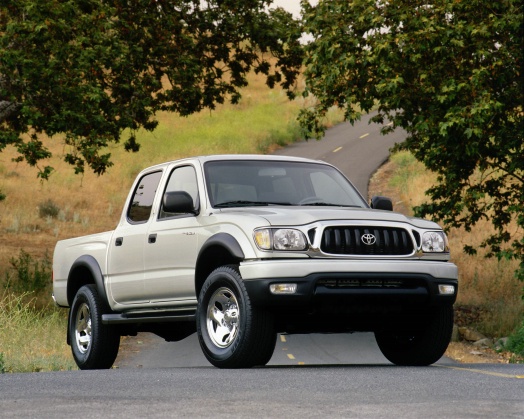
The Toyota Tacoma I Double Cab (facelift 2000) with the 3.4-liter V6 engine represents a significant iteration of Toyota’s popular compact pickup truck. Introduced as a mid-cycle refresh, this version of the first-generation Tacoma (1995-2004) aimed to enhance both aesthetics and functionality, solidifying the Tacoma’s position as a leading contender in the North American pickup market. While not initially designed specifically for the US market – the Tacoma evolved from the Hilux, a globally sold pickup – it quickly gained favor with American buyers seeking a versatile, reliable, and relatively compact truck. The Double Cab configuration, introduced in 1998, expanded the Tacoma’s appeal by offering seating for five passengers, a feature previously uncommon in the compact pickup segment.
Toyota Tacoma I Double Cab (2000-2004): A Detailed Overview
The facelifted 2000 model year Tacoma Double Cab brought subtle but noticeable changes to the exterior styling, including a revised grille, headlights, and front bumper. These updates, combined with the proven mechanical reliability of the Tacoma platform, contributed to its continued success. The 3.4-liter V6 engine became the primary powerplant for the Double Cab, offering a balance of power and fuel efficiency suitable for both daily driving and light-duty hauling. The Tacoma’s reputation for off-road capability, stemming from its robust suspension and available four-wheel-drive system, also remained a key selling point.
Engine & Performance
The heart of the 2000-2004 Toyota Tacoma I Double Cab is the 5VZ-FE 3.4-liter V6 engine. This naturally aspirated engine produces 190 horsepower at 4800 rpm and 298 Nm (219.79 lb.-ft.) of torque at 3600 rpm. The engine features a V-configuration with 6 cylinders, a displacement of 3378 cm3 (206.14 cu. in.), and a compression ratio of 9.6:1. It utilizes a multi-port fuel injection system and a Double Overhead Camshaft (DOHC) valvetrain with 4 valves per cylinder. This configuration delivers a power-to-weight ratio of 152.4 Hp/tonne and a torque-to-weight ratio of 239 Nm/tonne. The engine’s longitudinal front-engine layout contributes to balanced handling. Fuel economy is rated at approximately 13.8 l/100 km (17 US mpg) in urban driving and 12.4 l/100 km (19 US mpg) in extra-urban conditions. The 5VZ-FE is known for its durability and relatively simple maintenance requirements, contributing to the Tacoma’s overall reliability.
Design & Features
The Toyota Tacoma I Double Cab (facelift 2000) is a four-door, five-seat pickup truck. Its body-on-frame construction provides a robust platform for both on-road comfort and off-road durability. The Double Cab configuration significantly increased interior space compared to the standard cab models, making it a more practical option for families or those needing to transport passengers regularly. The truck’s dimensions are 5138 mm (202.28 in.) in length, 1781 mm (70.12 in.) in width, and 1715 mm (67.52 in.) in height, with a wheelbase of 3096 mm (121.89 in.). The curb weight is 1247 kg (2749.16 lbs), with a maximum weight capacity of 1928 kg (4250.51 lbs) and a maximum load capacity of 681 kg (1501.35 lbs). Safety features for the era included ventilated disc brakes in the front and drum brakes in the rear. Standard tire sizes were 205/75 R15 and 235/55 R16, mounted on 15 or 16-inch wheel rims. The Tacoma’s ride height (ground clearance) is 215 mm (8.46 in), enhancing its off-road capability. The truck’s design prioritized functionality and durability, with a focus on providing a versatile and reliable transportation solution.
Technical Specifications
| Brand | Toyota |
| Model | Tacoma |
| Generation | Tacoma I Double Cab (facelift 2000) |
| Type (Engine) | 3.4 V6 (190 Hp) |
| Start of production | 2000 |
| End of production | 2004 |
| Powertrain Architecture | Internal Combustion engine |
| Body type | Pick-up |
| Seats | 5 |
| Doors | 4 |
| Fuel consumption (urban) | 13.8 l/100 km (17 US mpg) |
| Fuel consumption (extra urban) | 12.4 l/100 km (19 US mpg) |
| Fuel Type | Petrol (Gasoline) |
| Weight-to-power ratio | 6.6 kg/Hp |
| Weight-to-torque ratio | 4.2 kg/Nm |
| Power | 190 Hp @ 4800 rpm |
| Torque | 298 Nm @ 3600 rpm (219.79 lb.-ft. @ 3600 rpm) |
| Engine layout | Front, Longitudinal |
| Engine Model/Code | 5VZ-FE |
| Engine displacement | 3378 cm3 (206.14 cu. in.) |
| Number of cylinders | 6 |
| Engine configuration | V-engine |
| Cylinder Bore | 93.4 mm (3.68 in.) |
| Piston Stroke | 82.04 mm (3.23 in.) |
| Compression ratio | 9.6:1 |
| Number of valves per cylinder | 4 |
| Fuel injection system | Multi-port manifold injection |
| Engine aspiration | Naturally aspirated |
| Valvetrain | DOHC |
| Kerb Weight | 1247 kg (2749.16 lbs.) |
| Max. weight | 1928 kg (4250.51 lbs.) |
| Max load | 681 kg (1501.35 lbs.) |
| Fuel tank capacity | 70 l (18.49 US gal | 15.4 UK gal) |
| Length | 5138 mm (202.28 in.) |
| Width | 1781 mm (70.12 in.) |
| Height | 1715 mm (67.52 in.) |
| Wheelbase | 3096 mm (121.89 in.) |
| Front track | 1461 mm (57.52 in.) |
| Rear track | 1455 mm (57.28 in.) |
| Ride height (ground clearance) | 215 mm (8.46 in.) |
| Drivetrain Architecture | Rear wheel drive |
| Number of gears | 5 |
| Gearbox type | Manual transmission |
| Front brakes | Ventilated discs |
| Rear brakes | Drum |
| Tires size | 205/75 R15; 235/55 R16 |
| Wheel rims size | 15; 16 |

