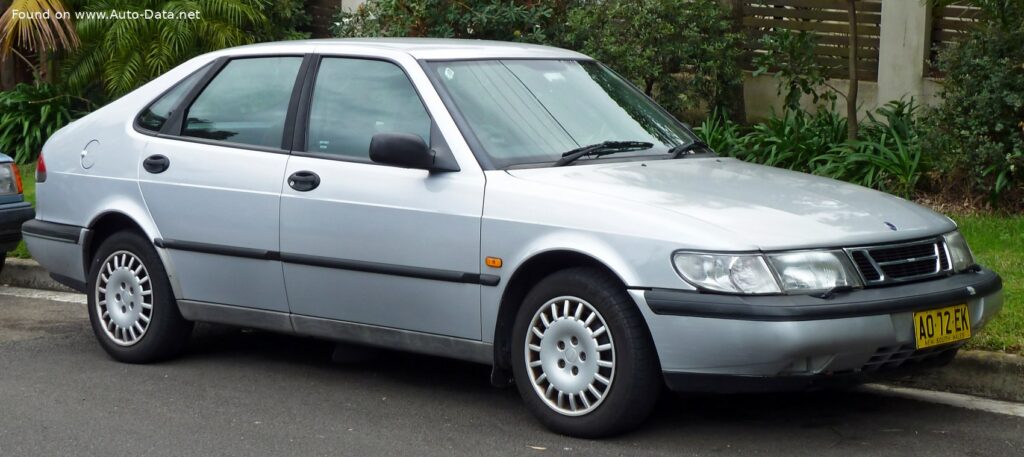
The Saab 900 II, produced between 1993 and 1998, represents a significant evolution of the original Saab 900, maintaining the brand’s reputation for quirky design, robust engineering, and a dedicated following. This second generation, while retaining the classic Saab hatchback silhouette, benefited from substantial improvements in safety, performance, and refinement. Primarily sold in Europe, the 900 II was never officially offered in the United States, though grey market imports exist. It occupied the compact family car segment, competing with vehicles like the Volkswagen Golf, Ford Escort, and Opel Astra. The 2.0 16V Turbo variant, producing 185 horsepower, was a performance-oriented offering within the 900 II range.
Saab 900 II 2.0 16V Turbo: A Detailed Overview
The 900 II marked a departure from the earlier, more hand-built approach of the original 900. While still retaining a unique character, the second generation benefited from more modern manufacturing techniques and a greater emphasis on safety and comfort. The 2.0 16V Turbo model, in particular, appealed to drivers seeking a blend of practicality and spirited performance. It represented Saab’s commitment to turbocharged engines, a technology the company had pioneered and become synonymous with.
Engine & Performance
At the heart of the Saab 900 II 2.0 16V Turbo lies the B206i inline-four cylinder engine, displacing 1,985 cubic centimeters (121.13 cubic inches). This engine is characterized by its 16-valve dual overhead camshaft (DOHC) configuration and, crucially, a Mitsubishi TD04HL-13C turbocharger. This combination allows the engine to produce 185 horsepower at 5,500 rpm and 263 Newton-meters (193.98 lb.-ft.) of torque at 2,100 rpm. The turbocharger provides a significant boost in power and torque, delivering strong acceleration and responsive performance. The engine utilizes multi-port fuel injection for precise fuel delivery.
Power is delivered to the front wheels via a five-speed manual transmission. This configuration allows for a 0-100 km/h (0-62 mph) acceleration time of 8.5 seconds, and a calculated 0-60 mph time of 8.1 seconds. The 900 II 2.0 16V Turbo boasts a maximum speed of 230 km/h (142.92 mph). The engine’s power-to-weight ratio is a respectable 7.2 kg/Hp, and the torque-to-weight ratio is 5.1 kg/Nm, contributing to its lively driving experience. Fuel consumption is rated at 8.5 liters per 100 kilometers (27.7 US mpg, 33.2 UK mpg).
Design & Features
The Saab 900 II retains the distinctive hatchback body style of its predecessor, offering a practical and versatile layout. The five-door configuration provides easy access to the spacious interior, which comfortably seats five passengers. The design, while evolutionary, features a more rounded and aerodynamic profile compared to the original 900.
Safety was a key focus in the development of the 900 II. It incorporated features such as Anti-lock Braking System (ABS) as standard equipment, a significant advancement for the time. The body structure was also strengthened to improve crashworthiness. Interior features included a driver-focused cockpit, known for its ergonomic design and intuitive controls. Trunk space is generous, ranging from 494 liters (17.45 cubic feet) with the rear seats up to 897 liters (31.68 cubic feet) with the seats folded down. The steering utilizes a hydraulic power steering rack and pinion system for precise and responsive handling. The vehicle rides on R15 tires mounted on 15-inch wheel rims.
Technical Specifications
| Brand | Saab |
| Model | 900 |
| Generation | 900 II |
| Type (Engine) | 2.0 16V Turbo (185 Hp) |
| Start of production | 1993 |
| End of production | 1998 |
| Powertrain Architecture | Internal Combustion engine |
| Body type | Hatchback |
| Seats | 5 |
| Doors | 5 |
| Fuel consumption (combined) | 8.5 l/100 km |
| Fuel consumption (US mpg) | 27.7 US mpg |
| Fuel consumption (UK mpg) | 33.2 UK mpg |
| Fuel Type | Petrol (Gasoline) |
| Acceleration 0 – 100 km/h | 8.5 sec |
| Acceleration 0 – 62 mph | 8.5 sec |
| Acceleration 0 – 60 mph | 8.1 sec |
| Maximum speed | 230 km/h (142.92 mph) |
| Weight-to-power ratio | 7.2 kg/Hp |
| Weight-to-torque ratio | 5.1 kg/Nm |
| Power | 185 Hp @ 5500 rpm |
| Torque | 263 Nm @ 2100 rpm (193.98 lb.-ft. @ 2100 rpm) |
| Engine layout | Front, Transverse |
| Engine Model/Code | B206i |
| Engine displacement | 1985 cm3 (121.13 cu. in.) |
| Number of cylinders | 4 |
| Engine configuration | Inline |
| Cylinder Bore | 90 mm (3.54 in.) |
| Piston Stroke | 78 mm (3.07 in.) |
| Compression ratio | 9.2:1 |
| Number of valves per cylinder | 4 |
| Fuel injection system | Multi-port manifold injection |
| Engine aspiration | Turbocharger |
| Valvetrain | DOHC |
| Engine oil capacity | 5 l (5.28 US qt | 4.4 UK qt) |
| Coolant capacity | 8.5 l (8.98 US qt | 7.48 UK qt) |
| Kerb Weight | 1330 kg (2932.15 lbs.) |
| Max. weight | 1840 kg (4056.51 lbs.) |
| Max load | 510 kg (1124.36 lbs.) |
| Trunk (boot) space – minimum | 494 l (17.45 cu. ft.) |
| Trunk (boot) space – maximum | 897 l (31.68 cu. ft.) |
| Fuel tank capacity | 68 l (17.96 US gal | 14.96 UK gal) |
| Length | 4637 mm (182.56 in.) |
| Width | 1711 mm (67.36 in.) |
| Height | 1436 mm (56.54 in.) |
| Wheelbase | 2600 mm (102.36 in.) |
| Front track | 1446 mm (56.93 in.) |
| Rear track | 1443 mm (56.81 in.) |
| Drivetrain Architecture | Front wheel drive |
| Number of gears | 5 |
| Gearbox type | Manual transmission |
| Front suspension | Wishbone |
| Rear suspension | Suspension with traction connecting levers |
| Front brakes | Ventilated discs |
| Rear brakes | Disc |
| Assisting systems | ABS (Anti-lock braking system) |
| Steering type | Steering rack and pinion |
| Power steering | Hydraulic Steering |
| Tires size | R15 |
| Wheel rims size | 15 |
The Saab 900 II 2.0 16V Turbo, despite not being officially sold in the US market, remains a highly regarded vehicle among Saab enthusiasts. Its blend of performance, practicality, and distinctive Scandinavian design continues to attract a loyal following. It represents a pivotal moment in Saab’s history, bridging the gap between its hand-built origins and the more modern, mass-produced vehicles that followed.