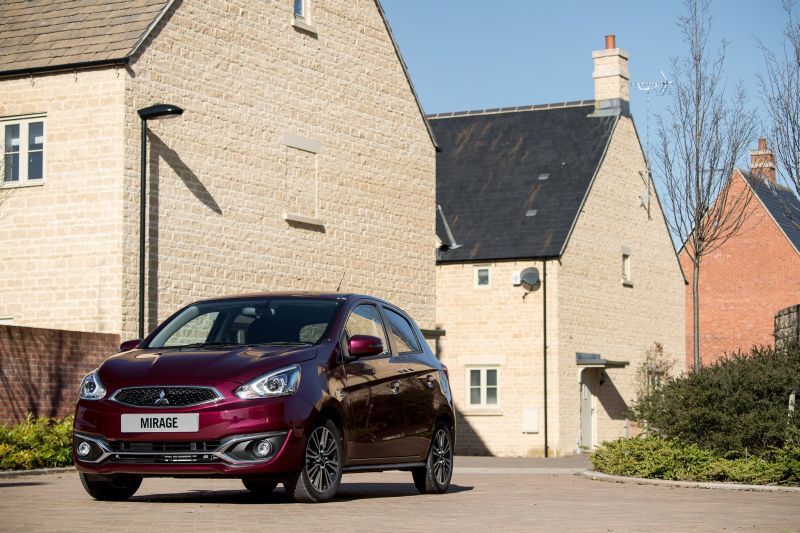
The Mitsubishi Space Star, particularly the facelifted version introduced in 2015, is a supermini hatchback primarily aimed at the European market. While not officially sold in the United States, it represents a significant offering in the affordable and fuel-efficient city car segment. Positioned below the larger Mitsubishi Mirage (which *is* sold in the US), the Space Star focuses on practicality, low running costs, and ease of driving. The 2015 facelift brought styling updates and improvements to the vehicle’s already competitive fuel economy. This generation of the Space Star was produced from 2015 to 2019, offering a budget-friendly option for buyers seeking a compact and economical vehicle.
Mitsubishi Space Star (Facelift 2015): Overview
The Space Star, known as the Mirage in some markets, is designed to be a no-frills, efficient transportation solution. The facelifted 2015 model refined the exterior styling and maintained the focus on fuel efficiency and affordability. It caters to drivers who prioritize low operating costs and maneuverability in urban environments. The vehicle’s compact size makes it easy to park and navigate congested city streets, while its relatively low weight contributes to its fuel economy.
Engine & Performance
The 2015 Mitsubishi Space Star 1.2 MIVEC CLEARTEC CVT is powered by a 1.2-liter, three-cylinder gasoline engine. This engine produces 80 horsepower at 6000 rpm and 106 Nm (78.18 lb.-ft.) of torque at 4000 rpm. The engine utilizes Mitsubishi’s MIVEC (Mitsubishi Innovative Valve timing and lift Electronic Control) technology to optimize valve timing and improve both power delivery and fuel efficiency. The engine is transversely mounted at the front of the vehicle. Power is delivered to the front wheels via a continuously variable transmission (CVT). This CVT is designed to maximize fuel economy by keeping the engine operating in its most efficient range. Performance figures include a 0-100 km/h (0-62 mph) acceleration time of 12.8 seconds and a top speed of 173 km/h (107.5 mph). While not designed for outright speed, the powertrain provides adequate performance for everyday driving. The weight-to-power ratio is 10.9 kg/Hp, and the weight-to-torque ratio is 8.2 kg/Nm.
Design & Features
The Mitsubishi Space Star is a five-door hatchback with a practical and functional design. The 2015 facelift brought subtle changes to the front fascia, including a revised grille and bumper, giving the car a more modern appearance. The interior is designed to be simple and durable, with a focus on providing comfortable seating for five passengers. Key features include a relatively spacious cabin for its size, a decent amount of cargo space (209 liters minimum, expanding to 912 liters with the rear seats folded down), and standard safety equipment such as ABS (Anti-lock Braking System). The Space Star prioritizes practicality over luxury, offering a straightforward and user-friendly driving experience. The vehicle’s compact dimensions (3795 mm long, 1665 mm wide, and 1505 mm high) make it easy to maneuver in tight spaces. The curb weight ranges from 870 to 880 kg, contributing to its fuel efficiency.
Technical Specifications
| Brand | Mitsubishi |
| Model | Space Star |
| Generation | Space Star (facelift 2015) |
| Type (Engine) | 1.2 MIVEC (80 Hp) CLEARTEC CVT |
| Start of production | 2015 |
| End of production | 2019 |
| Powertrain Architecture | Internal Combustion engine |
| Body type | Hatchback |
| Seats | 5 |
| Doors | 5 |
| Fuel consumption (urban) | 4.6-4.9 l/100 km (51.1 – 48 US mpg) |
| Fuel consumption (extra urban) | 3.8-3.9 l/100 km (61.9 – 60.3 US mpg) |
| Fuel consumption (combined) | 4.1-4.3 l/100 km (57.4 – 54.7 US mpg) |
| CO2 emissions | 95-99 g/km |
| Fuel Type | Petrol (Gasoline) |
| Acceleration 0 – 100 km/h | 12.8 sec |
| Acceleration 0 – 62 mph | 12.8 sec |
| Acceleration 0 – 60 mph | 12.2 sec |
| Maximum speed | 173 km/h (107.5 mph) |
| Emission standard | Euro 6 |
| Weight-to-power ratio | 10.9 kg/Hp |
| Weight-to-torque ratio | 8.2 kg/Nm |
| Power | 80 Hp @ 6000 rpm |
| Torque | 106 Nm @ 4000 rpm (78.18 lb.-ft. @ 4000 rpm) |
| Engine layout | Front, Transverse |
| Engine displacement | 1193 cm3 (72.8 cu. in.) |
| Number of cylinders | 3 |
| Engine configuration | Inline |
| Cylinder Bore | 75 mm (2.95 in.) |
| Piston Stroke | 90 mm (3.54 in.) |
| Compression ratio | 11:1 |
| Number of valves per cylinder | 4 |
| Fuel injection system | Multi-port manifold injection |
| Engine aspiration | Naturally aspirated engine |
| Valvetrain | DOHC |
| Kerb Weight | 870-880 kg (1918.02 – 1940.07 lbs.) |
| Max. weight | 1370 kg (3020.33 lbs.) |
| Max load | 490-500 kg (1080.27 – 1102.31 lbs.) |
| Trunk (boot) space – minimum | 209 l (7.38 cu. ft.) |
| Trunk (boot) space – maximum | 912 l (32.21 cu. ft.) |
| Fuel tank capacity | 35 l (9.25 US gal | 7.7 UK gal) |
| Max. roof load | 50 kg (110.23 lbs.) |
| Permitted trailer load with brakes (12%) | 200 kg (440.92 lbs.) |
| Permitted towbar download | 25 kg (55.12 lbs.) |
| Length | 3795 mm (149.41 in.) |
| Width | 1665 mm (65.55 in.) |
| Width including mirrors | 1950 mm (76.77 in.) |
| Height | 1505 mm (59.25 in.) |
| Wheelbase | 2450 mm (96.46 in.) |
| Front track | 1430 mm (56.3 in.) |
| Rear (Back) track | 1415 mm (55.71 in.) |
| Front overhang | 745 mm (29.33 in.) |
| Rear overhang | 600 mm (23.62 in.) |
| Ride height (ground clearance) | 150 mm (5.91 in.) |
| Minimum turning circle (turning diameter) | 9.2 m (30.18 ft.) |
| Drivetrain Architecture | Front wheel drive |
| Number of gears and type of gearbox | automatic transmission CVT |
| Front suspension | Independent, type McPherson with coil spring and anti-roll bar |
| Rear suspension | Semi-independent, coil spring |
| Front brakes | Ventilated discs |
| Rear brakes | Drum |
| Assisting systems | ABS (Anti-lock braking system) |
| Steering type | Steering rack and pinion |
| Power steering | Electric Steering |
| Tires size | 165/65 R14; 175/55 R15 |
| Wheel rims size | 4.5J x 14; 5.0J x 15 |
The Mitsubishi Space Star (facelift 2015) 1.2 MIVEC CLEARTEC CVT represents a practical and economical choice for buyers in the European supermini segment. Its focus on fuel efficiency, compact size, and affordability makes it a compelling option for urban commuters and those seeking a low-cost vehicle.