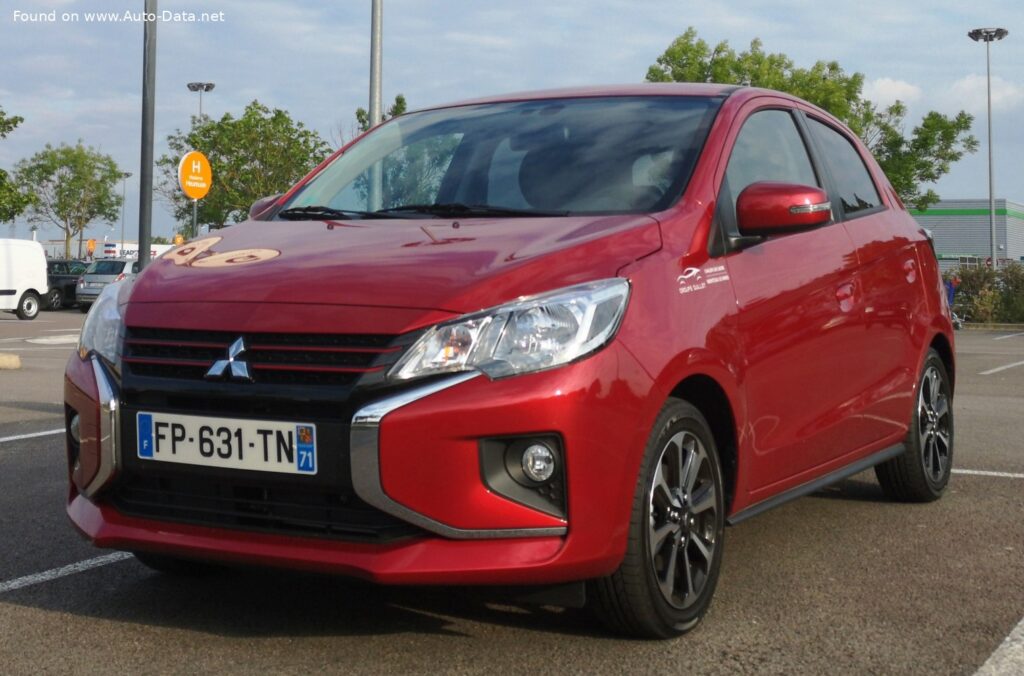
The Mitsubishi Space Star, known as the Mirage in some markets, is a supermini hatchback produced by Mitsubishi Motors. The facelifted version released in 2019 represents a significant update to the fifth generation, which began production in 2013. Primarily aimed at the European and Asian markets, the Space Star occupies the entry-level hatchback segment, focusing on affordability, fuel efficiency, and practicality. While not officially sold in the United States, it’s a popular choice for urban commuters in regions where small, economical cars are highly valued. The 2019 facelift brought styling revisions, improved safety features, and refinements to the powertrain, aiming to enhance its appeal in a competitive market.
Mitsubishi Space Star (Facelift 2019) 1.0 MIVEC: An Overview
The 2019 Mitsubishi Space Star 1.0 MIVEC is characterized by its compact dimensions and lightweight construction. It’s designed to be an easy-to-drive, economical vehicle suitable for navigating congested city streets. The 1.0 MIVEC engine, while modest in power output, prioritizes fuel efficiency and low emissions. The facelift included updates to the front fascia, interior trim, and available technology, bringing the Space Star more in line with contemporary automotive standards. It’s a five-door hatchback with seating for five passengers, offering a reasonable amount of cargo space for its size.
Engine & Performance
The heart of the 2019 Mitsubishi Space Star 1.0 MIVEC is a 999 cc inline-three cylinder petrol engine. This naturally aspirated engine produces 71 horsepower at 6000 rpm and 88 Nm (64.91 lb-ft) of torque at 5000 rpm. The engine utilizes Mitsubishi’s MIVEC (Mitsubishi Innovative Valve timing and lift Electronic Control) technology, which optimizes valve timing for improved efficiency and performance across the rev range. Power is delivered to the front wheels via a five-speed manual transmission. Performance is geared towards economy rather than outright speed; acceleration from 0 to 100 km/h (0-62 mph) takes 15.7 seconds, while 0-60 mph is achieved in approximately 14.9 seconds. The top speed is rated at 172 km/h (106.88 mph). The weight-to-power ratio of 12.3 kg/Hp and a weight-to-torque ratio of 9.9 kg/Nm reflect the car’s focus on efficiency.
Design & Features
The 2019 Space Star maintains the hatchback body style, offering five doors and seating for five occupants. The facelift brought a revised front grille, updated headlights, and a redesigned bumper, giving the car a more modern appearance. Inside, the cabin features a functional layout with a focus on practicality. Standard features typically include air conditioning, power steering, and a basic audio system. Safety features, enhanced in the facelift, include ABS (Anti-lock Braking System) and driver and passenger airbags. The rear seats can be folded down to increase cargo capacity, offering flexibility for carrying larger items. Trunk space ranges from a minimum of 235 liters (8.3 cu. ft.) with the rear seats up to a maximum of 912 liters (32.21 cu. ft.) with the seats folded. The Space Star’s compact dimensions – a length of 3845 mm (151.38 in.) and a width of 1665 mm (65.55 in.) – make it easy to maneuver in urban environments.
Technical Specifications
| Brand | Mitsubishi |
| Model | Space Star |
| Generation | Space Star (facelift 2019) |
| Type (Engine) | 1.0 MIVEC (71 Hp) |
| Start of production | 2019 |
| Powertrain Architecture | Internal Combustion engine |
| Body type | Hatchback |
| Seats | 5 |
| Doors | 5 |
| Fuel Type | Petrol (Gasoline) |
| Acceleration 0 – 100 km/h | 15.7 sec |
| Acceleration 0 – 62 mph | 15.7 sec |
| Acceleration 0 – 60 mph | 14.9 sec |
| Maximum speed | 172 km/h (106.88 mph) |
| Emission standard | EURO 6d – TEMP – EVAP – ISC |
| Weight-to-power ratio | 12.3 kg/Hp |
| Weight-to-torque ratio | 9.9 kg/Nm |
| Power | 71 Hp @ 6000 rpm |
| Power per litre | 71.1 Hp/l |
| Torque | 88 Nm @ 5000 rpm (64.91 lb.-ft. @ 5000 rpm) |
| Engine layout | Front, Transverse |
| Engine displacement | 999 cm3 (60.96 cu. in.) |
| Number of cylinders | 3 |
| Engine configuration | Inline |
| Cylinder Bore | 75 mm (2.95 in.) |
| Piston Stroke | 75.4 mm (2.97 in.) |
| Compression ratio | 11.5:1 |
| Number of valves per cylinder | 4 |
| Fuel injection system | Multi-port manifold injection |
| Engine aspiration | Naturally aspirated engine |
| Valvetrain | DOHC |
| Kerb Weight | 871 kg (1920.23 lbs.) |
| Max. weight | 1290 kg (2843.96 lbs.) |
| Max load | 419 kg (923.74 lbs.) |
| Trunk (boot) space – minimum | 235 l (8.3 cu. ft.) |
| Trunk (boot) space – maximum | 912 l (32.21 cu. ft.) |
| Fuel tank capacity | 35 l (9.25 US gal | 7.7 UK gal) |
| Max. roof load | 50 kg (110.23 lbs.) |
| Length | 3845 mm (151.38 in.) |
| Width | 1665 mm (65.55 in.) |
| Width including mirrors | 1950 mm (76.77 in.) |
| Height | 1505 mm (59.25 in.) |
| Wheelbase | 2450 mm (96.46 in.) |
| Front track | 1430 mm (56.3 in.) |
| Rear (Back) track | 1415 mm (55.71 in.) |
| Front overhang | 795 mm (31.3 in.) |
| Rear overhang | 600 mm (23.62 in.) |
| Ride height (ground clearance) | 150 mm (5.91 in.) |
| Minimum turning circle (turning diameter) | 9.2 m (30.18 ft.) |
| Drivetrain Architecture | Front wheel drive |
| Number of gears and type of gearbox | 5 gears, manual transmission |
| Front suspension | Independent, type McPherson with coil spring and anti-roll bar |
| Rear suspension | Semi-independent, coil spring |
| Assisting systems | ABS (Anti-lock braking system) |
| Tires size | 165/65 R 14 |
| Wheel rims size | 4; 5 J x 14 |
The Mitsubishi Space Star (facelift 2019) 1.0 MIVEC represents a practical and economical choice for buyers seeking a compact hatchback. Its focus on fuel efficiency, affordability, and ease of use makes it a suitable option for urban driving and commuting.