
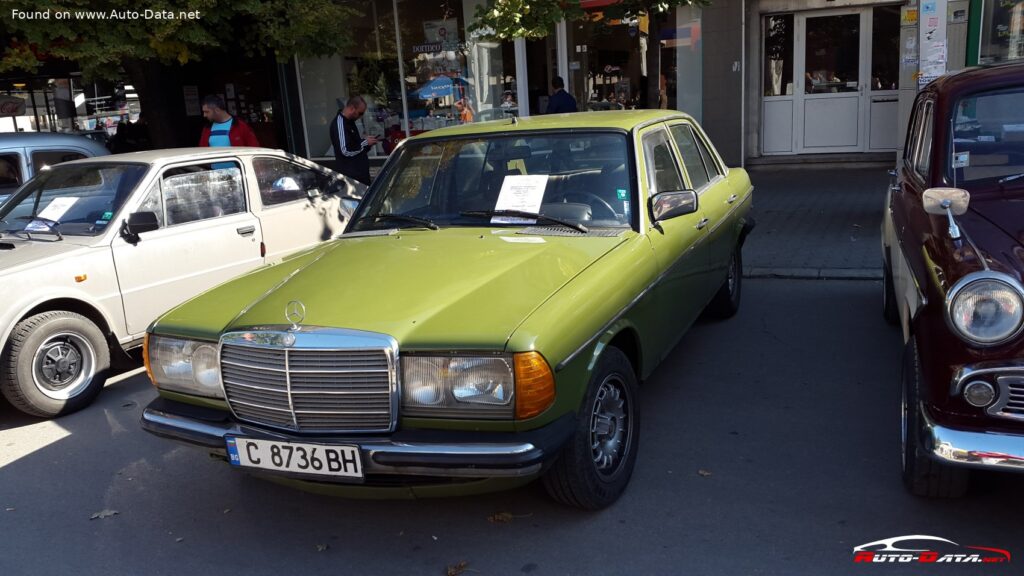
The Mercedes-Benz W123, produced from 1976 to 1985, represents a pivotal generation in the lineage of the Mercedes-Benz E-Class. Positioned as a mid-size executive car, the W123 succeeded the W114 and W115 models, and was itself replaced by the W201. Known for its robust engineering, build quality, and understated elegance, the W123 established a new benchmark for safety and refinement in its class. The 230 E variant, equipped with a 2.3-liter gasoline engine and automatic transmission, was a popular choice, offering a balance of performance and comfort. This article details the specifications and characteristics of the 1979-1985 Mercedes-Benz W123 230 E Automatic.
Mercedes-Benz W123 230 E: A Legacy of Engineering
The W123 series was a significant success for Mercedes-Benz, selling over 2.7 million units worldwide. While initially offered with a range of engine options, including diesel variants, the 230 E represented a gasoline-powered offering focused on providing a smooth and refined driving experience. The “E” designation signified fuel injection (Einspritzung in German), a relatively advanced feature for the time. The W123 was not initially sold in the United States, with import regulations and differing market preferences favoring larger vehicles. However, its reputation for durability and quality led to a strong following among enthusiasts in later years, and grey market imports became common.
Engine & Performance
The heart of the W123 230 E is its M102 E 23 inline-four cylinder engine, displacing 2.3 liters (2299 cm3 or 140.29 cu. in.). This naturally aspirated engine produces 136 horsepower at 5100 rpm and 205 Nm (151.2 lb.-ft.) of torque at 3500 rpm. The engine features multi-port manifold fuel injection and a single overhead camshaft (SOHC) valvetrain with two valves per cylinder. This configuration delivers a power-to-liter ratio of 59.2 hp/l. Power is delivered to the rear wheels via a four-speed automatic transmission. Performance figures include a 0-100 km/h (0-62 mph) acceleration time of 12.3 seconds, and a 0-60 mph time of 11.7 seconds. The vehicle achieves a maximum speed of 175 km/h (108.74 mph). The weight-to-power ratio is 10 kg/Hp, and the weight-to-torque ratio is 6.6 kg/Nm.
Design & Features
The W123 is characterized by its classic, understated sedan body style. It is a four-door, five-seater vehicle with a longitudinal front engine layout. The design emphasizes practicality and durability, with a focus on passenger comfort. The W123 incorporated significant advancements in safety for its time, including crumple zones, side impact protection, and a reinforced passenger cell. While not featuring the advanced electronic driver aids of modern vehicles, the W123 prioritized robust mechanical systems and a comfortable ride. Interior features included comfortable seating, a well-appointed dashboard, and a focus on build quality. The vehicle’s dimensions are: length 4725 mm (186.02 in), width 1786 mm (70.31 in), height 1438 mm (56.61 in), and wheelbase 2795 mm (110.04 in). The front and rear track widths are 1488 mm (58.58 in) and 1446 mm (56.93 in) respectively.
Technical Specifications
| Brand | Mercedes-Benz |
| Model | W123 |
| Generation | W123 |
| Type (Engine) | 230 E (136 Hp) Automatic |
| Start of production | October, 1979 |
| End of production | November, 1985 |
| Powertrain Architecture | Internal Combustion engine |
| Body type | Sedan |
| Seats | 5 |
| Doors | 4 |
| Fuel consumption (urban) | 13.1 l/100 km (18 US mpg, 21.6 UK mpg, 7.6 km/l) |
| Fuel consumption (extra urban) | 8.6 l/100 km (27.4 US mpg, 32.8 UK mpg, 11.6 km/l) |
| Fuel Type | Petrol (Gasoline) |
| Acceleration 0 – 100 km/h | 12.3 sec |
| Acceleration 0 – 62 mph | 12.3 sec |
| Acceleration 0 – 60 mph | 11.7 sec |
| Maximum speed | 175 km/h (108.74 mph) |
| Weight-to-power ratio | 10 kg/Hp |
| Weight-to-torque ratio | 6.6 kg/Nm |
| Power | 136 Hp @ 5100 rpm |
| Power per litre | 59.2 Hp/l |
| Torque | 205 Nm @ 3500 rpm (151.2 lb.-ft. @ 3500 rpm) |
| Engine layout | Front, Longitudinal |
| Engine Model/Code | M 102 E 23 / 102.980 |
| Engine displacement | 2299 cm3 (140.29 cu. in.) |
| Number of cylinders | 4 |
| Engine configuration | Inline |
| Cylinder Bore | 95.5 mm (3.76 in.) |
| Piston Stroke | 80.25 mm (3.16 in.) |
| Compression ratio | 9:1 |
| Number of valves per cylinder | 2 |
| Fuel injection system | Multi-port manifold injection |
| Engine aspiration | Naturally aspirated |
| Valvetrain | SOHC |
| Engine oil capacity | 5 l (5.28 US qt | 4.4 UK qt) |
| Coolant capacity | 8.5 l (8.98 US qt | 7.48 UK qt) |
| Kerb Weight | 1360 kg (2998.29 lbs.) |
| Max. weight | 1880 kg (4144.69 lbs.) |
| Max load | 520 kg (1146.4 lbs.) |
| Fuel tank capacity | 65 l (17.17 US gal | 14.3 UK gal) |
| Front suspension | Double wishbone |
| Rear suspension | Trailing arm |
| Front brakes | Disc |
| Rear brakes | Disc |
| Steering type | Cone worm with recirculation balls |
| Wheel rims size | Front/Rear: 5.5J x 14 |
| Number of gears and type of gearbox | 4 gears, automatic transmission |
| Drivetrain Architecture | Rear wheel drive |
The Mercedes-Benz W123 230 E Automatic remains a highly regarded classic car, appreciated for its build quality, reliability, and timeless design. Its enduring appeal continues to attract enthusiasts and collectors worldwide, solidifying its place as a significant model in automotive history.
