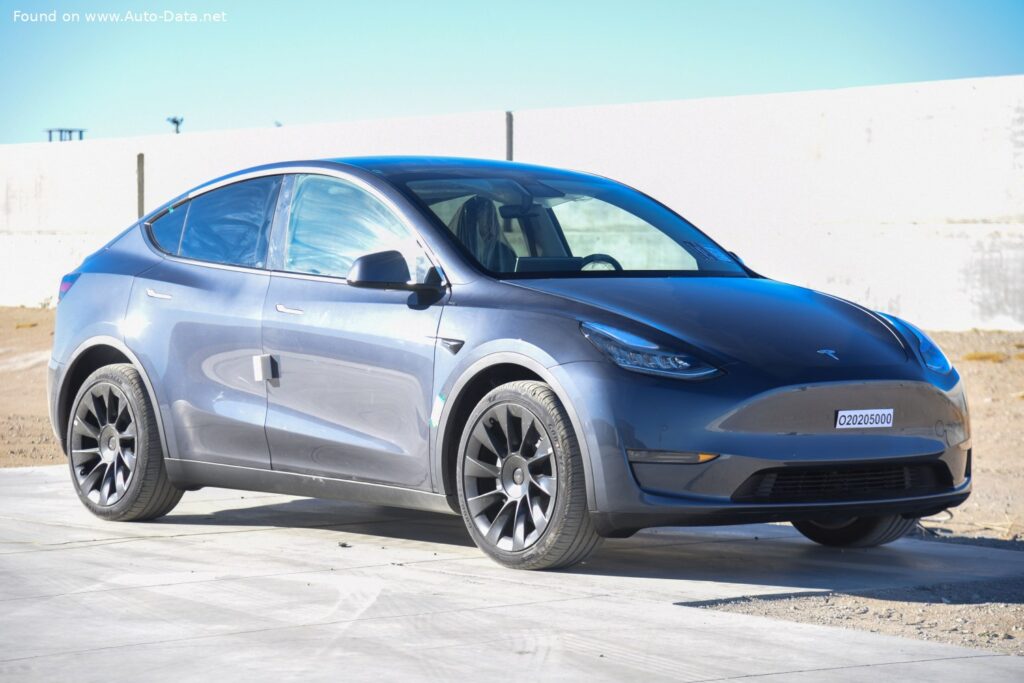
The Tesla Model Y Long Range, equipped with an 80.5 kWh battery and dual-motor all-wheel drive, represents a significant offering in the rapidly expanding electric SUV market. Introduced in September 2021 and produced through 2025, this variant of the Model Y aims to balance performance, range, and practicality for consumers seeking a fully electric vehicle. It builds upon Tesla’s established technology and design language, offering a compelling alternative to traditional gasoline-powered crossovers and SUVs. The Model Y, in general, has quickly become one of Tesla’s best-selling vehicles, contributing substantially to the company’s growth and the broader adoption of electric vehicles.
Tesla Model Y Long Range: Overview
The Model Y is a compact SUV/crossover produced by Tesla, Inc. It shares approximately 75% of its parts with the Tesla Model 3 sedan, offering a higher ride height, increased cargo space, and optional seating for up to seven passengers. The Long Range variant specifically focuses on maximizing driving range and delivering strong acceleration, making it a popular choice for both daily commuting and longer journeys. Positioned as a premium vehicle, the Model Y competes with other electric SUVs like the Ford Mustang Mach-E, Hyundai IONIQ 5, and Kia EV6, as well as established luxury crossovers.
Engine & Performance
The Model Y Long Range utilizes a dual-motor, all-wheel drive (AWD) powertrain. Each axle is powered by a separate electric motor – the front motor designated 3D3 and the rear motor 3D7 – providing instant torque and enhanced traction. The system delivers a combined output of 514 horsepower (Hp). This translates to brisk acceleration, achieving 0-60 mph in approximately 4.8 seconds, and 0-100 km/h in 5.0 seconds. The vehicle boasts a maximum speed of 134.84 mph (217 km/h). The powertrain architecture is a Battery Electric Vehicle (BEV), relying entirely on electricity for propulsion. The gross battery capacity is 80.5 kWh, with a usable capacity of 77.0 kWh, operating at a voltage of 360V utilizing Lithium-ion (Li-Ion) battery technology. The battery pack is strategically located beneath the floor of the vehicle, contributing to a lower center of gravity and improved handling.
Design & Features
The Tesla Model Y features a sleek, aerodynamic design characteristic of Tesla’s styling. As a five-door SUV/crossover, it offers a spacious interior and a versatile cargo area. The trunk space ranges from a minimum of 12.82 cubic feet (363 liters) with the rear seats up to a maximum of 76.21 cubic feet (2158 liters) with the rear seats folded down. Seating configurations accommodate either five or seven passengers, depending on the chosen option. Key features include Tesla’s Autopilot system, a large touchscreen interface controlling most vehicle functions, over-the-air software updates, and access to Tesla’s Supercharger network. Safety features are comprehensive, including ABS (Anti-lock braking system) and a suite of advanced driver-assistance systems (ADAS). The vehicle’s dimensions are 187.05 inches (4751 mm) in length, 75.63 inches (1921 mm) in width, and 63.94 inches (1624 mm) in height, with a wheelbase of 113.78 inches (2890 mm).
Technical Specifications
| Brand | Tesla |
| Model | Model Y |
| Generation | Model Y |
| Type (Engine) | Long Range 80.5 kWh (514 Hp) Dual Motor AWD |
| Start of production | September, 2021 |
| End of production | 2025 |
| Powertrain Architecture | BEV (Electric Vehicle) |
| Body type | SUV, Crossover |
| Seats | 5-7 |
| Doors | 5 |
| Fuel Type | Electricity |
| Acceleration 0 – 100 km/h | 5.0 sec |
| Acceleration 0 – 62 mph | 5.0 sec |
| Acceleration 0 – 60 mph | 4.8 sec |
| Maximum speed | 134.84 mph (217 km/h) |
| Weight-to-power ratio | 3.9 kg/Hp, 259.7 Hp/tonne |
| Gross battery capacity | 80.5 kWh |
| Net (usable) battery capacity | 77.0 kWh |
| Battery voltage | 360 V |
| Battery technology | Lithium-ion (Li-Ion) |
| Battery location | Below the floor |
| All-electric range (WLTP) | 331.19 mi (533 km) |
| Average Energy consumption (WLTP) | 27.2 kWh/100 mi (16.9 kWh/100 km) |
| MPGe | 124 |
| km/kWh | 5.9 |
| mi/kWh | 3.7 |
| Electric motor 1 model/code | 3D3 |
| Electric motor 1 location | Front axle, Transverse |
| Electric motor 2 model/code | 3D7 |
| Electric motor 2 location | Rear axle, Transverse |
| System power | 514 Hp |
| Kerb Weight | 4362.95 lbs (1979 kg) |
| Trunk (boot) space – minimum | 12.82 – 30.16 cu. ft. (363-854 l) |
| Trunk (boot) space – maximum | 76.21 cu. ft. (2158 l) |
| Length | 187.05 in. (4751 mm) |
| Width | 75.63 in. (1921 mm) |
| Width with mirrors folded | 77.87 in. (1978 mm) |
| Width including mirrors | 83.82 in. (2129 mm) |
| Height | 63.94 in. (1624 mm) |
| Wheelbase | 113.78 in. (2890 mm) |
| Front track | 64.41 in. (1636 mm) |
| Rear (Back) track | 64.41 in. (1636 mm) |
| Front overhang | 34.45 in. (875 mm) |
| Rear overhang | 38.82 in. (986 mm) |
| Ride height (ground clearance) | 6.57 in. (167 mm) |
| Minimum turning circle (turning diameter) | 39.7 ft (12.1 m) |
| Drivetrain Architecture | One electric motor drives the front wheels, one electric motor drives the rear wheels. |
| Drive wheel | All wheel drive (4×4) |
| Number of gears and type of gearbox | 1 gears, automatic transmission |
| Front suspension | Double wishbone |
| Rear suspension | Independent multi-link suspension |
| Front brakes | Ventilated discs, 355×25 mm |
| Rear brakes | Ventilated discs, 335×20 mm |
| Steering type | Steering rack and pinion |
| Power steering | Electric Steering |
| Tires size | 255/45 R19 XL; 255/40 R20 XL |
| Wheel rims size | 19; 20 |
The Tesla Model Y Long Range continues to evolve through software updates and minor hardware revisions. Its success demonstrates the growing consumer acceptance of electric vehicles and Tesla’s position as a leader in the EV market.