
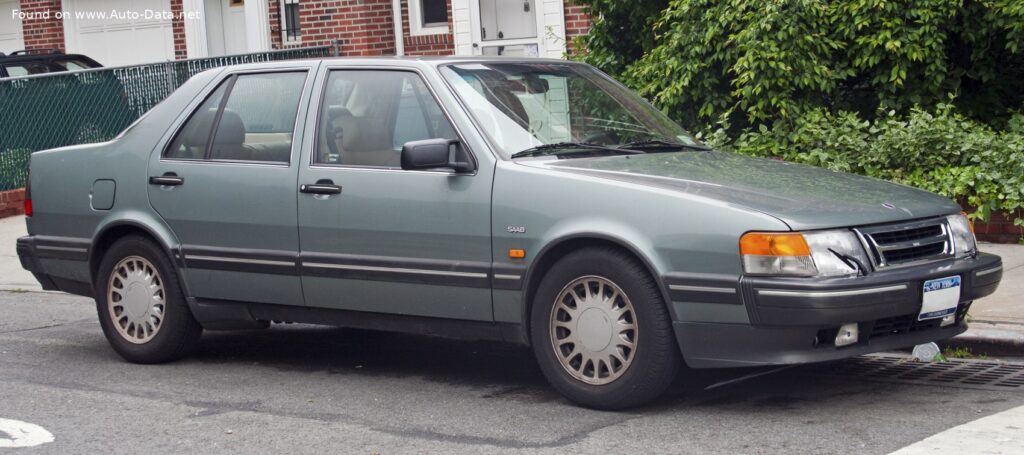
The Saab 9000 2.0 16V Turbo was a significant model in Saab’s lineup, produced between 1985 and 1991. Representing the Swedish automaker’s foray into the mid-size executive car segment, the 9000 aimed to offer a blend of Scandinavian practicality, innovative safety features, and turbocharged performance. This generation of the 9000 was a departure from Saab’s earlier, more compact offerings, and it established a new benchmark for comfort and refinement within the brand. While not initially a large seller in the United States, the 9000 gained a loyal following among those seeking an alternative to mainstream German and Japanese competitors.
The Saab 9000 2.0 16V Turbo: A Detailed Overview
The 9000 was Saab’s first attempt at a true mid-size car, designed to compete with models like the BMW 5 Series and Audi 100. It was a crucial model for the company, intended to broaden its appeal and increase sales volume. The 2.0 16V Turbo variant, equipped with a 175 horsepower engine and an automatic transmission, represented a popular configuration, balancing performance with ease of driving. The car’s design emphasized aerodynamic efficiency and interior space, hallmarks of Saab’s engineering philosophy.
Engine & Performance
At the heart of the Saab 9000 2.0 16V Turbo lies a 1985 cc (121.13 cubic inches) inline-four cylinder engine. This engine, designated the B202, featured a turbocharger and multi-port fuel injection, allowing it to produce 175 horsepower at 5500 rpm and 273 Nm (201.35 lb-ft) of torque at 3000 rpm. The power-to-liter ratio was a respectable 88.2 hp/l for the era. The engine’s transverse mounting and front-wheel drive configuration contributed to its efficient packaging and handling characteristics. The automatic transmission, with four forward gears, provided smooth and convenient shifting. Performance figures included a 0-100 km/h (0-62 mph) acceleration time of 8.8 seconds and a 0-60 mph time of 8.4 seconds. The car boasted a maximum speed of 215 km/h (133.59 mph). The weight-to-power ratio of 7.7 kg/Hp and weight-to-torque ratio of 4.9 kg/Nm indicated a reasonably responsive driving experience.
Design & Features
The Saab 9000 was a five-seater sedan with four doors, characterized by its clean lines and aerodynamic profile. The design prioritized both form and function, with a spacious interior and a large trunk offering between 625 and 1600 liters (22.07 to 56.5 cubic feet) of cargo space. Saab was renowned for its focus on driver ergonomics, and the 9000 continued this tradition with a well-designed dashboard and comfortable seating. Safety was also a key consideration, with features like ABS (Anti-lock Braking System) becoming increasingly common. The car’s suspension, featuring wishbones at the front and traction connecting levers at the rear, aimed to provide a comfortable ride and stable handling. The hydraulic power steering contributed to ease of maneuverability. The 9000’s exterior styling, while understated, was distinctly Saab, with a focus on practicality and functionality. The car rode on 15-inch wheels with 205/55 R15 tires.
Technical Specifications
| Brand | Saab |
| Model | 9000 |
| Type (Engine) | 2.0 16V Turbo (175 Hp) Automatic |
| Start of production | 1985 |
| End of production | 1991 |
| Powertrain Architecture | Internal Combustion engine |
| Body type | Sedan |
| Seats | 5 |
| Doors | 4 |
| Fuel consumption (urban) | 14.3 l/100 km (16.4 US mpg, 19.8 UK mpg, 7 km/l) |
| Fuel consumption (extra urban) | 7.9 l/100 km (29.8 US mpg, 35.8 UK mpg, 12.7 km/l) |
| Fuel consumption (combined) | 9.5 l/100 km (24.8 US mpg, 29.7 UK mpg, 10.5 km/l) |
| Fuel Type | Petrol (Gasoline) |
| Acceleration 0 – 100 km/h | 8.8 sec |
| Acceleration 0 – 62 mph | 8.8 sec |
| Acceleration 0 – 60 mph | 8.4 sec |
| Maximum speed | 215 km/h (133.59 mph) |
| Weight-to-power ratio | 7.7 kg/Hp |
| Weight-to-torque ratio | 4.9 kg/Nm |
| Power | 175 Hp @ 5500 rpm |
| Torque | 273 Nm @ 3000 rpm (201.35 lb.-ft. @ 3000 rpm) |
| Engine layout | Front, Transverse |
| Engine Model/Code | B202 |
| Engine displacement | 1985 cm3 (121.13 cu. in.) |
| Number of cylinders | 4 |
| Engine configuration | Inline |
| Cylinder Bore | 90 mm (3.54 in.) |
| Piston Stroke | 78 mm (3.07 in.) |
| Compression ratio | 9:1 |
| Number of valves per cylinder | 4 |
| Fuel injection system | Multi-port manifold injection |
| Engine aspiration | Turbocharger |
| Valvetrain | DOHC |
| Engine oil capacity | 4.2 l (4.44 US qt | 3.7 UK qt) |
| Coolant capacity | 9 l (9.51 US qt | 7.92 UK qt) |
| Kerb Weight | 1340 kg (2954.19 lbs.) |
| Max. weight | 1820 kg (4012.41 lbs.) |
| Max load | 480 kg (1058.22 lbs.) |
| Trunk (boot) space – minimum | 625 l (22.07 cu. ft.) |
| Trunk (boot) space – maximum | 1600 l (56.5 cu. ft.) |
| Fuel tank capacity | 66 l (17.44 US gal | 14.52 UK gal) |
| Length | 4794 mm (188.74 in.) |
| Width | 1764 mm (69.45 in.) |
| Height | 1420 mm (55.91 in.) |
| Wheelbase | 2672 mm (105.2 in.) |
| Front track | 1522 mm (59.92 in.) |
| Rear track | 1492 mm (58.74 in.) |
| Drivetrain Architecture | Front wheel drive |
| Number of gears | 4 |
| Gearbox type | Automatic transmission |
| Front suspension | Wishbone |
| Rear suspension | Suspension with traction connecting levers |
| Front brakes | Ventilated discs |
| Rear brakes | Disc |
| Assisting systems | ABS (Anti-lock braking system) |
| Steering type | Steering rack and pinion |
| Power steering | Hydraulic Steering |
| Tires size | 205/55 R15 |
| Wheel rims size | 15 |
The Saab 9000 2.0 16V Turbo, while not a massive sales success, remains a fondly remembered vehicle for its blend of Scandinavian design, turbocharged performance, and commitment to driver safety and comfort. It represented a significant step forward for Saab, paving the way for future models and solidifying the brand’s reputation for innovation and individuality.
