
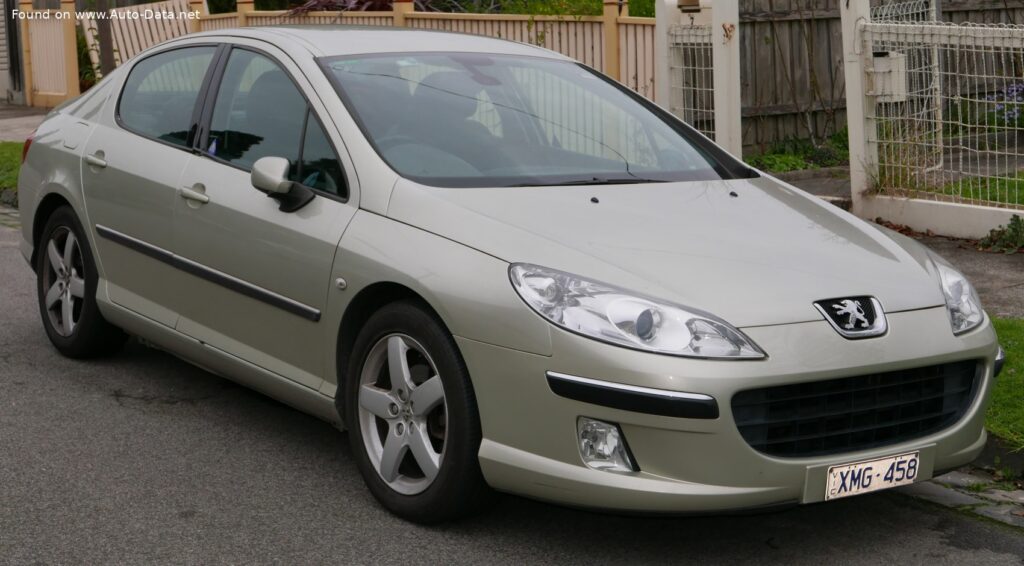
The Peugeot 407 is a large family car produced by the French manufacturer Peugeot from 2004 to 2011. Positioned above the 307 and below the 607 in Peugeot’s lineup, the 407 aimed to provide a more sophisticated and spacious alternative to mainstream competitors like the Ford Mondeo and Vauxhall/Opel Vectra. This article focuses on the early model, specifically the 2.0i 16V variant with an automatic transmission, produced between April 2004 and August 2005. While not initially sold in the United States, the 407 represented Peugeot’s attempt to elevate its brand image and compete more effectively in the European D-segment.
Peugeot 407: Overview and Market Position
The 407 was a significant departure from its predecessor, the 406, offering a more modern design, improved interior quality, and enhanced driving dynamics. It was available in saloon (sedan), coupé, and estate (station wagon) body styles. The 2.0i 16V model, equipped with a naturally aspirated four-cylinder engine and an automatic gearbox, was a popular choice for buyers seeking a balance between performance and fuel economy. In Europe, the 407 was marketed as a comfortable and refined family car, emphasizing its spacious interior and advanced features for the time. It competed directly with other European and Japanese manufacturers in the mid-size segment.
Engine & Performance
The Peugeot 407 2.0i 16V is powered by a 1,997 cc (121.86 cubic inches) inline-four cylinder gasoline engine. This engine, designated RFN EW10J4, produces 136 horsepower (Hp) at 6,000 rpm and 190 Newton-meters (140.14 lb.-ft.) of torque at 4,100 rpm. The engine features multi-port fuel injection and a compression ratio of 10.8:1. Power is delivered to the front wheels via a four-speed automatic transmission. Performance figures include a 0-100 km/h (0-62 mph) acceleration time of 12.2 seconds and a top speed of 206 km/h (128 mph). The 0-60 mph time is calculated at 11.6 seconds. The engine’s power-to-weight ratio is 96.1 Hp per tonne, while the torque-to-weight ratio is 134.3 Nm per tonne. Fuel economy is rated at 8.7 liters per 100 kilometers (27 US mpg) combined, with 12.7 l/100 km (18.5 US mpg) in urban conditions and 6.4 l/100 km (36.8 US mpg) on the extra-urban cycle.
Design & Features
The Peugeot 407 is a four-door sedan with a sleek and contemporary design for its era. It features a relatively long wheelbase of 2,725 mm (107.28 inches) and a spacious interior capable of comfortably seating five passengers. The trunk (boot) offers a minimum capacity of 407 liters (14.37 cubic feet). Safety features included Anti-lock Braking System (ABS) as standard equipment. The car’s suspension utilizes a spring strut setup for both the front and rear axles, providing a comfortable ride. The 407’s design prioritized a blend of style and practicality, with a focus on creating a refined and comfortable driving experience. The interior was designed with ergonomics in mind, offering a user-friendly layout and quality materials. Standard tire size is 205/60 R16 fitted on 6.5 x 16 inch wheel rims.
Technical Specifications
| Brand | Peugeot |
| Model | 407 |
| Type (Engine) | 2.0i 16V (136 Hp) Automatic |
| Start of production | April, 2004 |
| End of production | August, 2005 |
| Powertrain Architecture | Internal Combustion engine |
| Body type | Sedan |
| Seats | 5 |
| Doors | 4 |
| Fuel consumption (urban) | 12.7 l/100 km (18.5 US mpg) |
| Fuel consumption (extra urban) | 6.4 l/100 km (36.8 US mpg) |
| Fuel consumption (combined) | 8.7 l/100 km (27 US mpg) |
| Fuel Type | Petrol (Gasoline) |
| Acceleration 0 – 100 km/h | 12.2 sec |
| Acceleration 0 – 62 mph | 12.2 sec |
| Acceleration 0 – 60 mph | 11.6 sec |
| Maximum speed | 206 km/h (128 mph) |
| Weight-to-power ratio | 10.4 kg/Hp |
| Weight-to-torque ratio | 7.4 kg/Nm |
| Power | 136 Hp @ 6000 rpm |
| Torque | 190 Nm @ 4100 rpm (140.14 lb.-ft. @ 4100 rpm) |
| Engine layout | Front, Transverse |
| Engine Model/Code | RFN EW10J4 |
| Engine displacement | 1997 cm3 (121.86 cu. in.) |
| Number of cylinders | 4 |
| Engine configuration | Inline |
| Cylinder Bore | 85 mm (3.35 in.) |
| Piston Stroke | 88 mm (3.46 in.) |
| Compression ratio | 10.8:1 |
| Number of valves per cylinder | 4 |
| Fuel injection system | Multi-port manifold injection |
| Engine aspiration | Naturally aspirated |
| Engine oil capacity | 4.25 l (4.49 US qt | 3.74 UK qt) |
| Coolant capacity | 8.1 l (8.56 US qt | 7.13 UK qt) |
| Kerb Weight | 1415 kg (3119.54 lbs.) |
| Max. weight | 1998 kg (4404.84 lbs.) |
| Max load | 583 kg (1285.29 lbs.) |
| Trunk (boot) space – minimum | 407 l (14.37 cu. ft.) |
| Fuel tank capacity | 66 l (17.44 US gal | 14.52 UK gal) |
| Length | 4675 mm (184.06 in.) |
| Width | 1811 mm (71.3 in.) |
| Height | 1447 mm (56.97 in.) |
| Wheelbase | 2725 mm (107.28 in.) |
| Front track | 1552 mm (61.1 in.) |
| Rear track | 1518 mm (59.76 in.) |
| Drivetrain Architecture | Front wheel drive |
| Number of gears | 4 |
| Gearbox type | Automatic transmission |
| Front suspension | Spring Strut |
| Rear suspension | Spring Strut |
| Front brakes | Ventilated discs |
| Rear brakes | Disc |
| Assisting systems | ABS (Anti-lock braking system) |
| Steering type | Steering rack and pinion |
| Tires size | 205/60 R16 |
| Wheel rims size | 6.5 x 16 |
The Peugeot 407 2.0i 16V Automatic, while not a performance car, offered a comfortable and refined driving experience. Its blend of practicality, style, and reasonable fuel economy made it a popular choice in the European market during its production run. It represents a key model in Peugeot’s history, demonstrating the brand’s ambition to compete with established players in the mid-size family car segment.
